Is coding still worth it for kids?
Yes — coding is still worth it for kids, but the valuable part has moved. It was never the syntax; it is the thinking: breaking a problem down, being precise, testing, and fixing. In an AI world that matters more, not less, because someone still has to tell the machine what to do and know when it is wrong.

The short answer
- Is coding worth it for kids in 2026?
- Yes. AI writes more of the code now, which removes the tedious part and leaves the part that was always worth learning: deciding what to build, saying it precisely, and checking the result. A child who practises that is learning a skill AI makes more valuable, not less.
- Is coding worth it if my child does not want a tech job?
- Yes, for the same reason writing is worth it without a journalism career. Specifying clearly, checking a result, and fixing what is wrong are general-purpose thinking skills — and in a world where most jobs involve directing software, they are closer to literacy than to a speciality.
- When is it genuinely not worth it?
- When the format is syntax worksheets with no project at the end. A child pushed through drills concludes they are "not a computer person", and that belief lasts. The fix is almost never dropping coding — it is switching from lessons to projects.
What's worth learning has shifted
The skill moved from "write the code" to "think it through and direct the tool." A child who can specify what they want, spot a bug, and refine their instruction is doing the durable work — and they can practise it today by building real projects with an AI, meeting Scratch or Python along the way when they want more control.
Quick answers
- So should I still sign my kid up for a coding class?
- If it teaches thinking and building — yes. If it's pure syntax drills with no project, it's teaching the part AI now handles. Look for project-based, judgement-building learning.
- What's the single most useful thing to teach?
- To tell a computer exactly what they want and check that it did it. Everything else — languages, tools — hangs off that.
What changed, and what didn't
- Changed: syntax recall — Remembering exact punctuation and method names used to be a real barrier and a real skill. It is now the part machines do best, and it is no longer a sensible thing to organise a child's learning around.
- Changed: the on-ramp — A child no longer has to earn their first working program through months of drills. They can build something real in week one, which changes who sticks with it — particularly kids who'd have quit during the boring part.
- Didn't change: decomposition — Breaking a fuzzy goal into precise, ordered steps is still the core act. AI can execute steps; it can't decide which steps a half-formed idea needs.
- Didn't change: debugging — Something is wrong, nothing tells you where, and you have to reason from symptom to cause. This is the most transferable thinking skill in the whole subject and AI has made it more important, not less — because now there's more code to check.
The argument for coding that doesn't depend on jobs
Most "is coding still worth it" arguments are really career arguments, and career arguments about a 9-year-old are guesswork. The more honest case doesn't rely on predicting the job market at all: coding is one of the few activities where a child can hold a complete idea in their head, build it, be wrong in public, fix it, and end up with a thing that exists.
That experience — I was wrong, I found out why, I fixed it, it works now — is rare in a child's life and unusually valuable. School rarely offers it; most instruction is graded once and moves on. Software gives immediate, honest, unemotional feedback and unlimited retries. Whether or not your child ever writes code professionally, having practised that loop a few hundred times is worth having.
How to judge a coding class or tool in the AI era
Ask what the child produces and whether they can explain it. A programme that ends with every child holding an identical, polished project has optimised for the parent showcase rather than the learning. Some divergence between children's work is a healthy sign.
Ask how AI is handled. A course that pretends AI doesn't exist is teaching a world your child won't live in; a course where AI does the work while the child watches is worse. What you want is explicit: use it, then check it, then explain it.
And ask what happens when a child gets stuck. If the answer is that an instructor fixes it, that's the most valuable moment in the subject being handed to an adult. Being coached through your own stuck-ness is the product.
What the Bureau of Labor Statistics actually projects
Most answers to this question are opinion. Here is the closest thing to data the United States produces, and it is more interesting than either side of the usual argument.
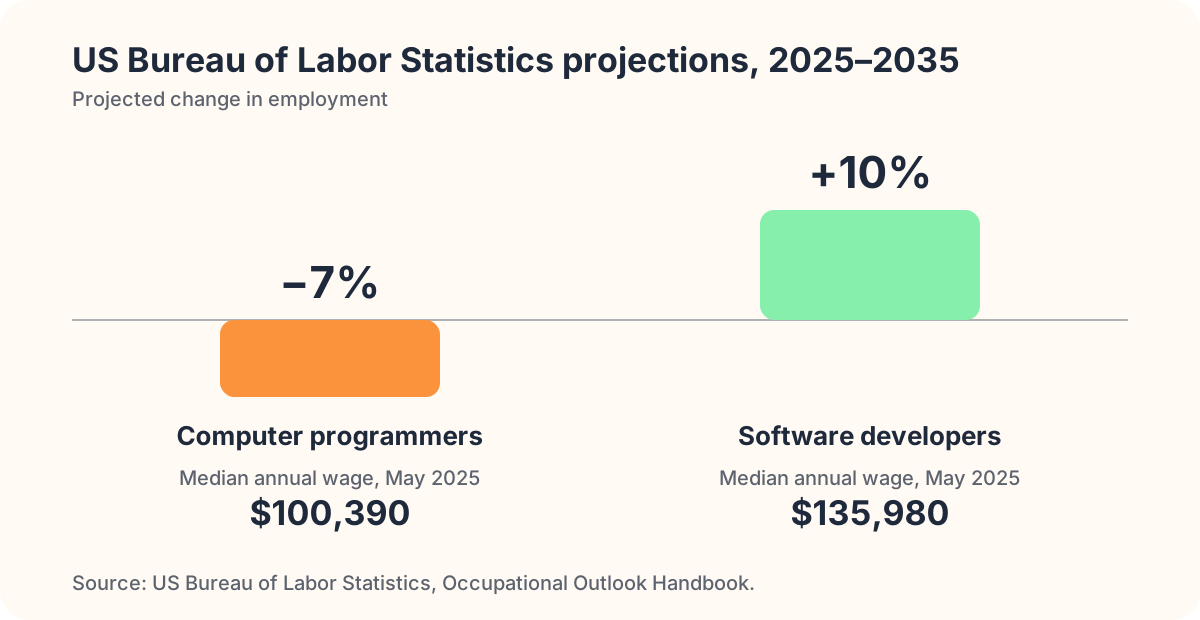
The BLS Occupational Outlook Handbook projects the two occupations separately. Computer programmers: employment "is projected to decline 7 percent from 2025 to 2035." Median annual wage, $100,390 in May 2025. Software developers, quality assurance analysts and testers: employment "is projected to grow 10 percent from 2025 to 2035, much faster than the average for all occupations." Median annual wage for software developers, $135,980 in May 2025.
So the honest answer to "will there be coding jobs" is: one of them is shrinking by seven percent and the other is growing by ten, and they are not the same job. Anyone telling you coding is dead is quoting the first line. Anyone telling you to relax is quoting the second.
The distinction between the two occupations is the entire point of this page. BLS defines computer programmers largely by writing and testing code that follows a specification somebody else produced. Software developers are defined by designing the thing — deciding what it should do, how it should be structured, and whether it actually works. Translation is contracting. Deciding and verifying is expanding.
And the necessary caveat, stated plainly: these are ten-year projections published in 2026, and a child who is nine today enters the labor market around 2036. Nobody — including BLS — knows what tooling looks like then. Do not make a decision about your child on the strength of a forecast. Make it on the strength of what the forecast is measuring, which is that the valuable part of the work moved from producing code to specifying and checking it.
Which means the question changes shape
If translation is the shrinking half, then "should my child learn to code" is the wrong question and "should my child learn to think in the way that coding teaches" is the right one. Those have different answers and different price tags.
The thinking half has never depended on syntax. Decomposition — taking something big and vague and cutting it into pieces small enough to actually do — is the same skill whether the pieces end up in Python or on a whiteboard. Debugging is the practised belief that when something does not work there is a specific reason and it is findable, which is a disposition more than a technique, and it transfers to nearly everything.
What has genuinely changed is the on-ramp. A ten-year-old in 2016 who wanted to build a game had to learn syntax before they could build anything, and most of them quit during that gap. A ten-year-old in 2026 can describe the game, watch it get built, play it, find out the collision detection is wrong, and go read the code to find out why. They arrive at loops and conditionals from the direction of a problem they care about. That is a better order and it was not available before.
The risk in the new on-ramp is equally real: a child can now produce a working thing without understanding any of it, which is a new failure mode that did not exist when syntax was the gate. The gate did that work for free. Now an adult, or a tool designed for it, has to do that work on purpose.
What a US parent can check locally, this week
- Your state’s computer science standards — Public, free, and specific. Search your state department of education site for "computer science standards." Most are adapted from the CSTA K–12 framework — Level 1A for grades K–2, 1B for grades 3–5, Level 2 for grades 6–8. Reading your child’s grade band takes ten minutes and tells you exactly what school will ask of them.
- Whether your high school offers AP CS — AP Computer Science Principles is the broad, language-agnostic course most students take first; AP Computer Science A uses "a subset of the Java programming language." Whether your zoned high school offers either is a concrete fact about your child’s actual options, and it is worth knowing in fifth grade rather than ninth.
- Your district’s AI policy — As of an August 2026 count, 35 states and Puerto Rico have official K–12 AI guidance, and districts have written their own on top of it. Read the policy document rather than the announcement email. It tells you what your child will be allowed to do, and it is usually more moderate than the summary.
- What a coding class near you actually costs — US prices for kids’ coding instruction range from free — libraries, Scratch, school clubs — to several hundred dollars a week for summer camps. Before paying anything, ask the provider one question: what does my child finish, and can they explain how it works afterward? A class that produces a finished, explainable project is worth real money. A class that produces attendance is not.
More questions worth an honest answer
- Will AI have taken the jobs before my child graduates?
- Some of them, on the evidence. The BLS projection of a 7 percent decline in computer programmer employment from 2025 to 2035 is a federal statistical agency saying out loud that the translate-a-spec-into-code occupation is contracting. What the same data shows is that software developer employment is projected to grow 10 percent over the identical decade. The work is not disappearing; it is concentrating in the part that requires judgement. Teach the judgement.
- Is it worth it if my child has no interest in a tech career?
- Yes, and the jobs argument is the weakest reason to say so. Decomposition and debugging are general-purpose thinking. A child who has learned that a broken thing has a findable cause approaches a failed science experiment, a stuck essay, and a disagreement with a friend differently. The BLS numbers are useful for answering a specific worry about employability; they are not the reason to do it.
- Should I pay for a US coding camp, or is free enough?
- Free is genuinely enough for most children through about grade 5. Scratch costs nothing, many public libraries run free clubs, and the constraint at that age is a child’s attention rather than the tool. Pay when you are buying something specific: structure a child will not supply themselves, a peer group, or an adult who will insist they explain their own work. Luchi Family is one plan for the whole family: $99 a month ($49 for founding families), every kid included, with your first 7 days for $5 — cancel before it renews. That is enough time to find out whether your particular child comes back to it unprompted.
- The national push — does it change anything for my family?
- It changes the timeline more than the substance. Executive Order 14277, signed 23 April 2025, created a White House Task Force on AI Education, directed the development of K–12 AI-literacy resources and teacher training, and launched a nationwide Presidential AI Challenge. Combined with 35 states and Puerto Rico having issued K–12 AI guidance, the practical effect is that your child will meet this as a school subject sooner than you expected. What to teach did not change. How long you have before somebody else teaches it did.
Teach the thinking, not just the typing
Luchi turns coding into building real projects with Luchi the fox — the durable skill, made motivating.
Part of the series: Should my kid learn coding or AI?
Related guides in this series
- Coding vs AI for kids: which first? — Not a versus. Why the two are one skill for a school-age kid — and the order that actually makes sense when you sit your child down.
- Will AI replace coding? — AI changes what coding is, not whether your kid should learn it. The durable skill is telling a computer what you want — and how to check it.
- What age should kids start with AI? — A practical, age-by-age answer for 5–12s — when AI helps, when to wait, and what “starting” should actually look like.
- Best AI apps for kids, compared — Eight products side by side, every claim quoted from the product’s own site with the capture date — including ours, and including where a cheaper option is the better buy.