The method
How Luchi teaches
Luchi helps with homework through hints, not answers, and keeps a record of what your kid knows. Each question is tagged to one of 1,389 K–8 skills, a worked example comes only after two hints, and answer keys are worked out by code. Short checks come back days apart, and a skill counts as mastered after right answers on three separate days. Parents pick what must happen; kids pick when. Each part rests on published learning research, named below with a link to the paper.
At a glance
- 1,389 skills mapped, kindergarten to grade 8
- 2 hints, then a worked example. Never the answer, unless a parent turns that on
- 3 separate days of right answers before a skill counts as mastered
- 15 common wrong rules Luchi knows by name, so a slip is told from a gap
Finds the skill underneath
When adding fractions is new and it rests on a skill your kid hasn’t practiced, the week’s lesson starts there.
Checks that come back
Three quick questions, no hints, days apart. Knowing it today isn’t enough.
Parents pick what. Kids pick when.
A kid can move a must-do. They can’t make it disappear.
Built on Bloom’s mastery learning, Sweller’s worked examples, Roediger & Karpicke’s retrieval practice, Cepeda’s spacing, Corbett & Anderson’s knowledge tracing, and Grolnick & Ryan’s autonomy support.
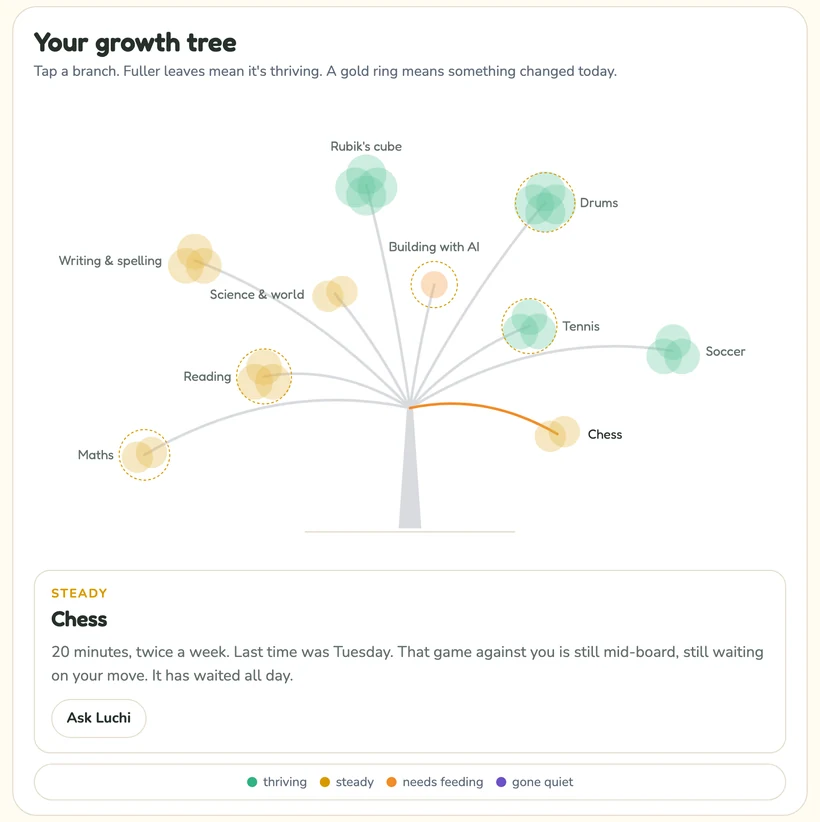
Every kid has a growth tree
A branch for each goal you set, each thing your kid does, and each school subject. Luchi reads how often it’s fed and how recently: thriving, steady, needs feeding, gone quiet. Tap a branch and it tells the story, from what really happened.
One leaf, up close
A kid gets stuck on 1/2 + 1/4 on a Monday. Here is what happens next.
- Monday · Stuck Two hints on the board. They find that halves and fourths aren’t the same size.
- Tuesday · Practice Up to five like it, hints allowed. Answers marked by code.
- Thursday · Check Three fresh ones, no hints. Right.
- Next week · Check again Right, on a new day. The gap grows.
- The week after · Mastered Right on three separate days. The parent’s weekly note says so.
An example. The real gaps are set for each kid from how the last check went, up to a month apart.
Tuned to your kid
| What Luchi knows | What changes |
|---|---|
| From you Age, grade, interests, your own rules for Luchi, how much help with homework, daily minutes, bedtime. | Words, examples and jokes pitched to that age. Your rules sit in every conversation. Hints only, hints and a worked example, or full answers: your call. |
| From every answer A skill record: what’s strong, the five weakest skills and the mistakes behind them, when each check is due, the explanation that helped last time. | Every homework session starts from that record. The week’s lesson is built from your kid’s own two hardest topics. The next explanation starts from what worked before. |
| From what they tell her What they make, learn and like, kept in your kid’s own memory. Feelings and health are never kept between talks. | Luchi picks up where they left off and builds on their own canvases. Practice questions can be retold around their interests, with every number kept. |
| From their days What they did, what they said was hard or easy, fun or not, which areas haven’t come up this week. | “What goes here?” suggests shorter things after a hard week and says why: “You said you like animals.” The Sunday note is written from what really happened. |
| Per person Each kid and each parent has their own memory, canvases and PIN. Siblings share one family brain and one bank of checked questions. | A kid’s private canvases stay theirs. A question verified for one kid is ready for the next. |
Learning
A map of school skills
What your kid sees Help that starts at the right place.
What Luchi does Tags each question with one of 1,389 K–8 skills. In maths, when a skill builds on one that is shaky or unpractised, the week’s lesson and the live help start from that one.
Where it comes from Common Core State Standards (NGA Center & CCSSO, 2010). Next Generation Science Standards (NGSS Lead States, 2013). Coherence Map, Student Achievement Partners · Every skill Luchi knows
Hints, then the thinking is theirs
What your kid sees They tap the light. The picture changes and the hint is read aloud. After two hints, a worked example.
What Luchi does Holds the two-hint limit in code. A hint stays closed until a separate blind check says it doesn’t give the answer away. Only a parent can switch answers on.
Where it comes from Wood, Bruner & Ross, 1976. Sweller & Cooper, 1985
The same idea, made smaller
What your kid sees When they say “I don’t get it”, the same method comes back with tiny numbers.
What Luchi does Checks every re-explanation on the board against the idea being taught, and sends Luchi back to redo it if a different method slipped in.
Where it comes from Our own rule
Finding the step that went wrong
What your kid sees Their problem in small steps with one blank each. Help opens at the first blank they miss.
What Luchi does Marks each blank by code. The answers never go to the kid’s page.
Where it comes from Newman, 1977
Knowing what they know
What you see Each skill moving from Beginning to Developing, Proficient and Mastered. Your kid sees “just started” to “got it”.
What Luchi does Updates an estimate on every answer. A right answer after a hint isn’t counted as proof; it only nudges the estimate. A real miss moves a skill down.
Where it comes from Corbett & Anderson, 1995
Checks that come back
What your kid sees “Quick check on fractions is ready”, on their day and on their phone. Three questions, no hints.
What Luchi does Sets the next check from how this one went, up to a month out. Mastered needs right answers on three separate days.
Where it comes from Cepeda et al., 2006. Roediger & Karpicke, 2006. Rawson & Dunlosky, 2011
A slip is not a gap
What your kid sees If they keep rushing, Luchi asks them to read their answers back before Done.
What Luchi does Tells a fast careless miss on a strong skill from a real gap, and knows 15 common wrong rules by name. The same mistake three times in two weeks is coached as a habit.
Where it comes from Brown & VanLehn, 1980
Answers that are right
What your kid sees Practice, checks and quizzes they can trust.
What Luchi does Works out answer keys in code, and every quiz goes through the same checked bank. A question Luchi wrote waits until two blind checks pass: a second solve that lands on the same answer, and a check that it practises the right skill. Written answers get two blind graders; if they disagree, the kid keeps the credit and you see “needs a look”.
Where it comes from Our own design
Graded paper, read back in
What you see A photo of a marked test becomes one row per question. Rows Luchi isn’t sure of wait for someone to confirm against the photo.
What Luchi does Confirmed rows go on the skill record, and the wrong ones are read as a pattern.
Where it comes from Our own design
Family
Parents pick what. Kids pick when.
What your kid sees Math is on their day. They drag it to after snack.
What Luchi does Lets a must-do move, never vanish. Only a grown-up can let one go. “Homework with Luchi” can be one.
Where it comes from Grolnick & Ryan, 1989. Patall, Cooper & Robinson, 2008
They plan their own afternoon
What your kid sees At home time Luchi speaks first: “Want to plan your afternoon?” Then one nudge, then an alarm in her voice.
What Luchi does Asks once, nudges once. With no plan after half an hour, you get one note. Rests at weekends and on no-school days. You turn it on.
Where it comes from Gollwitzer, 1999
Reminders that stop
What your kid sees An alarm for what can’t be missed, a lock-screen note with Done and Snooze for the rest, a quiet badge for things with no time.
What Luchi does Three levels, one follow-up, then silence. At bedtime nothing sounds but their own alarms.
Where it comes from Our own design
Rewards for doing, not for screen time
What your kid sees Gems for each thing they finish on their day, and once a day for making a plan. No streak to protect.
What Luchi does Only ever adds gems, sized by the thing done, never by time with Luchi. Wishes are granted by a grown-up. Talk and games close at bedtime and at the daily limit you set.
Where it comes from Our own design
You see what happened. Their work stays theirs.
What you see A Sunday note: what went well, what felt hard, one thing to try. Written only from what was really done.
What Luchi does Keeps each kid’s private canvases out of the parent view. Never keeps a kid’s feelings or health between talks.
Where it comes from Our own design
Every source above links to the paper. These are studies of the methods, not of Luchi, and they don’t promise a particular result for your kid.