Math games for kids: what to play tonight, and what to build
Not a directory of apps. Three math games a child built by asking for them, five you can play tonight with a deck of cards and no screen at all, and a short, honest note on which kinds are worth the time. Ages 7–12.
Three math games a kid asked for, and got
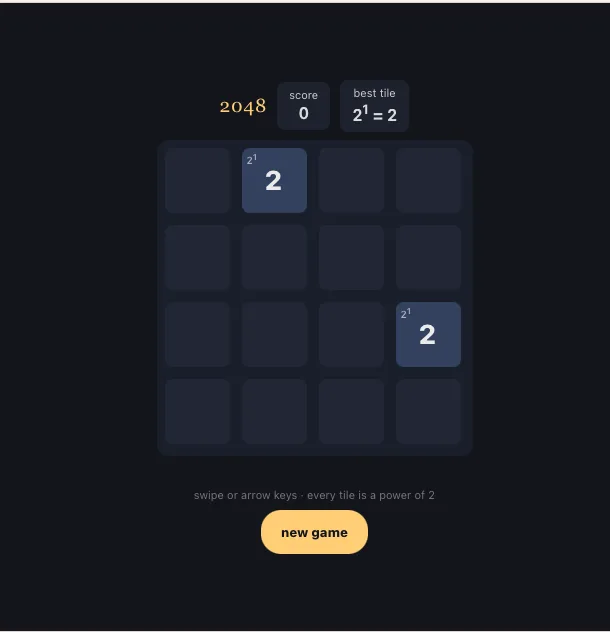
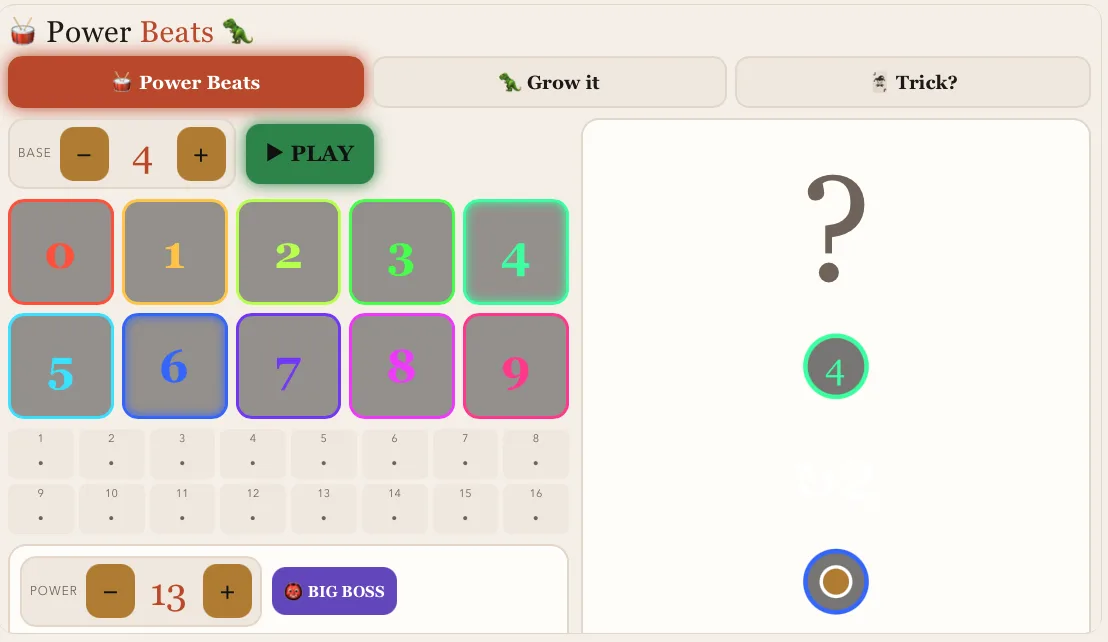
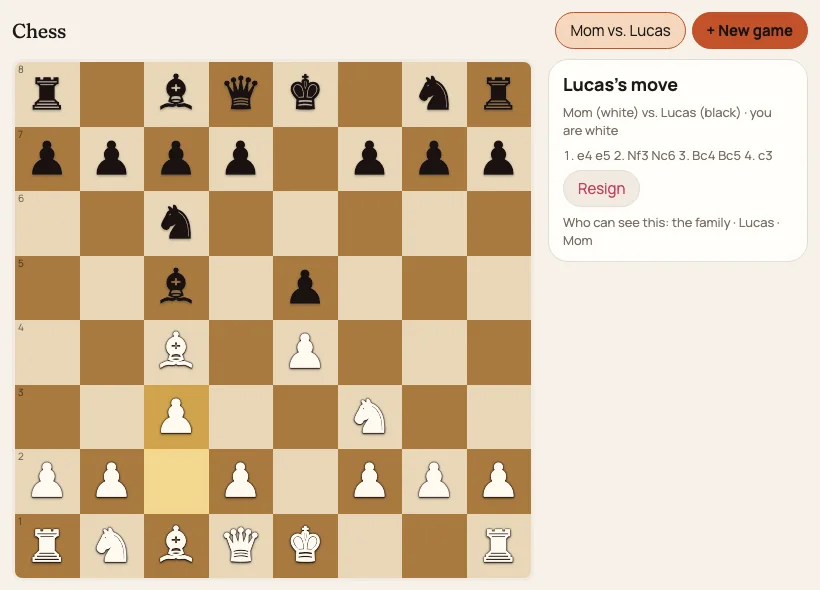
These are not games Luchi ships. A child asked for them in plain words and Luchi built them, playable, in the time it takes to make a snack. That is the difference between a maths app and a maths workshop: the game is the thing your child made, so the rules are theirs to argue with.
Ask for one in your own words
- “Make me 2048 but it shows the powers” — The version above. Good next asks from the same family: make the tiles thirds instead of doubles, or let me set the winning tile. Changing the rule is where the understanding shows up — a child cannot change a scoring rule they cannot state.
- “A game where I have to hit the target number” — Three numbers on screen, a target, any operations you like. This is Twenty-four with a timer, and it is the single highest-return arithmetic game there is, because the work happens in the search rather than the answer.
- “A fractions game that is actually fun” — Usually arrives as something to cut, pour or stack rather than a quiz — pizza slices, measuring jugs, a bar you slide. Fractions go wrong when they stay symbolic, so a version your child can drag around is worth more than a worksheet.
- “Something with dinosaurs and times tables” — Unserious asks make the best games, because your child will actually play the one they designed. The maths underneath is the same drill; the dinosaur is why it gets opened on Thursday.
Five math games to play tonight, no app
- 1. Twenty-four Deal four cards. First person to make 24 using all four, any operations, wins the hand. It scales the whole way: ages 7–9 with small numbers and plus-minus only, ages 10–12 with fractions and exponents allowed. Ten minutes and nobody notices they are doing order of operations.
- 2. Target number Roll three dice, write a target between 20 and 100 on paper, and race to get closest using any operations you like. The argument about whose answer is closer is the lesson — it is estimation and comparison, out loud, with stakes.
- 3. Make ten Ten cards face up; on your turn take any set that sums to ten and refill the gaps. Number bonds without a worksheet, it fits in a coat pocket, and a six-year-old can play it against a twelve-year-old without either being bored.
- 4. Guess my rule You think of a rule — double it and add one. They call out numbers, you give back the output, they guess the rule. This is function thinking, which is the actual content of early algebra, and most children meet it two years before anyone calls it that.
- 5. The receipt game Hand your child the shopping receipt in the car and have them estimate the total before looking. Closest estimate picks the music. Estimation is the math adults use most and the one that gets the least practice at home.
Which kind is worth your Tuesday
Almost everything sold as a "math game" is one of these five. They are not interchangeable, and the mismatch between what you wanted and what you bought is usually why the app stopped getting opened.
| Kind of game | What it actually builds | Where it stops |
|---|---|---|
| Fact-fluency drills | Speed and automaticity on facts your child already understands — times tables, number bonds, doubles. | It cannot teach a fact that was never understood. It makes a known fact faster, which is worth real marks, and nothing more. |
| Adventure and RPG math apps | Minutes on task. A story carries a child through far more repetitions than a worksheet ever would. | Whether the questions match your child’s actual gap depends entirely on how the app picks them, and most do not publish how. |
| Puzzle games (logic grids, tangrams, KenKen, Sudoku) | Reasoning, trial-and-check, spatial sense — the part of math that is not arithmetic and barely gets taught. | No curriculum coverage at all. A child can be excellent here and still be stuck on fractions on Monday. |
| Strategy board games (chess, Set, Blokus, backgammon) | Planning several moves ahead, pattern-spotting, probability intuition, and losing without falling apart. | The math is indirect. It shows up in school work months later, not this week, which makes it a terrible way to fix an urgent gap. |
| Build-your-own (your child makes the game) | The strongest understanding on this list: you cannot code a scoring rule you cannot state out loud. | Slow, and it covers only whatever skills the game happens to need. One game can take a week. |
The one thing no game will give you
A game is good at fluency and bad at diagnosis. It can make 7 × 8 automatic. It cannot tell you that your child multiplies fine and is losing marks because they never secured equal parts in fractions two years ago — and that second problem is usually the reason the app got bought. Engagement and difficulty pull in opposite directions, and in a game, engagement wins: the questions that keep it fun are the ones your child can already do.
So play the games, and keep a record alongside them. Luchi does not make a math game you can buy off a shelf — it builds the one your child asks for, and then it keeps the record a scoreboard cannot. Homework questions are tagged to one of 1,389 skills from kindergarten to grade 8, and in maths 454 prerequisite links from the Coherence Map record which skill rests on which, so when adding fractions is new and the skill underneath it is shaky, the week starts underneath. Help is two hints and then a worked example — never the answer, unless a parent turns that on. Short checks come back days apart, and a skill only counts as mastered after right answers on three separate days, because knowing it tonight is not the same as knowing it. It also knows fifteen common wrong rules by name, so a careless slip can be told apart from a genuine gap.
How Luchi decides what to practise next · Every skill Luchi knows, K–8 · Screen time and AI: which minutes count
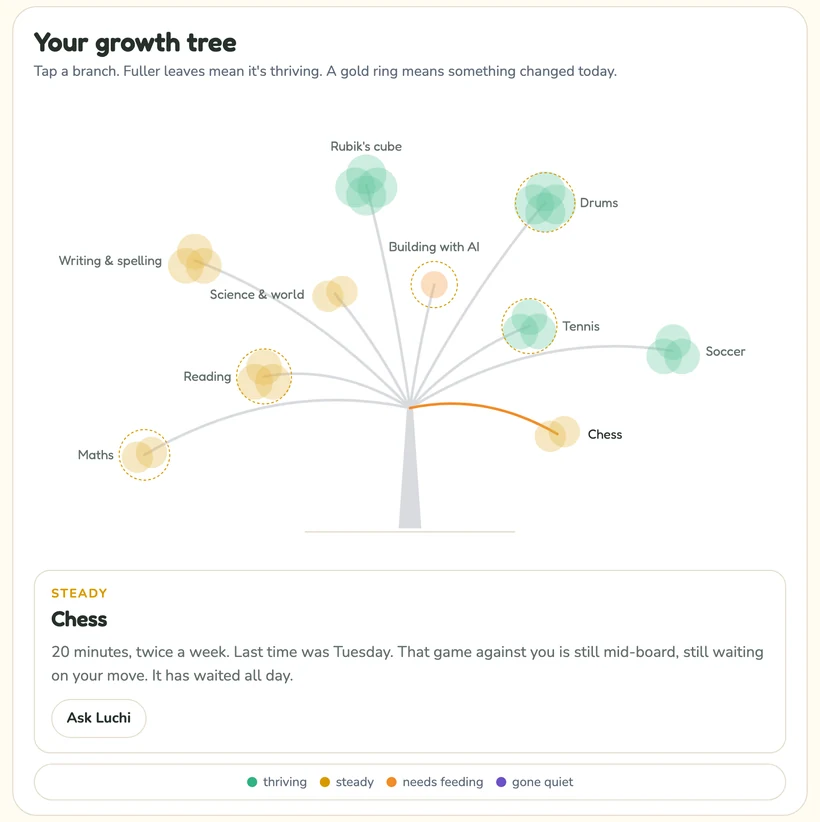
What you see while they play
Questions parents ask
- What is a good math game for a 7-year-old versus a 10-year-old?
- Ages 7–9: number bonds, counting on, and anything physical — dice, cards, dominoes. The goal at this age is that numbers feel like objects you can push around. Ages 10–12: fractions, ratio and strategy — chess, Set, Twenty-four with fractions allowed, and building a game of their own. The goal shifts from handling numbers to planning several steps ahead.
- Do math games actually improve math grades?
- They reliably improve the thing they drill, which is usually recall speed on facts. Whether that shows up in a grade depends on whether recall speed was the problem. If your child is slow but accurate, a fluency game is one of the highest-return twenty minutes you can spend. If the gap is conceptual — fractions, place value, ratio — then more drilling of the facts they already know will not move it.
- How much time on a math game is reasonable?
- Fifteen to twenty minutes is where most families land, and the cap matters more than the exact number. A math game that runs an hour has stopped being practice and started being a game you are counting as math. Set the cap before you start, not when you want it to end.
- Is building a game a reasonable way to learn math?
- It is slow and it is excellent. A child writing the scoring rule for their own game has to state a rule precisely enough for a computer to follow, which is a harder test of understanding than any worksheet. Treat it as a weekend project rather than this week’s fractions homework, and let it cover whatever it happens to cover.
- Which math app should I buy?
- Judge any of them on one question: can it tell you which specific skill your child is missing, or only how many questions they answered? Free arcade sites are good at fluency and honest about being games — there is nothing wrong with using one for exactly that. A paid adaptive app is worth the money only if you can see the skill map it is adapting against, and if you cannot find that map on its site, assume there is not one you would recognise.
- How do I know whether any of it is working?
- Close the app and ask your child to explain one problem out loud — not solve it, explain it. If they can say why the method works, it is in. If they can only run the steps, it is not yet. Do this once a fortnight and you will know more about their math than any weekly score email will tell you.
Let them build the next one
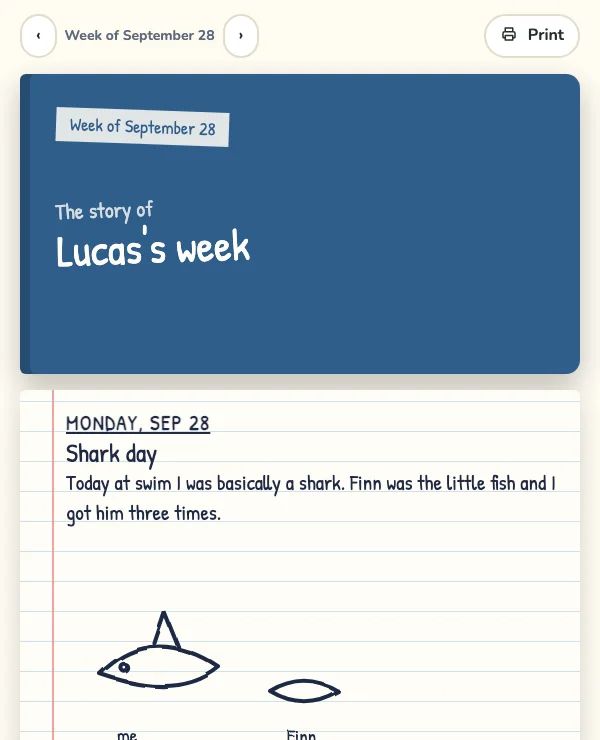
Your child asks for a game, Luchi builds it, and you get a weekly note in their own words about what they made. Homework gets hints, not answers, tagged to one of 1,389 K–8 skills. One plan, Luchi Family — your first 7 days for $5 — cancel before it renews.