Staying connected with your kid while you travel
A practical guide for the parent who is somewhere else a lot of the time — what actually keeps the thread with a kid in grade school, and what doesn’t.

The four-minute call
The call is at 7:15, between bath and lights-out, because that’s the only gap in the evening nobody else needs. It lasts about four minutes.
You ask what they did today. “Nothing.” You ask about school. “I don’t remember.” You can hear the TV. Somewhere in the background your kid asks the grown-up holding the phone whether they can go rinse the shampoo out, and the call ends with you saying “love you, buddy” to a kid already halfway down the hallway.
Then you sit in a hotel room in a city you didn’t want to be in and feel like a payroll deposit with a phone number.
Two things are going wrong here, and neither of them is you. The call sits at the worst hour of your kid’s day, when they are tired and finished with questions. And “what did you do today” is a question kids genuinely can’t answer — not because nothing happened, but because a day isn’t a story yet. Adults can’t summarize their days either. We’ve just had more practice dodging the question.
What works better than the check-in
Give the call a job, not an agenda
Calls go better when your kid is holding something. A tour: “walk me through the base you’re building.” A performance: they read you a page of their book, you read a page of yours. A contest: you each build a paper airplane and race them on camera.
Ten minutes in which your kid is showing you something beats twenty minutes of you asking and them shrugging. You’re not extracting a report. You’re being an audience — which is a job kids take seriously.

Let some of it be async
If your trip crosses time zones, stop pretending the live call is the product. Voice notes travel better than calls: your kid can listen at breakfast, alone, twice.
Send one on your morning — the weird hotel breakfast, the rain, the meeting that ran long. Then ask one small question they can answer whenever they feel like it. What matters isn’t that the exchange happens at the same time. It’s that it happens at all, and keeps happening.
Hide things before you go
Before you leave, write five short notes — one for each day you’re gone. Paper. Hide them yourself, or hand them to the grown-up at home with instructions: one per day, in the lunchbox, under the pillow, wherever your kid finds things.
A note that arrives while you’re unreachable reads to a kid as proof that you were thinking of them — which is the thing they’re actually checking for. It beats a call, because it didn’t need them to perform.

Protect one ritual, not the whole day
Kids track patterns, not calendars. Same time, same channel, same opening — “tell me the best thing and the worst thing” — every day, even when it’s short. A four-minute call that always happens beats a thirty-minute call that happens when your schedule permits.
And if you’re going to miss it, say so in advance. To a kid, a promised call that evaporates without explanation is a different event from a call that was never promised.
Don’t make the at-home parent your switchboard
Every “is the kid free at 7? can you get them?” lands on the person already running bath, homework and dinner alone. Ask once what time works for your kid — then protect that slot yourself.
And take a real task off their plate while you’re gone. Not “call me if anything happens” — that’s a beeper. “I’ve got Tuesday’s carpool forms” — that’s a load.
Let the boring parts of the trip in
Resist the urge to perform Fun Parent. Kids want the ordinary parts: the hotel room, the weather, the food that confused you. It lets them place you in the world — and a parent who is located, specifically, is easier to miss in a manageable way than a parent who has vanished into the word “business.”
Keep small promises at an unreasonable standard
A promise to call at 7 that lands at 7:09 does more damage than no promise at all — 7:09 is a data point on whether your word is load-bearing. Under-promise. Then be where you said you’d be, on the device you said you’d be on. Reliability at a distance is the whole game.
About the guilt
The guilt is loud, so deal with it honestly. Working away from your kid is not a moral failure, and neither is missing them. What harms kids isn’t a parent’s travel. It’s unpredictability, disinterest, and a parent who comes home and acts as if nothing happened.
The measure a kid actually uses isn’t hours. It’s three questions: Can I predict you? Are you interested in my world? Do you come back when you said? You can pass all three from an airport.
The interest part is testable, and it isn’t in the call. It’s the follow-up three days later — “how did the volcano diorama turn out?” Remembering is presence. Nothing else you do on a business trip scores higher.

Coming home
The first hour home sets the terms. Don’t open with an interview — “so what did I miss?” puts your kid on the stand after four days of coping without you.
Instead, join whatever they’re doing. Sit down at the LEGO. Ask them to teach you the card game they learned. Let them lead for an hour. The trip debrief, if it happens, will happen sideways, while you’re building something together.

Where Luchi Family fits
No app fixes a four-minute call. What a tool can honestly do is keep a thread running between calls, and hand you something real to ask about — because the follow-up question is where the connection actually lives.
Here is what Luchi Family does today. No more than this:
- Your kid talks to Luchi out loud, at home, in English or Chinese. — It’s a voice companion built for kids: it plans the day with them, and it builds things with them — games, stories, little apps on their own canvas.
- Homework gets coached, not answered. — When schoolwork is on the table, Luchi is instructed never to state the final answer to the question at hand — it works the kid toward it. So homework help doesn’t evaporate just because the parent who usually checks it is in another city.
- Once a week, Luchi writes you a note. — A few warm, specific sentences — what went well, what felt hard, one thing to try together — written from what actually happened that week, not from a usage chart.
- The parent dashboard shows the week. — Insights built from your kid’s own words — what they said they learned, in their phrasing — in the language you’ve set, plus the things they’ve been making.
- Your kid knows how this works. — The app tells them, in plain words, when a parent can see what they’re doing. And if anything serious ever comes up in conversation, Luchi makes sure a parent hears about it.
And here is what it doesn’t do, because you should know before you want it:
- Your kid can’t message you through it. — It isn’t a phone, and it isn’t a video call.
- It doesn’t replace the Tuesday call or the notes in the lunchbox. — What it hands you is material. “You built a quiz game about axolotls?” is a better opener than “what did you do today” — and a kid who has been showing Luchi their week all along has something to show you too.
For the parent on the road, that’s the honest pitch: not presence — a running record of your kid’s week, in their own voice, so the four minutes you do get start somewhere real.
The after-school hour, without the nagging · What is my kid doing on AI?
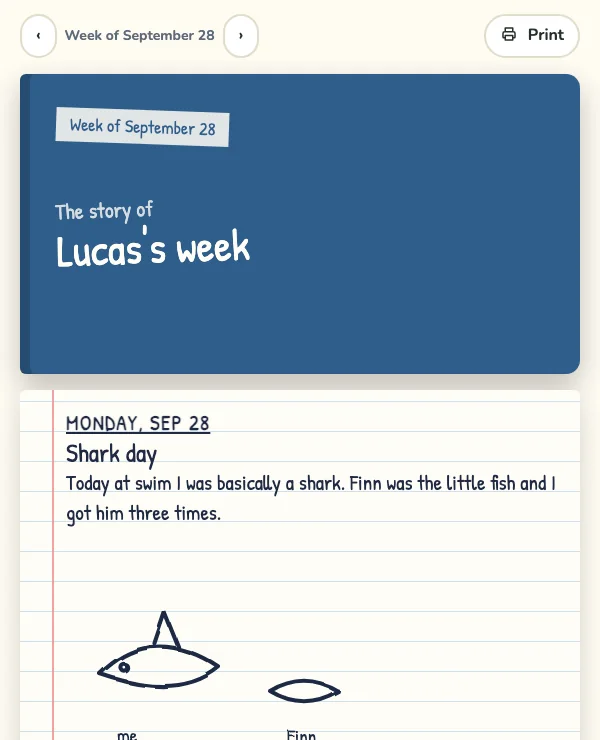
The parent dashboard, as parents actually see it
Questions parents ask
- How long should a call with my kid be when I’m traveling?
- Shorter and more predictable beats longer and occasional. A four-minute call at the same time every day beats a thirty-minute call that happens when your schedule permits — and if you’re going to miss it, say so in advance. To a kid, a promised call that evaporates without explanation is a different event from a call that was never promised.
- What should we actually do on the call?
- Give the call a job, not an agenda. Ask your kid to show you something — a tour of what they’re building, a page of their book read aloud, a paper-airplane contest on camera. Ten minutes in which your kid is showing you something beats twenty minutes of you asking and them shrugging.
- How do I stay connected when we’re in different time zones?
- Stop pretending the live call is the product. Voice notes travel better than calls: send one on your morning, then ask one small question your kid can answer whenever they feel like it. What matters isn’t that the exchange happens at the same time — it’s that it happens at all, and keeps happening.
- Can my kid use Luchi Family to message me while I’m away?
- No — it isn’t a phone, and it isn’t a video call, and your kid can’t message you through it. What it does is keep a thread running between calls: your kid talks to Luchi at home and builds things with it, and once a week you get a note written from what actually happened, so the four minutes you do get start somewhere real.
Luchi Family invites you as soon as you join the list.
Get on the list, and be the parent who still knows what the volcano diorama was about.