AI homework help that doesn’t do the homework
Every AI your child can reach will hand over a finished answer in two seconds, and most homework evenings are short on patience. So the useful question is not whether to allow it — it is what good help looks like when the tool is willing to do too much. Here is the line, where it sits subject by subject, a five-step routine for one hard question, and what to ask any homework-help product before you pay for it.
Help and doing it for them are not on a spectrum
There is a tempting way to think about this — that help runs along a dial from a gentle nudge to a finished answer, and that good parenting is finding the right setting. It does not work like that, because the two things fail differently. Help that leaves your child doing the thinking makes the next question easier. Help that finishes the question for them makes the next question harder, because the practice that would have made it easier never happened. More of the first is usually fine. A little of the second is not a smaller version of the first.
This is why the line is drawn around a single thing: who is doing the step the task was set to practise. If tonight’s worksheet is for practising long division, a hint about where to line up the digits is help; the quotient is not. If the assignment is a paragraph about the water cycle, a reminder of the four stages is help; the paragraph is not. The subject does not change the rule, but it does change where the rule lands — which is the table below.
And be realistic about the pressure. A ten-year-old at half past eight who is tired, behind, and holding a tool that answers instantly is not making a moral choice. They are taking the only exit that is visible. Every workable plan here assumes that and designs around it, rather than relying on a child to refuse an offer an adult would struggle to refuse.
Where the line sits, subject by subject
The same rule — your child does the step the task was set to practise — lands in a different place in each subject. This is the version worth agreeing out loud before an argument about it, not during one.
| Subject | Fair AI help | Over the line |
|---|---|---|
| Maths | Naming the method, a worked example of a different problem with different numbers, checking a finished answer, explaining why a step is legal. | Solving the actual problem set. Also: “check my work” where the tool silently corrects it instead of saying which line is wrong. |
| Writing | Brainstorming before a draft, questions about an argument your child already made, pointing at an unclear sentence without rewriting it, spelling and punctuation. | Drafting, rewriting a paragraph “in better words”, or generating a thesis. The sentences have to be theirs, or none of the practice occurred. |
| Reading | Defining a word, explaining a reference the author assumed, summarising a chapter your child has already read to check their own understanding. | Summarising a chapter they have not read. This is the single most common substitution, and it is invisible in the finished homework. |
| Science and history | Explaining a concept a different way, finding a source, checking a date, asking what a diagram is showing. | Writing the answer to the set question — most of these assignments are graded on explanation, which is exactly what the AI is best at producing. |
| Languages | Conjugation tables, pronunciation, asking why a construction is wrong after your child has tried it. | Translating the exercise. Machine translation on a language exercise removes one hundred percent of the task. |
| Projects and coding | Debugging help, explaining an error message, suggesting an approach, building the parts your child specified. | Not much, honestly — this is the one category where directing a tool well is itself the skill being learned. Ask them to explain what it built. |
The five-step routine for one hard question
- 1. Try it badly first, for two minutes The attempt matters more than its quality. Two minutes of a wrong approach tells both your child and any tool exactly where the misunderstanding is, and it is the step AI most reliably deletes. A tool asked cold produces a generic explanation of the whole topic; a tool asked after an attempt can address the actual error.
- 2. Say what you tried and where it stopped “I don’t get question four” gets a lecture. “I tried to subtract the numerators and I got a negative number, which seems wrong” gets a useful answer in one turn. This is a skill worth teaching explicitly — it is the same skill as asking a teacher a good question, and it transfers.
- 3. Ask for a hint, or for the same problem with different numbers Two requests that are almost never refused and almost always better than what a child asks for by default. A worked example of a parallel problem gives the method without giving the answer — and the research on worked examples is unusually solid for an education finding.
- 4. Do the step yourself, on paper, before reading further The mechanical part that makes the difference, and the part no product can enforce from the outside. Close the screen, or at least look away. Reading a correct method and performing it feel similar in the moment and leave very different traces a week later.
- 5. Explain it back to someone, or to nobody Out loud, thirty seconds, to you or to the dog. This is the whole quality gate on the evening. A child who can say why the method works has learned it; a child who can only reproduce the steps has not yet, and that is useful information rather than a failure — it says do one more tomorrow.
Four ways AI homework help goes wrong
- The answer arrives before the attempt — The default failure, and a design problem rather than a character one. A general chatbot has no concept of withholding, so the first message produces a complete solution and the evening is over. If you change one thing about how your child uses AI on homework, make it the order: attempt, then ask.
- It is confidently wrong, and nobody checks — General-purpose AI is noticeably weaker at multi-step arithmetic than its fluency suggests, and it does not hedge when it is wrong. A child who has outsourced the thinking has also outsourced the only thing that would have caught the error, so the mistake arrives at school unexamined.
- It explains at the wrong level — The quiet one. An explanation pitched at an adult reader is not wrong, it is just useless to a nine-year-old, and what follows is forty minutes of apparent activity with the homework still undone. Nothing in the session announces this. Asking “did that explanation actually make sense?” catches most of it.
- It becomes the first move instead of the third — The one with the longest shadow. Dependence does not start with a decision to cheat; it starts with a tool that is faster than thinking being available at the exact moment thinking got hard. The habit, not any single evening, is the thing worth spending your attention on.
Why hints beat answers — and this part is not our opinion
Two findings from well-replicated learning research do most of the work here, and both are older than the technology. The first is scaffolding: support that lets a learner complete a task they could not yet complete alone, and that is then withdrawn as they can. The point is the withdrawal. Support that is never withdrawn is not scaffolding, it is a crutch, and it produces a child who can do the task only while the support is present.
The second is worked examples: studying a fully worked parallel problem is often more efficient than struggling unaided, particularly early in learning a method. This is the finding people misread as “just show them the answer.” It is not. A worked example is a different problem, worked in full, that the learner then applies themselves. Handing over the answer to the set question is the one version that teaches nothing, because the applying step never happens.
Put the two together and you get the shape of good homework help, which is also why a hint-first order is not merely a moral preference: ask for a hint, attempt, ask for a worked parallel example if the hint was not enough, attempt again, and explain it back. A tool built around that order is doing something a general chatbot structurally cannot, because a general chatbot has no notion of what the task was set to practise.
The research under each part of how Luchi teaches · How to know what happened in a session without reading it
What you see when the help is designed this way
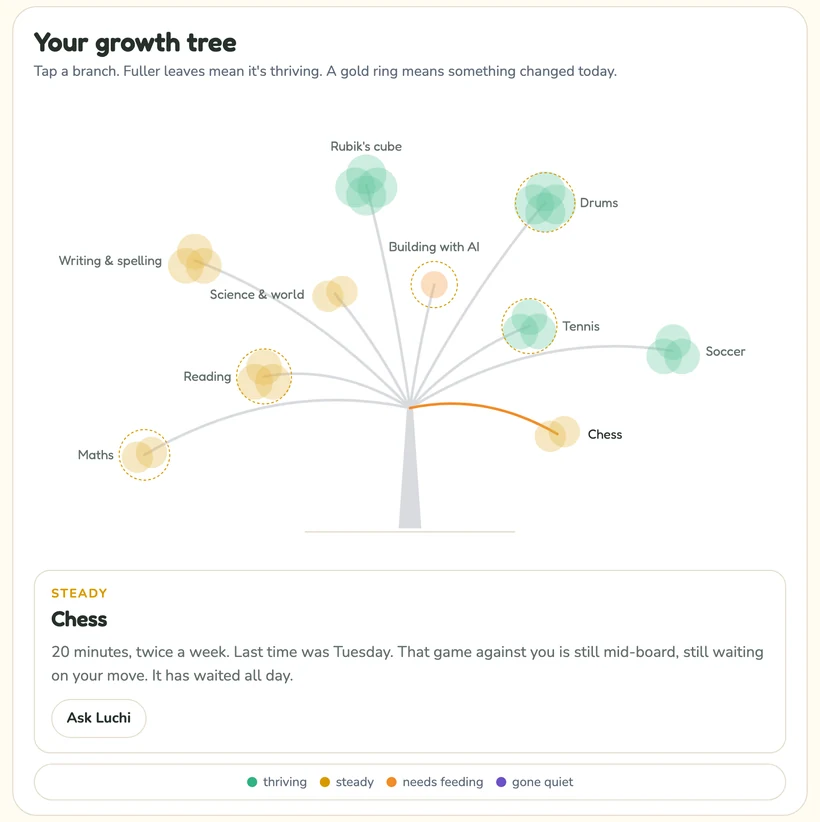
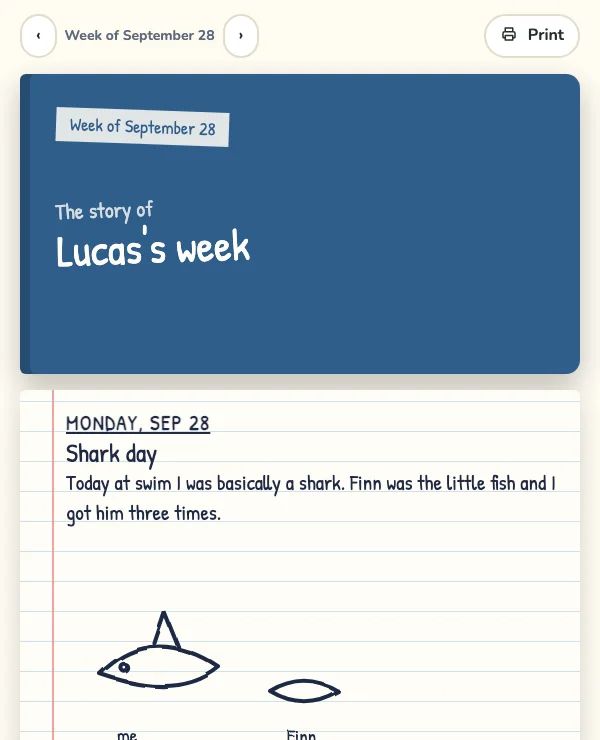
The reason a parent cares about the hint-first order is that it produces something a transcript cannot: a record of which skills are actually in. These are two screens from the app.
Five questions to ask any homework-help product
There are a lot of these now and they are hard to tell apart from their marketing, so here are five questions that separate them quickly. Does it withhold the answer by default, and is that enforced in its code or merely requested in its prompt? Can it tell me which specific skill my child is missing, or only how many questions they answered? Does a right answer that followed a hint count as proof of mastery? What does it show me at the end of the week, and is that written from what my child did or from how long they were logged in? And can I see the skill map it claims to be adapting against?
Most products cannot answer the second and third, which is itself informative. A tool that counts a hinted right answer as mastery will tell you your child has learned something they have not, and you will find out at the test rather than on the Thursday it was checkable.
For completeness, here is how Luchi answers them, stated no more strongly than is true. Homework help comes as hints first and a worked example only after two of them — full answers are off unless a parent turns that on, and the two-hint limit is held in code rather than requested in a prompt. Each question is tagged to one of 1,632 K–8 skills. A right answer that followed a hint is not counted as proof; it only nudges the estimate, and a skill counts as mastered only after right answers on three separate days. Fifteen common wrong rules are known by name, so a careless slip on a strong skill is told apart from a real gap. And for step-by-step work the answers never go to the child’s page — the blanks are marked by code, and help opens at the first blank they miss.
What we do not claim: none of this makes a child want to do their homework, and none of it is a study of Luchi. The learning research above is research on the methods, not on our product, and it does not promise a particular result for your child.
What Luchi is, in one page · Maths practice that does not feel like homework
Questions parents ask
- Is it cheating for a kid to use AI for homework?
- It depends entirely on whether your child did the step the task was set to practise. Asking AI to explain long division and then doing the division is not cheating. Asking it to do the division is, regardless of how the finished page looks. The useful test at home is oral rather than forensic: can they walk you through one answer and handle a follow-up question? If yes, the thinking happened somewhere. School policies vary and are worth reading, but they are mostly formalisations of that same line.
- What is the best AI for homework help for kids?
- Judge them on whether they withhold the answer by default and whether they can name the specific skill your child is missing. A general assistant does neither — not because it is badly made, but because it was built to be maximally helpful in one turn, which is the opposite of what a homework tool should do. A dedicated homework tool is only better if its restraint is enforced in its code rather than asked for in its prompt, and if you can see the skill map it adapts against.
- How do I help with homework without doing it for them?
- Ask rather than tell, and do it in a fixed order. What is the question actually asking? What have you tried? Where exactly did it stop working? Can you show me a similar one you got right? That sequence costs you four questions instead of one explanation, and the difference is that your child is doing the retrieval each time. When you genuinely do not know the material, saying so and working it out alongside them is better than an authoritative wrong answer — and it models the thing you want.
- Is AI homework help bad for learning?
- The evidence that exists points at the order, not the tool. Support withdrawn as a learner improves helps; support that substitutes for the attempt does not, and that is true of a parent doing the homework too. The specific risk AI adds is speed: it removes the productive friction between “this is hard” and “I asked for help”, which used to be where a lot of learning quietly happened. Reinstating that friction deliberately — attempt first, always — is most of the fix.
- My kid uses AI for homework and their grades went up. Is that a problem?
- Possibly, and the way to find out is cheap. Pick one topic from last week and ask them to do a fresh problem in front of you with no tool. If they can, the grades are real. If they cannot, the grades are the tool’s and the gap is still there, growing quietly until an exam makes it visible. Do this once a fortnight rather than as an interrogation after a good report.
- What age should a kid start using AI for homework?
- Later than they will ask, and the constraint is not maturity but whether they have enough of the underlying skill to tell a wrong answer from a right one. A seven-year-old cannot evaluate an AI explanation of subtraction, so AI help at that age should be read aloud and discussed with an adult present. By ten to twelve, with the habits in this guide in place and a tool that withholds answers, independent use on homework is reasonable — with the explain-it-back check still happening.
Homework help that hands back hints, not answers
Luchi gives two hints and then a worked example — never the answer, unless a parent turns that on — tags every question to one of 1,632 K–8 skills, and writes you a weekly note from what actually happened.
Part of the series: How to end the daily homework battle
Related guides in this series
- Teaching kids to start homework without reminders — Independence is a prompt you remove on purpose, not a trait you wait for. A five-rung ladder from "you say it daily" to "you only ask afterwards", with how long each rung takes.
- Seven practical homework focus strategies — Seven things that help once they have started, in the order worth trying them — plus an honest table of which rest on solid evidence and which do not.
- What parents should know about AI homework helpers — Unguarded AI help measurably lowered later unaided test scores; guardrails removed the harm. What is known, what is not, and five questions to ask any product.
- Is my kid cheating with AI? — Why AI detectors are not reliable enough to accuse a child on, the ninety-second check that is, and what to do about each of the four things you are likely to find.
- The after-school hour, without the nagging — The fight is about the forty minutes before homework. A five-block plan, the four traps that turn a routine back into nagging, and the research that makes it work.