Will using AI make my child lazy or less creative?
These are two different questions and they have two different answers. On effort, there is a real measurement and it partly supports the worry — a study of nearly a thousand students found an unguarded AI assistant left them worse off on a later unaided exam. On originality, the best evidence points both ways at once. Here is what has actually been measured, why it happens, and the one change that has been shown to move it.
Split the question before you answer it
The worry arrives as one sentence, but it contains two claims the evidence treats completely differently. The first is about effort: if the machine does the hard part, does your child stop building the capacity to do it? The second is about originality: if the ideas come from a model trained on everyone, does your child end up thinking what everyone thinks?
The first has been measured directly, and the answer should make you uncomfortable. The second has been measured too, and refuses to be either reassuring or alarming. Taking them together — which is what every opinion column does — is how this topic produces so much heat and so little a parent can act on.
On lazy: there is a number, and it is not reassuring
Bastani and colleagues ran the study this question needed. Nearly a thousand high-school students, randomised, working through maths practice with GPT-4 in different configurations. The students using the unguarded assistant did better during practice — noticeably better. Then they sat an exam without it, and scored about 17% LOWER than students who had never had it.
So the worry has a measurement behind it, and the measurement is not small. The second half matters just as much: a version of the assistant redesigned to give hints rather than answers essentially eliminated the harm. Not some of it — the damage was removed. But — and this is the part that gets dropped by anyone citing this study to sell something — the guarded version produced no positive exam effect either. It removed a harm. It did not add a benefit.
The honest limits: high-school mathematics in Turkey, not a nine-year-old at a kitchen table, and one study. What transfers is the shape rather than the number. Practice performance went up while learning went down, and the difference between the two arms was not how much AI was used but whether it would hand over the answer.
The testable property that separates a hint-giving tool from a vending machine · The sibling worry: if it writes the code, is the skill still worth having?
Why it happens: the skipped step was the step that worked
The mechanism is older than AI and among the better-replicated findings in learning research. Roediger and Karpicke had students read prose passages and then either take recall tests with no feedback, or reread the material the same number of times. Five minutes later, rereading won. Two days and a week later, the tested group retained substantially more.
Now the sentence that explains your whole household: rereading "increased students' confidence in their ability to remember the material". The weaker method felt better. Retrieval — the uncomfortable business of trying to produce an answer before you have it — is what builds durable memory, and it is precisely the step an instant answer removes. Your child is not being lazy in any character sense; they are choosing the option that feels like learning, exactly as adults do. It is also why "they seemed to understand it at the time" is such unreliable evidence, chatbot or no chatbot. University students on prose passages, so take the mechanism and the inversion, not a number.
On creative: the finding points both ways
Doshi and Hauser ran an experiment where some writers got story ideas from a large language model and others did not, then had the output judged. Access to AI ideas "causes stories to be evaluated as more creative, better written, and more enjoyable, especially among less creative writers". That is the opposite of the usual claim, and it is the strongest version of the case for letting your child use one.
And then: "generative AI–enabled stories are more similar to each other than stories by humans alone". Individually better, collectively narrower. The authors describe it as a social dilemma — with AI, "writers are individually better off, but collectively a narrower scope of novel content is produced".
So the honest answer to "will it make my child less creative" is: probably not less creative than they would have been, and quite possibly more — while the pool of ideas everyone is drawing from gets smaller. That is a real cost, but it is a cost at the level of a population rather than something happening inside your child. Anyone citing this study as proof that AI kills creativity is citing half of it, and so is anyone citing it the other way.
The lever: make them commit before they look
- 1. Guess first, out loud or on paper Before the question goes into any tool, your child says or writes what they think the answer is — even a bad one, even "I have no idea, but maybe something like…". This is not a moral exercise and it is not about earning the help. It is the step that creates something to retrieve, which is the thing the research says does the work. Thirty seconds is enough.
- 2. Then compare, rather than receive With a guess already written down, the AI's answer becomes something to check against rather than something to copy. "Where were you different?" and "which one is right, and how would we know?" are the two questions, and they turn an answer into a comparison. This is also the only version of the activity where your child notices the tool being wrong, which happens more often than its confidence suggests.
- 3. Finish with the explain-it test Close the laptop and ask them to explain it to you as if you did not know. This is retrieval practice wearing a dinner-table costume, and it is also the most sensitive detector of copied work you will ever own — a child who directed the work can always explain it, and a child who watched it happen cannot. You do not need to announce what the question is for.
Why the commit-first step rather than a better explanation
This particular lever was tested against the obvious alternative and won. Buçinca and colleagues studied overreliance on AI decision support directly: people "accept an AI's suggestion even when that suggestion is wrong", and adding explanations of the AI's reasoning "does not appear to reduce the overreliance". Making the person commit to their own answer first — cognitive forcing — "significantly reduced overreliance compared to the simple explainable AI approaches".
And then the finding that should set your expectations at home: "people assigned the least favorable subjective ratings to the designs that reduced the overreliance the most." The thing that worked was the thing people liked least. Your child will push back on guessing first, and that pushback is not evidence you chose badly. Adults on a decision task, not children on homework — so this is a mechanism and a warning about how it will feel, not a measured effect on a nine-year-old.
How you check, without hovering
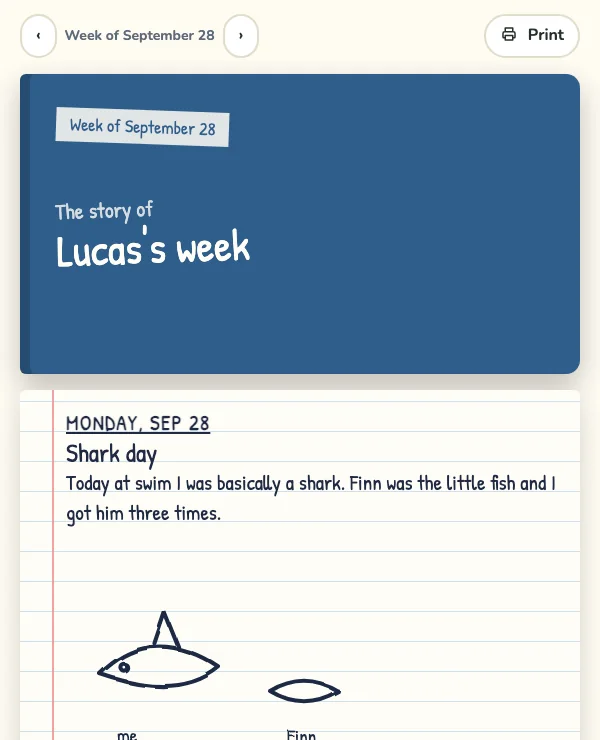
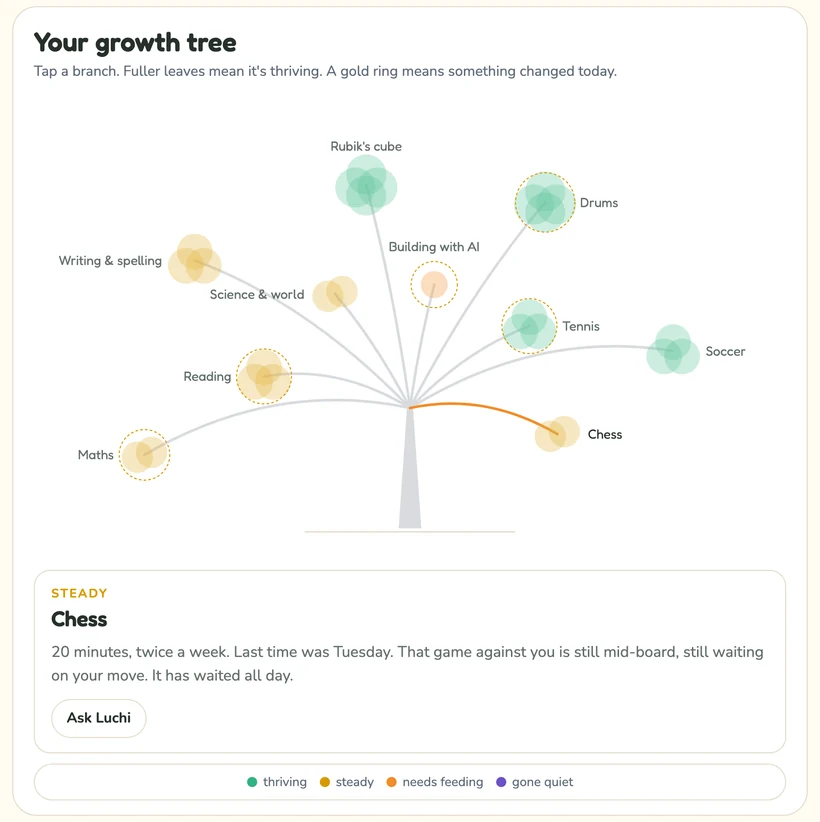
The question this page ends on — did my child do the thinking? — is not answerable from a finished artefact. It needs their own words, which is what these two surfaces are for.
The research under this page
Four sources. One of them supports the worry this page is answering, and is cited for that rather than argued with.
- Bastani, Bastani, Sungu, Ge, Kabakcı & Mariman, 2024 — Generative AI without guardrails can harm learning: evidence from high school mathematics. (Nearly 1,000 students; an unguarded GPT-4 assistant raised practice scores but LOWERED later unaided exam scores by about 17%, an effect essentially eliminated by a hint-giving tutor version.) The measured harm: an unguarded assistant raised practice scores and lowered later unaided exam scores by about 17%, with a hint-giving version removing the harm but adding no benefit. High-school maths in Turkey — the shape transfers, the number does not. What it does not show: High-school maths in Turkey, not elementary school, and the "guardrails" arm showed no POSITIVE exam effect either — it removed the harm. Anyone citing this as proof that AI tutoring raises attainment is citing the opposite of what it found.
- Roediger & Karpicke, 2006 — Test-enhanced learning: taking memory tests improves long-term retention. Psychological Science, 17(3), 249–255. (Students studied prose passages, then either took free-recall tests without feedback or restudied the same number of times. "When the final test was given after 5 min, repeated studying improved recall relative to repeated testing. However, on the delayed tests, prior testing produced substantially greater retention than studying, even though repeated studying increased students’ confidence in their ability to remember the material.") The mechanism an instant answer removes, and the inversion that makes it invisible: retrieval beat rereading at a delay, while rereading raised confidence. University students on prose, not children on homework. What it does not show: University students on prose passages, not children with a chatbot. It is cited for one mechanism and one inversion — retrieval beats rereading at a delay, while rereading feels better at the time — and never as a measurement of what AI does to a child’s memory.
- Doshi & Hauser, 2024 — Generative AI enhances individual creativity but reduces the collective diversity of novel content. Science Advances, 10(28), eadn5290. (An online experiment in which some writers received story ideas from a large language model. "Access to generative AI ideas causes stories to be evaluated as more creative, better written, and more enjoyable, especially among less creative writers. However, generative AI–enabled stories are more similar to each other than stories by humans alone… With generative AI, writers are individually better off, but collectively a narrower scope of novel content is produced.") Cited in both directions, because it points both ways: AI ideas made stories be rated more creative, especially for less creative writers, AND made the stories more similar to one another. The homogenisation is across a population, not inside one child. What it does not show: Adults writing short stories in one online experiment, judged by raters. CITED IN BOTH DIRECTIONS, because it points both ways: it does not support "AI kills creativity", and it does not support "AI makes your child more creative" either. The homogenisation it measures is across a population, not inside one child.
- Buçinca, Malaya & Gajos, 2021 — To trust or to think: cognitive forcing interventions can reduce overreliance on AI in AI-assisted decision-making. Proceedings of the ACM on Human-Computer Interaction, 5(CSCW1), 1–21. (N = 199. "People supported by AI-powered decision support tools frequently overrely on the AI: they accept an AI’s suggestion even when that suggestion is wrong", and adding explanations "does not appear to reduce the overreliance". Cognitive forcing — making the person commit to their own answer before they see the AI’s — "significantly reduced overreliance compared to the simple explainable AI approaches". The trade-off: "people assigned the least favorable subjective ratings to the designs that reduced the overreliance the most".) Why commit-first rather than a better explanation: explanations did not reduce overreliance, committing first did — and people rated the designs that worked best the least favourably. Adults on a decision task. What it does not show: Adults in a controlled study on a decision task, not children on homework. Cited for the mechanism and for its uncomfortable trade-off — the intervention that worked best was the one people liked least — and never as a measured effect on a child.
Questions parents ask
- Does using AI make kids lazy?
- There is a measurement, and it partly supports the worry. In a randomised study of nearly a thousand high-school students, those given an unguarded GPT-4 assistant for maths practice performed better during practice and then scored about 17% lower on a later exam taken without it. The crucial detail is that a version redesigned to give hints instead of answers essentially eliminated that harm. So the variable is not how much AI, it is whether the tool will hand over the answer.
- Will AI make my child less creative?
- The best available evidence says probably not, and possibly the reverse — with a catch that operates at a different level. In a controlled experiment, writers given AI story ideas produced work judged more creative, better written and more enjoyable, with the largest gains among the least creative writers. The same study found those AI-assisted stories were more similar to each other than human-only ones. Your individual child likely benefits; the collective pool of ideas narrows.
- How do I know if my child actually learned it or just copied?
- Close the device and ask them to explain it to you as though you did not know. A child who directed the work can always do this, and a child who watched it happen cannot — they will be able to repeat the conclusion and not the reason. This also happens to be retrieval practice, which is itself one of the better-evidenced ways to make the thing stick, so the test is not wasted time even when they pass it.
- Should I just ban it?
- That is a reasonable thing to want and a hard thing to make work, since the same tools are arriving through school devices and friends' phones regardless. The evidence points somewhere more useful than a ban: the harm in the study came from a tool that answered, and it disappeared with a tool that hinted. So the lever you actually hold is which kind of tool, and the house rule that your child's own guess exists before the machine's does.
A tool built to make them think first
The commit-first habit on this page is hard to enforce with a general assistant, because it answers instantly every time you ask. Luchi is built the other way round: it asks a kid what they think before it tells them, makes them explain what they made, and sends you a short note in their own words so you can see the thinking rather than take our word for it.
Part of the series: Should my kid learn coding or AI?
Related guides in this series
- Coding vs AI for kids: which first? — Not a versus. Why the two are one skill for a school-age kid — and the order that actually makes sense when you sit your child down.
- Will AI replace coding? — AI changes what coding is, not whether your kid should learn it. The durable skill is telling a computer what you want — and how to check it.
- Is coding still worth learning for kids? — Yes — but the skill shifted from syntax to thinking and directing. Exactly what a kid practices when they build with AI.
- What age should kids start with AI? — A practical, age-by-age answer for 5–12s — when AI helps, when to wait, and what “starting” should actually look like.
- Best AI apps for kids, compared — Eight products side by side, every claim quoted from the product’s own site with the capture date — including ours, and including where a cheaper option is the better buy.
- Does my child need to learn prompting? — No — the syntax expires every model release. The skill underneath it has thirty years of intervention evidence: asking a precise question, and judging the answer. How to tell which one a course is selling you.
- How do I know if an AI app is actually safe? — The children’s category is not the signal — a study of 5,855 popular kids’ apps found most potentially in breach, mostly via third-party SDKs. The five things the law requires an app’s own notice to tell you, checkable in fifteen minutes.