No — but they do need the skill underneath it
The prompt-engineering courses aimed at parents are selling a syntax that changes every model release. What does not change is the thing a good prompt is made of: asking a precise question, and judging the answer you get back. Both have decades of intervention research behind them, both are taught in school under other names, and neither is learned by copying a template. Here is the honest answer, and what to do with a Saturday morning instead.
The question has two halves and they have different answers
"Prompting" is doing duty for two unrelated things. One is interface craft: where to put the role line, whether to say "think step by step", which phrasing this month’s model responds to. That has a shelf life measured in model releases, and a nine-year-old who memorises it is learning a keyboard shortcut for a keyboard that is being replaced.
The other is the skill the craft is a wrapper around — working out what you actually want, asking for it precisely enough that a stranger could act on it, and then being able to tell whether what came back is any good. That one is not new, is not going anywhere, and is already on the school curriculum under names like comprehension, questioning and evaluating sources.
So: no, your child does not need a prompting course, and yes, there is something real to practise. The rest of this page is which half you are buying when you buy one, and what the other half looks like at a kitchen table.
The tactical version: what to actually type · When any of this becomes age-appropriate
Asking good questions is a taught skill, and it has been measured
This is the part that makes "it is just asking questions" a weaker dismissal than it sounds. Rosenshine, Meister and Chapman reviewed the intervention studies in which students were explicitly taught to generate their own questions about material they had read, and reported that "teaching students the cognitive strategy of generating questions about the material they had read resulted in gains in comprehension, as measured by tests given at the end of the intervention. All tests were based on new material."
Both of their effect sizes are worth having, because the gap between them is the caveat: a median of 0.86 on tests the researchers built, and 0.36 on standardised tests somebody else wrote. The smaller one is the honest guide to what transfers out of the room it was taught in. Even so, 0.36 on a standardised comprehension test for teaching children to ask their own questions is a real finding, and it is thirty years older than any chatbot.
The other half — judging the answer — has its own literature, and it is not encouraging about the untaught case. Breakstone and colleagues gave 3,446 US high-school students live internet access and six tasks; "the students struggled on all of them", and were "often duped by weak signs of credibility: a website’s ‘look’, its top-level domain, the content on its About page, and the sheer quantity of information it provided". A fluent, well-formatted, confident paragraph is a machine that produces exactly those weak signs on demand.
What a prompting course teaches, and what it skips
A rough test for any course, video or printable you are considering. The left column dates; the right column does not.
| Taught as "prompting" | The durable skill underneath | How to tell which you are buying |
|---|---|---|
| Templates and role lines — "act as a tutor and…" | Working out what you actually want before you ask for it. | If the child could fill in the template without being able to say what problem they are solving, it is syntax. Ask them to say the goal out loud first, with no template in front of them. |
| Magic phrases ("think step by step", "be concise") | Specifying constraints because you know why they matter. | Ask why the phrase helps. "Because the video said so" is the whole finding. A child who can say "so it shows its working and I can check it" has the real thing. |
| Getting a better-looking output | Judging whether the output is any good. | The course that never once says "and here is how to check it" is teaching production, not evaluation — which is the half the national study found students failing at. |
| Longer, more elaborate prompts | Asking the next question when the first answer is thin. | Watch for one shot and done. The durable version is a conversation where the second question comes from reading the first answer properly. |
| Copy-paste prompt packs | Generating your own questions about the thing in front of you. | A pack means no question was generated, which is precisely the act with the intervention evidence behind it. The pack is the part that gets skipped. |
Twenty minutes that teach the real thing
- 1. They say the goal before they touch the keyboard Out loud, in one sentence: what do you want at the end of this? It will be vague the first few times — "a story about a dragon" — and the useful move is one follow-up: for who, how long, and what has to happen in it? That negotiation IS the skill. The typing afterwards takes ten seconds and is the part everybody mistakes for the lesson.
- 2. Guess first, then ask Before the AI answers, your child commits to what they expect — a number, a one-line prediction, anything written down. Buçinca and colleagues found that people "accept an AI’s suggestion even when that suggestion is wrong", that adding explanations "does not appear to reduce the overreliance", and that making the person commit to their own answer first "significantly reduced overreliance". Their own caveat is worth knowing: participants liked the designs that worked best the least. Expect your child to find this annoying, because it is doing something.
- 3. They make it ask THEM Turn the direction round: "ask me questions about my story until you know enough to help." Now the child is answering rather than collecting, and you can hear whether they have a goal. It is also the one instruction in this whole page that reliably produces a better result on the first try, which makes it the easiest to get a child to adopt.
- 4. Score the answer, not the prompt Finish by asking what was wrong with what came back. Something always is: a made-up detail, a bit that ignored the constraint, a paragraph of padding. Children who have been asked this a dozen times read AI output like a draft; children who never have read it like a result. This is the half a prompt course does not sell, and it is the half the research says is failing.
The explaining is the active ingredient, not the asking
There is a reason the fourth step is where the learning is. Chi and colleagues recorded students thinking aloud while studying worked examples and found that the good ones "generate many explanations which refine and expand the conditions for the action parts of the example solutions", guided by "accurate monitoring of their own understanding and misunderstanding" — while the poor ones "do not generate sufficient self-explanations, monitor their learning inaccurately, and subsequently rely heavily on examples".
A finished AI answer is a worked example delivered on demand, infinitely many of them, with no requirement to explain anything. That is a very good description of the conditions under which the poor-explainer pattern in that study is the path of least resistance. The intervention is not a better prompt. It is a question afterwards that cannot be answered without explaining.
The usual limit: a small protocol study of university students on mechanics problems, and correlational — explainers did better, which is not the same as showing that making someone explain causes the gain. Cited for the mechanism, which is what a parent can act on.
And it is worth saying what good feedback has to look like for any of this to work, because it is a property of the feedback and not of who produced it. Shute’s review of the feedback literature concludes that formative feedback — "information communicated to the learner that is intended to modify his or her thinking or behavior to improve learning" — "should be nonevaluative, supportive, timely, and specific". Hold an AI’s reply to that standard out loud with your child in front of you. "Great job, here is a better version" fails three of the four, and naming why is a better prompting lesson than any template.
The same standard, applied to a piece of writing · Tools that ask rather than tell
What this looks like when it is not a Saturday exercise
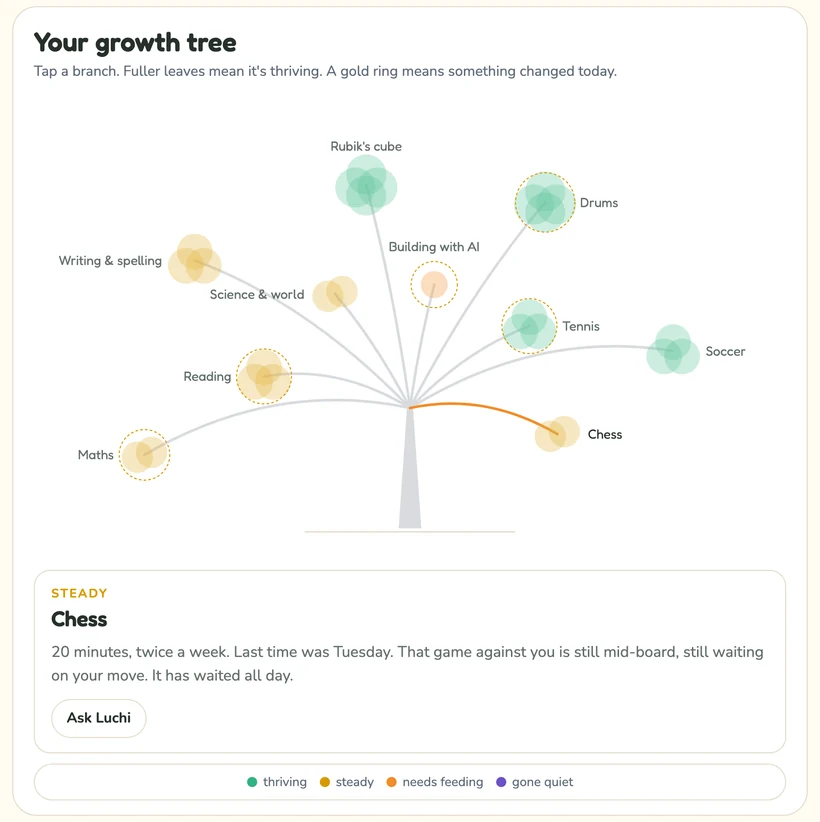
The twenty minutes above work, and the reason households stop doing them is that they depend on a parent remembering to ask the last question. That is the part worth building into the tool rather than into your week.
The research under this page
Four sources: the evidence that question-generation is teachable, the national study on judging what comes back, the mechanism that makes the explaining matter, and the standard any feedback has to meet.
- Rosenshine, Meister & Chapman, 1996 — Teaching students to generate questions: a review of the intervention studies. Review of Educational Research, 66(2), 181–221. (A review of intervention studies in which students were taught to generate their own questions about material they had read. "Overall, teaching students the cognitive strategy of generating questions about the material they had read resulted in gains in comprehension, as measured by tests given at the end of the intervention. All tests were based on new material. The overall median effect size was 0.36 (64th percentile) when standardized tests were used and 0.86 (81st percentile) when experimenter-developed comprehension tests were used.") The spine: teaching children to generate their own questions produced comprehension gains on new material. Both effect sizes are quoted together on purpose — 0.86 on researcher-built tests and 0.36 on standardised ones — because the smaller figure is the honest guide to what transfers. Reading passages in classrooms, not prompting, so it is evidence the underlying skill is teachable rather than a measurement of anybody using an AI. What it does not show: Question-generation about READING passages, in classrooms, long before chatbots existed — so it is evidence that the underlying skill is teachable and worth teaching, not a measurement of anybody prompting an AI. The two effect sizes are both quoted deliberately: the figure more than halves when the test is a standardised one somebody else wrote rather than one built for the study, and the smaller number is the more honest guide to what transfers.
- Breakstone, Smith, Wineburg, Rapaport, Carle, Garland & Saavedra, 2021 — Students’ civic online reasoning: a national portrait. Educational Researcher, 50(8), 505–515. (3,446 US high-school students with a live internet connection, on six constructed-response tasks. "The students struggled on all of them." 96% never learned that a site claiming to disseminate factual climate reports had ties to the fossil fuel industry; two thirds could not distinguish news stories from ads; more than half believed an anonymously posted video shot in Russia was "strong evidence" of US voter fraud. Students "were often duped by weak signs of credibility: a website’s ‘look’, its top-level domain, the content on its About page, and the sheer quantity of information it provided.") The evaluation half, and why "they will pick it up" is not a plan: 3,446 students with live internet access struggled on all six tasks and were duped by a site’s look, its domain and the sheer quantity of information. High-school students on websites rather than children on chatbots — cited because a chatbot manufactures exactly those weak credibility signals on demand. What it does not show: High-school students, and about websites rather than chatbots. It is evidence that this skill does not arrive on its own with age or screen time — not a measurement of what a seven-to-twelve-year-old can do, and we quote no figure as if it were.
- Chi, Bassok, Lewis, Reimann & Glaser, 1989 — Self-explanations: how students study and use examples in learning to solve problems. Cognitive Science, 13(2), 145–182. (Talk-aloud protocols from students studying worked examples of mechanics problems. "We find that 'Good' students learn with understanding: They generate many explanations which refine and expand the conditions for the action parts of the example solutions, and relate these actions to principles in the text. These self-explanations are guided by accurate monitoring of their own understanding and misunderstanding." The contrast is the finding that matters here: "'Poor' students do not generate sufficient self-explanations, monitor their learning inaccurately, and subsequently rely heavily on examples.") Why step four is where the learning is: good students generated many self-explanations and monitored their own understanding, poor students did not and leaned on the worked examples. Correlational, university students, physics problems — cited for the mechanism, never as an effect size or as a finding about children. What it does not show: A small protocol study of university students on physics problems, and correlational in its design — good and poor students differed in how much they explained to themselves, which is not the same as showing that making someone explain causes the gain. Cited for the mechanism and for the direction of the dependence (poor explainers leaned on the worked example), never as an effect size, and never as a measurement about children.
- Shute, 2008 — Focus on formative feedback. Review of Educational Research, 78(1), 153–189. (A review of the research corpus on feedback, defining formative feedback as "information communicated to the learner that is intended to modify his or her thinking or behavior to improve learning". Its summary of what that literature requires: "According to researchers, formative feedback should be nonevaluative, supportive, timely, and specific." It catalogues the types — "verification of response accuracy, explanation of the correct answer, hints, worked examples" — and notes that several learner and task variables "interact with formative feedback’s success at promoting learning".) The standard the page holds an AI reply to — nonevaluative, supportive, timely, specific. A review of pre-generative-AI feedback research, so it is evidence about what feedback needs to be, and not evidence that a chatbot can supply it. That is why it is used as a checklist a parent applies out loud rather than as a claim about the tool. What it does not show: A review of feedback research from before generative AI existed, mostly on school and university learners in instructional settings. It is evidence about what properties feedback needs in order to change learning, and it is NOT evidence that a chatbot can supply them — the page citing it has to make that case separately, which is why the four properties are used as a checklist a parent applies to the output rather than as a claim about the tool.
- Buçinca, Malaya & Gajos, 2021 — To trust or to think: cognitive forcing interventions can reduce overreliance on AI in AI-assisted decision-making. Proceedings of the ACM on Human-Computer Interaction, 5(CSCW1), 1–21. (N = 199. "People supported by AI-powered decision support tools frequently overrely on the AI: they accept an AI’s suggestion even when that suggestion is wrong", and adding explanations "does not appear to reduce the overreliance". Cognitive forcing — making the person commit to their own answer before they see the AI’s — "significantly reduced overreliance compared to the simple explainable AI approaches". The trade-off: "people assigned the least favorable subjective ratings to the designs that reduced the overreliance the most".) The basis for guess-first, including the part that makes it honest: people accepted wrong AI suggestions, explanations did not fix it, committing to your own answer first did — and the designs that reduced overreliance most were the ones participants liked least. Adults, N = 199, a controlled decision task; cited for the mechanism, never as a measured effect on a child. What it does not show: Adults in a controlled study on a decision task, not children on homework. Cited for the mechanism and for its uncomfortable trade-off — the intervention that worked best was the one people liked least — and never as a measured effect on a child.
Questions parents ask
- Does my child need to learn prompt engineering?
- No. The part that is genuinely called prompt engineering is interface craft with a shelf life of a model release or two, and a child who memorises this year’s phrasing has learned something that expires. What is worth learning is the skill the craft wraps: deciding what you actually want, asking for it precisely, and judging what comes back. Teaching children to generate their own questions about material has decades of intervention evidence behind it — a median effect size of 0.36 even on standardised tests somebody else wrote. A prompt pack teaches none of that, because with a pack no question is ever generated.
- What should I look for in a kids’ prompting course?
- One test does most of the work: does it ever teach the child how to check the answer? A course that only improves the output is teaching production, and judging the output is the half a national study of 3,446 students found them failing — duped by a site’s look, its domain and the sheer volume of text, which is exactly what a fluent AI paragraph supplies. The second test is whether the child has to say their goal out loud before any template appears. If they can fill in the template without being able to state the problem, you are paying for syntax.
- Is there anything useful we can do at home instead?
- Twenty minutes, four moves, no course. Have them say the goal in one sentence before touching the keyboard, and push once on for-who and how-long. Have them write down what they expect before the AI answers — committing first is the one intervention measured to reduce people accepting wrong AI suggestions, and explanations alone were found not to. Have them tell the AI to ask THEM questions until it knows enough to help. Then finish by asking what was wrong with the answer, because something always is, and that last question is where the learning sits.
- My child writes great prompts already. Is that a sign of anything?
- It is a sign of something if they can tell you why the prompt is shaped that way, and of very little if they cannot. The two look identical from across the room. Ask them to get the result they want without their usual phrasing, or to say what they would change if the first answer came back thin. A child who answers both is doing the durable thing; a child who cannot has a template, which is fine and is not the skill this page is about.
The question, then the explaining
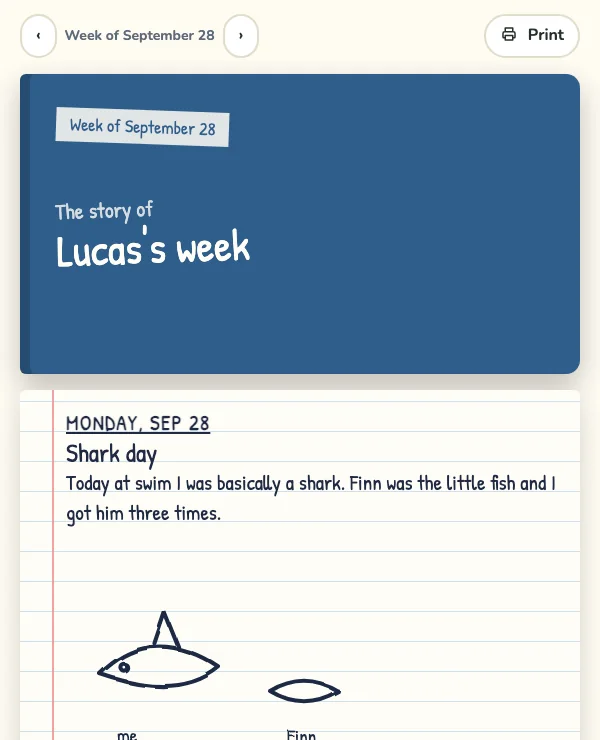
Luchi is built around the two halves this page says are the real skill: a kid decides what they want to make, and then has to explain how it works in their own words. You get a short weekly note written from those explanations — which is also how you can hear their questions getting better.
Part of the series: Should my kid learn coding or AI?
Related guides in this series
- Coding vs AI for kids: which first? — Not a versus. Why the two are one skill for a school-age kid — and the order that actually makes sense when you sit your child down.
- Will AI replace coding? — AI changes what coding is, not whether your kid should learn it. The durable skill is telling a computer what you want — and how to check it.
- Is coding still worth learning for kids? — Yes — but the skill shifted from syntax to thinking and directing. Exactly what a kid practices when they build with AI.
- What age should kids start with AI? — A practical, age-by-age answer for 5–12s — when AI helps, when to wait, and what “starting” should actually look like.
- Best AI apps for kids, compared — Eight products side by side, every claim quoted from the product’s own site with the capture date — including ours, and including where a cheaper option is the better buy.
- Will using AI make my child lazy or less creative? — Two different questions with two different answers. The measured one is uncomfortable — an unguarded assistant left students about 17% worse off on a later unaided exam — and the creativity evidence points both ways at once.
- How do I know if an AI app is actually safe? — The children’s category is not the signal — a study of 5,855 popular kids’ apps found most potentially in breach, mostly via third-party SDKs. The five things the law requires an app’s own notice to tell you, checkable in fifteen minutes.