How do I know if an AI app is actually safe?
"Safe" is not a property you can read off a store listing, and the one thing most parents use as a proxy — that it is in the children's category — has been measured and does not hold. The good news is that US law requires an app aimed at children to tell you specific things, in writing, before it collects anything. That list is short, it is checkable in about fifteen minutes, and an app that will not answer it has told you something.
Why the children's category is not the signal you think it is
Reyes and colleagues built an automated system that watches what an Android app actually sends over the network, and pointed it at 5,855 of the most popular free children's apps. Their finding: "a majority are potentially in violation of COPPA, mainly due to their use of third-party SDKs". Not a majority of bad apps — a majority of the most popular ones, in the category built for children.
The mechanism is the part a parent can use, because it explains why this is not simply a story about careless developers. The leaks come through third-party code the developer did not write: advertising, analytics and crash-reporting kits dropped into the app, many of which "offer configuration options to respect COPPA by disabling tracking and behavioral advertising" while "a majority of apps either do not make use of these options or incorrectly propagate them". They also found that 19% of these apps "collect identifiers or other personally identifiable information (PII) via SDKs whose terms of service outright prohibit their use in child-directed apps".
Two honest limits, because this is the page's load-bearing source. "Potentially in violation" is the authors' own wording and it stays: this is observed network traffic, not a legal ruling. And the measurement is from 2018 on Android, so it says nothing about any specific app today — which is exactly why this page names no products. What it does establish is structural and has not expired: the label on the shelf is uncorrelated with the behaviour underneath, and the usual cause is code the person who sold you the app does not control.
If you want the comparison instead: eight products, side by side · And what “monitoring” actually means when it is sold to you
What the law actually entitles you to, in plain words
The COPPA Rule — 16 CFR Part 312, amended in April 2025 — puts "the obligation of the operator to provide notice and obtain verifiable parental consent prior to collecting, using, or disclosing personal information from children". That notice is not allowed to be a wall: the rule requires it to be "clearly and understandably written, complete, and must contain no unrelated, confusing, or contradictory materials".
Then it enumerates what the notice must tell you. Not in spirit — as a list. The items of personal information collected, how they will be used, and the "potential opportunities for the disclosure" of it. Where data goes to third parties, "the identities or specific categories of such third parties" and "the purposes for such disclosure". How you can give consent, and how to refuse. And one clause worth reading twice, because it is the most useful single sentence in the rule for a parent standing in a sign-up flow: "the parent can consent to the collection and use of the child's personal information without consenting to the disclosure of such personal information."
Two more that give you questions to ask. Before letting a third party touch children's data, the operator must "obtain written assurances" that they can protect it. And data may be kept "for only as long as is reasonably necessary to fulfill the specific purpose(s) for which the information was collected" — so "we keep it indefinitely" is not a policy choice, and an app with no answer about deletion is describing a gap.
What none of this gives you is a quality judgement. A product can satisfy every line above and still be a poor way for a nine-year-old to spend an hour. This is a floor, and the rest of the decision is yours.
The five things an app's own notice has to tell you
Read these off the app's privacy notice and consent screen, not off its marketing page. The right-hand column is what an absence means — which is the part that makes this a fifteen-minute check rather than a reading exercise.
| What to look for | Where the rule puts it | If it is missing or vague |
|---|---|---|
| A specific list of what is collected from the child | § 312.4(c)(1) — "the items of personal information the operator intends to collect from the child, how the operator intends to use such information" | "We may collect certain information to improve our services" is not a list. An operator that cannot name the items has either not scoped it or does not want to. Either way you cannot consent to it, because you do not know what it is. |
| Who the third parties are, by name or category | § 312.4(c)(1) — "the identities or specific categories of such third parties… and the purposes for such disclosure" | This is the one the 2018 measurement says to push on, because third-party kits were the main route the leaks took. "Trusted partners" names nobody. Ask which analytics and advertising kits are in the app; a straight answer is itself a good sign. |
| A separate choice about SHARING, not just about collecting | § 312.4(c)(1) — "the parent can consent to the collection and use… without consenting to the disclosure of such personal information" | If accepting the terms grants both in one tick, the flow is not offering you the choice the rule describes. This is the single most informative thing to look at, and it takes one screen. |
| How long it is kept, and how to get it deleted | § 312.10 — retention "for only as long as is reasonably necessary to fulfill the specific purpose(s)" | No retention answer and no delete route is the commonest gap on small apps. Find the delete path BEFORE you create the account, because that is the one moment you have leverage and nothing to lose. |
| A real consent step, aimed at you | § 312.4(a)–(b) — notice to the parent and verifiable consent BEFORE collection | A birthday field your child fills in is not parental consent. If you were never asked anything, either the app believes it collects nothing covered, or it has skipped the step. Which of those it is, is a fair question to put to support. |
The fifteen-minute check, tonight, before you pay
- 1. Open the sign-up flow and stop at the consent screen Do not create the account yet. The question is whether anything on this screen asks YOU for permission, separately from asking your child their age. Then look for whether sharing and collecting are two ticks or one. That single detail tells you more than the whole privacy page, and it is visible in under a minute.
- 2. Search the privacy notice for three words "Third", "retain" or "delete", and "advertising". You are not reading the document; you are finding out whether it answers three questions. A notice that names specific categories of third party and gives a deletion route is in a different class from one that says "trusted partners" and goes quiet. The rule requires the notice to be "complete" and free of "unrelated, confusing, or contradictory materials", so a notice you cannot navigate is not you failing to read it properly.
- 3. Ask support one question and keep the reply Written, so you have it: "Which third-party SDKs are in the app, and is behavioural advertising disabled for child accounts?" That is the exact failure mode the 5,855-app study found, so it is the question most likely to separate a careful operator from a careless one. How fast and how specifically they answer is most of the signal — and a vague answer to a specific written question is itself an answer.
- 4. Then decide the thing the law cannot decide for you Everything above is the floor. Whether this is a good hour for your child is a different question with different evidence: does it ask them things or answer things, is there something to show at the end, can you see what actually happened. That is what the comparison page and the monitoring page are for, and they are the next click, not this page's job.
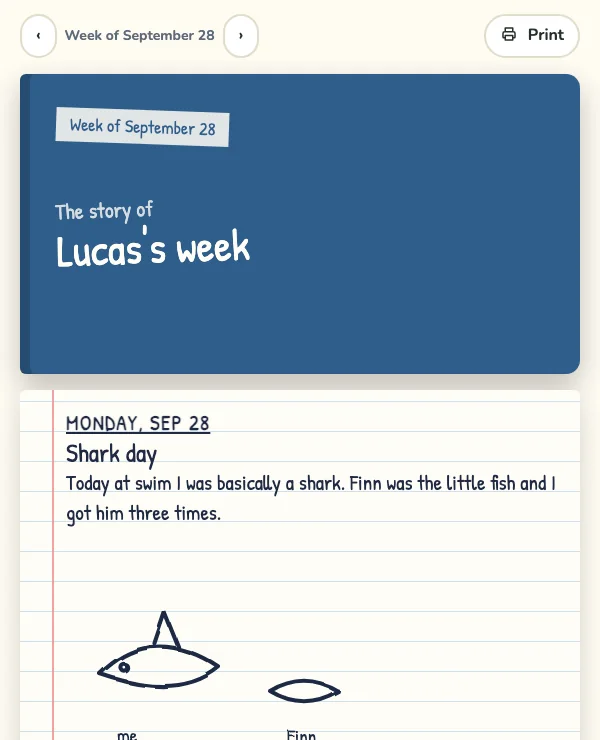
What "you can see what happened" looks like when it is real
Legal compliance and visibility are different things, and the second is the one you will actually use. This is the surface we ship, included so the claim on this page is something you can look at rather than something we assert.
Where these facts come from
Two sources, and they do opposite jobs: one is the rule text that says what you are entitled to be told, the other is a measurement of how often the category gets it wrong. Neither is a judgement about any particular app, and this page names none.
- 16 CFR § 312, COPPA Rule as amended, read 31 October 2026 — Children’s Online Privacy Protection Rule, 16 CFR Part 312 (78 FR 4008, as amended at 90 FR 16977, 22 April 2025) — the operative rule text. § 312.4(a) places "the obligation of the operator to provide notice and obtain verifiable parental consent prior to collecting, using, or disclosing personal information from children", and requires that the notice be "clearly and understandably written, complete, and must contain no unrelated, confusing, or contradictory materials". § 312.4(c)(1) enumerates what the direct notice to a parent must set forth, including "the items of personal information the operator intends to collect from the child, how the operator intends to use such information, and the potential opportunities for the disclosure of personal information"; where information goes to third parties, "the identities or specific categories of such third parties" and "the purposes for such disclosure", and that "the parent can consent to the collection and use of the child’s personal information without consenting to the disclosure of such personal information". § 312.8(c) requires the operator to "obtain written assurances" that such third parties can protect the data. § 312.10 permits retention "for only as long as is reasonably necessary to fulfill the specific purpose(s) for which the information was collected". The operative text of the COPPA Rule, read directly rather than through a summary, because the parent-usable part is the ENUMERATED list in § 312.4(c)(1) and summaries drop it. Cited for what an operator must disclose and for nothing else: it is a legal floor, so it cannot support a claim that any product is safe, well-made, or good for a child. The separate-consent clause in § 312.4(c)(1) is the one this page leans on hardest, and it is quoted in full above so you can check it against the sign-up screen in front of you. What it does not show: The text of a US federal rule, so it establishes what an operator is REQUIRED to disclose and nothing whatever about whether any given product complies. It is a floor, not a quality bar. The parent-facing use of it here is deliberately narrow: it says what an app’s own notice must contain, so a notice missing those items is a signal you can act on tonight. A notice containing all of them is evidence of a compliant disclosure — not of a product that is good for your child.
- Reyes, Wijesekera, Reardon, Elazari Bar On, Razaghpanah, Vallina-Rodriguez & Egelman, 2018 — "Won’t Somebody Think of the Children?" Examining COPPA compliance at scale. Proceedings on Privacy Enhancing Technologies, 2018(3), 63–83. (Automated dynamic analysis of the network behaviour of 5,855 of the most popular free children’s Android apps. "Based on our automated analysis of 5,855 of the most popular free children's apps, we found that a majority are potentially in violation of COPPA, mainly due to their use of third-party SDKs. While many of these SDKs offer configuration options to respect COPPA by disabling tracking and behavioral advertising, our data suggest that a majority of apps either do not make use of these options or incorrectly propagate them across mediation SDKs." Further: "we observed that 19% of children's apps collect identifiers or other personally identifiable information (PII) via SDKs whose terms of service outright prohibit their use in child-directed apps", and of the 3,454 apps sharing Google’s resettable advertising ID, "66% transmit other, non-resettable, persistent identifiers as well, negating any intended privacy-preserving properties of the advertising ID".) Why the store category is not a proxy. Automated network analysis of 5,855 popular free children's Android apps, with the authors' own hedge kept: "potentially in violation" describes observed traffic, not a legal finding. Android-only and from 2018, so it supports no claim about any app today — which is why no product is named here. What it supports is the structural point and the question in step three: third-party kits are the usual route, so they are the thing to ask about. What it does not show: POTENTIALLY in violation is the authors’ own wording and the page keeps it: this is automated observation of network traffic, not a legal finding. It is Android-only, and the measurement is from 2018 — so no individual app can be assumed to behave that way today, and the page names none. What it supports is the structural claim: being listed as a children’s app is uncorrelated with the data behaviour underneath, and the usual cause is third-party code the developer did not write. It does not support a percentage claim about apps in 2026.
Questions parents ask
- How can I tell if an AI app is safe for my child?
- Not from the store category, which has been measured and does not hold — an automated study of 5,855 of the most popular free children's apps found "a majority are potentially in violation of COPPA, mainly due to their use of third-party SDKs". What you can do instead is check the app's own notice against what the COPPA Rule requires it to contain: a specific list of what is collected, the identities or categories of any third parties it goes to, a consent choice about SHARING that is separate from collecting, a retention and deletion answer, and a real consent step aimed at you rather than a birthday box aimed at your child. That is about fifteen minutes, and an app that cannot answer it has told you something useful.
- What does "COPPA compliant" on a website actually mean?
- On its own, it is a claim the company is making about itself. COPPA is a US federal rule — 16 CFR Part 312 — and compliance means, among other things, giving a parent notice and obtaining verifiable consent before collecting a child's personal information, naming the third parties data is disclosed to, and keeping it "for only as long as is reasonably necessary". It is a floor, not a quality mark: a product can be entirely compliant and still be a poor use of your child's afternoon. Treat the badge as a prompt to read the notice, not as a substitute for reading it.
- Why does it matter which third parties an app uses?
- Because that is where the problem has actually been found. The leaks in the 5,855-app study came mostly through third-party kits for advertising, analytics and crash reporting — code the app's own developer did not write. Many of those kits have a setting to turn off tracking for child-directed apps, and the study found most apps either did not use it or "incorrectly propagate" it across intermediaries. The rule also requires an operator to "obtain written assurances" that third parties can protect the data before handing any over. So "which SDKs are in the app, and is behavioural advertising off for child accounts?" is a fair, specific, written question — and the quality of the reply is most of the signal.
- Is a paid app safer than a free one?
- Sometimes, and for a reason worth understanding rather than a rule to rely on. The measured failure route is advertising and analytics code, and an app with no advertising business has less reason to carry it — so paying does change the incentive. But the study looked at free apps and therefore cannot tell you what the paid ones do, and plenty of paid software still ships analytics. Use the same five checks either way. Paying for an app buys you a different incentive, not a different privacy notice.
Run the five checks on us
This page is a method, so the fair thing is for it to apply here too: Luchi asks the parent to create the account and consent before a child uses anything, and the parent-facing weekly note is the record of what actually happened. Open the sign-up flow and look at the consent screen first — that is the check this page says matters most.
Part of the series: Should my kid learn coding or AI?
Related guides in this series
- Coding vs AI for kids: which first? — Not a versus. Why the two are one skill for a school-age kid — and the order that actually makes sense when you sit your child down.
- Will AI replace coding? — AI changes what coding is, not whether your kid should learn it. The durable skill is telling a computer what you want — and how to check it.
- Is coding still worth learning for kids? — Yes — but the skill shifted from syntax to thinking and directing. Exactly what a kid practices when they build with AI.
- What age should kids start with AI? — A practical, age-by-age answer for 5–12s — when AI helps, when to wait, and what “starting” should actually look like.
- Best AI apps for kids, compared — Eight products side by side, every claim quoted from the product’s own site with the capture date — including ours, and including where a cheaper option is the better buy.
- Will using AI make my child lazy or less creative? — Two different questions with two different answers. The measured one is uncomfortable — an unguarded assistant left students about 17% worse off on a later unaided exam — and the creativity evidence points both ways at once.
- Does my child need to learn prompting? — No — the syntax expires every model release. The skill underneath it has thirty years of intervention evidence: asking a precise question, and judging the answer. How to tell which one a course is selling you.