Let it mark the draft, not write it
Writing is the assignment where handing the whole thing over is easiest, and it is also the one where good feedback is hardest to come by — a teacher with thirty essays cannot give any of them twenty minutes. Those two facts point in opposite directions, and the gap between them is where an AI is genuinely useful. The research is clear about what feedback has to be in order to work, which makes it a checklist you can hold an AI’s reply against tonight.
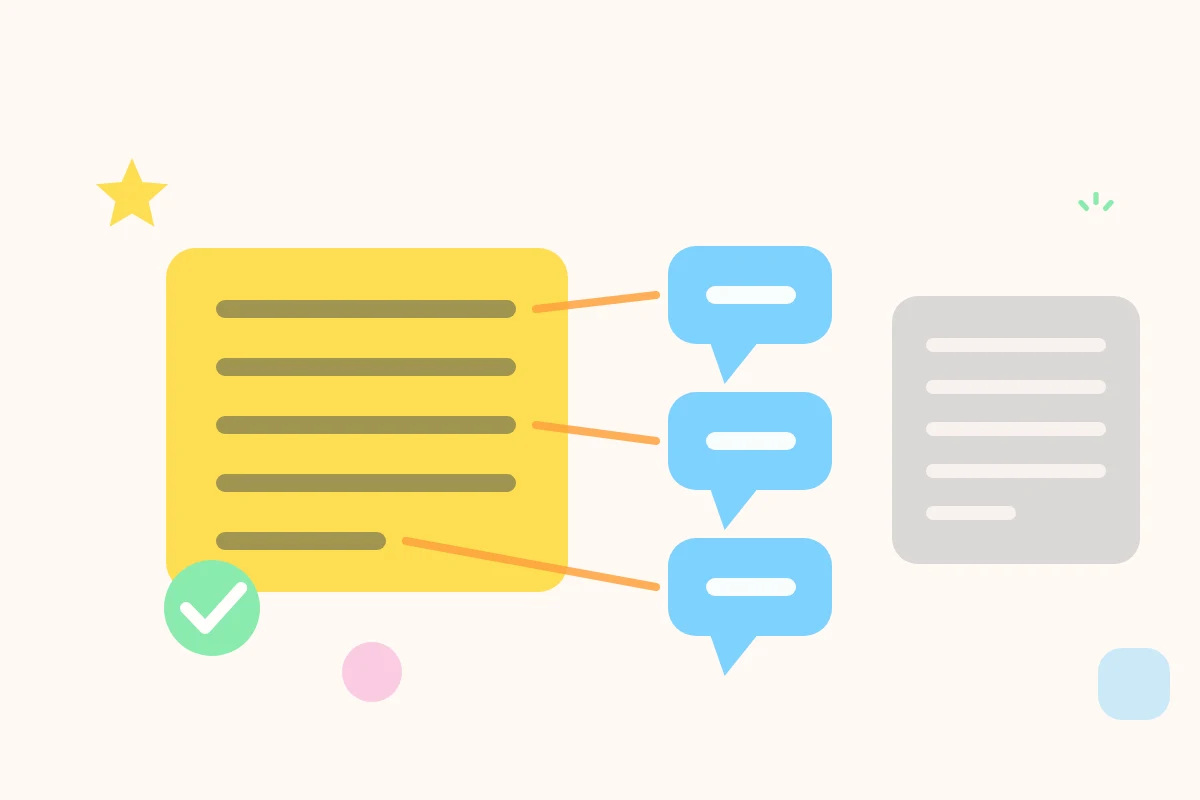
Four properties, and most AI feedback fails three of them
Shute reviewed the research corpus on feedback and defined the useful kind — formative feedback — as "information communicated to the learner that is intended to modify his or her thinking or behavior to improve learning". The review’s summary of what that literature requires is short enough to keep in your head: "According to researchers, formative feedback should be nonevaluative, supportive, timely, and specific."
Now read what a chatbot does with a child’s paragraph by default. "This is a great start! Here is an improved version:" — that is evaluative in the first three words, and then it replaces the work instead of pointing at it. It is timely, and that is one out of four.
So the whole technique on this page is making the AI produce the other three. Not a cleverer prompt: a different request. You are asking it to be specific about this draft, to stop grading, and to not hand back a rewrite — and each of those is a sentence you can type.
The honest caveat, stated once: Shute’s review is from before generative AI and is mostly about school and university learners in instructional settings. It is strong evidence about what properties feedback needs in order to change learning. It is not evidence that a chatbot can supply them. That is the part you have to check yourself, which is why the four words are a checklist rather than a reassurance.
When they want the answer rather than the help · The line between feedback and substitution
The rule, and it is one rule
- 1. A draft exists before the AI is opened Messy, short, bad — it does not matter, and arguing about its quality is a way of not starting. What matters is that something of theirs exists first, because everything below operates on a draft and none of it works on a blank page. If getting to a first draft is the actual problem in your house, that is a different page and a different fix; do not use AI feedback as a solution to it.
- 2. Ask for questions, not improvements "Read my paragraph and ask me three questions about it. Do not rewrite it and do not tell me if it is good." This is the single highest-value sentence on the page. Questions are nonevaluative and specific by construction, they leave the writing in the child’s hands, and teaching children to generate and answer questions about text is one of the better-evidenced comprehension interventions there is — a median effect size of 0.36 even on standardised tests the researchers did not write.
- 3. They answer the questions out loud, to you Not into the chat box. Out loud, to a person. This is the step that does the work and the step everybody drops. Chi and colleagues found that students who learned well "generate many explanations… guided by accurate monitoring of their own understanding and misunderstanding", while those who did not "rely heavily on examples". Answering out loud is that explaining, and it takes four minutes.
- 4. They revise. The AI does not touch the file Then, and only then, the child changes their own draft based on what they just said out loud. The hard boundary is simple enough for a nine-year-old to hold: the AI may ask and may point, and the only person who types into the document is the person whose name is on it. No "polish this", no "fix my grammar" on the whole thing, no accepting a suggested rewrite.
What to type, and the version that quietly does the work for them
Every request on the left keeps the writing with the child. Every one on the right produces something that looks like help and leaves the child with less than they started with.
| Ask for this | Not this | What goes wrong |
|---|---|---|
| "Ask me three questions about my paragraph." | "Give me feedback on my paragraph." | Open-ended feedback comes back as a verdict plus a rewrite — evaluative, and it replaces the work. Questions cannot be answered by the machine, so they stay the child’s problem. |
| "Point at the sentence that is confusing. Do not fix it." | "Make this clearer." | "Make it clearer" returns a different, better sentence that your child did not write and cannot reproduce. Pointing leaves the diagnosis with them and gives them something specific to work on. |
| "Where did I say the same thing twice?" | "Tidy this up." | A tidy-up silently merges fifteen decisions, none of which the child sees. A named problem — repetition — is a thing they can learn to spot next time without help. |
| "Do not tell me if it is good." | Nothing (letting it praise by default) | Praise first is what makes almost all AI feedback evaluative. It also ends the work: a child who has been told it is great has no reason to open the document again. |
| "What would a reader not know yet?" | "Add more detail." | "Add detail" is an instruction to the machine. The reader question is a prompt to the child, and it teaches the one thing that makes writing improve on its own: noticing that what is in your head is not on the page. |
Why the boundary is where it is
This is not a rule about cheating. It is where the evidence puts the line. Bastani and colleagues gave nearly a thousand high-school students an AI assistant for maths practice: the unguarded version raised their practice scores and then LOWERED their later unaided exam scores by about 17%. A hint-giving version, which refused to hand over answers, essentially eliminated that harm.
Read the second half carefully, because it is the part people skip: the guarded arm removed the damage and did not produce a positive exam effect. So the honest claim is not that AI feedback makes children better writers. It is that there is a shape of AI help which does not quietly cost them something, and a shape which does, and the difference is whether the machine produces the finished thing. It is high-school maths in Turkey rather than primary-school writing, so the transfer is the mechanism, not the number.
There is a second reason specific to writing. Doshi and Hauser had writers produce short stories with and without ideas from a language model and found that access to AI ideas "causes stories to be evaluated as more creative, better written, and more enjoyable, especially among less creative writers" — and in the same breath that AI-assisted stories "are more similar to each other than stories by humans alone". Individually better, collectively more alike.
That finding points both ways and this page cites it in both directions. It does not support "AI kills creativity" — the individual stories were judged better. It also does not support handing a child a machine that supplies the ideas, because the thing being homogenised is precisely the thing a nine-year-old is supposed to be developing. Adults in one online experiment, judged by raters, and the homogenisation is measured across a population rather than inside one writer. The practical reading is narrow and holds anyway: let it ask about their ideas, not supply them.
The question-asking skill this depends on · If a teacher has already raised it
Two things to tell the teacher, and one to tell your child
Say it before it becomes a conversation you are having defensively. One sentence at the next check-in — "he drafts it himself, then uses AI to ask him questions about it, and he does the rewriting" — does more than any policy document, because it describes a practice a teacher can recognise and, crucially, can see the evidence of in the work. Ask what they would prefer, and do that instead if it differs; a teacher who has been consulted about a method rarely objects to it later.
The second thing is the artefact. Keep the draft before and the draft after, for the first few weeks. It takes one extra file and it is the only thing that settles an accusation quickly — a before-and-after pair in the child’s own voice is nearly impossible to fake and immediately legible. Detectors are not reliable enough to be the thing you rest on.
And for your child, one sentence, said once and not as a warning: the machine can tell you what a reader will not understand, and it cannot tell you what you meant. That is the whole division of labour, it is true, and it is the reason the typing stays theirs.
What it looks like with the explaining built in
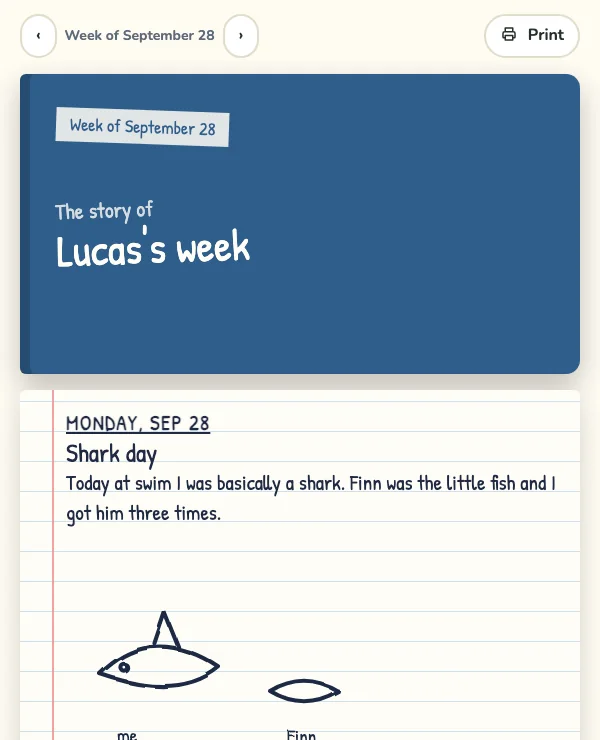
Step three — the child answering out loud — is the one that gets dropped, because it needs a parent in the room at the right moment. That is the part worth building into the tool.
The research under this page
Four sources: what feedback has to be, why the child has to do the explaining, what happens when the machine produces the finished thing, and the specific risk to writing.
- Shute, 2008 — Focus on formative feedback. Review of Educational Research, 78(1), 153–189. (A review of the research corpus on feedback, defining formative feedback as "information communicated to the learner that is intended to modify his or her thinking or behavior to improve learning". Its summary of what that literature requires: "According to researchers, formative feedback should be nonevaluative, supportive, timely, and specific." It catalogues the types — "verification of response accuracy, explanation of the correct answer, hints, worked examples" — and notes that several learner and task variables "interact with formative feedback’s success at promoting learning".) The four-word checklist the page is built on — nonevaluative, supportive, timely, specific. A review of feedback research from before generative AI, mostly instructional settings: evidence about what feedback needs to be, and explicitly not evidence that a chatbot supplies it. That gap is why the page asks a parent to check the reply against the four words rather than trusting the tool. What it does not show: A review of feedback research from before generative AI existed, mostly on school and university learners in instructional settings. It is evidence about what properties feedback needs in order to change learning, and it is NOT evidence that a chatbot can supply them — the page citing it has to make that case separately, which is why the four properties are used as a checklist a parent applies to the output rather than as a claim about the tool.
- Chi, Bassok, Lewis, Reimann & Glaser, 1989 — Self-explanations: how students study and use examples in learning to solve problems. Cognitive Science, 13(2), 145–182. (Talk-aloud protocols from students studying worked examples of mechanics problems. "We find that 'Good' students learn with understanding: They generate many explanations which refine and expand the conditions for the action parts of the example solutions, and relate these actions to principles in the text. These self-explanations are guided by accurate monitoring of their own understanding and misunderstanding." The contrast is the finding that matters here: "'Poor' students do not generate sufficient self-explanations, monitor their learning inaccurately, and subsequently rely heavily on examples.") Why step three is answered out loud to a person rather than typed back into the chat: good learners generated many self-explanations and monitored their own understanding; poor ones did not and leaned on the worked examples. Correlational, university students, physics problems — the mechanism transfers, the magnitudes do not. What it does not show: A small protocol study of university students on physics problems, and correlational in its design — good and poor students differed in how much they explained to themselves, which is not the same as showing that making someone explain causes the gain. Cited for the mechanism and for the direction of the dependence (poor explainers leaned on the worked example), never as an effect size, and never as a measurement about children.
- Bastani, Bastani, Sungu, Ge, Kabakcı & Mariman, 2024 — Generative AI without guardrails can harm learning: evidence from high school mathematics. (Nearly 1,000 students; an unguarded GPT-4 assistant raised practice scores but LOWERED later unaided exam scores by about 17%, an effect essentially eliminated by a hint-giving tutor version.) Where the no-typing boundary comes from: an unguarded assistant raised practice scores and lowered later unaided exam scores by about 17%, and a hint-only version removed the harm. Cited with its own caveat — the guarded arm showed no positive exam effect either, so this is evidence for a shape of help that does not cost the child something, not evidence that AI feedback raises attainment. High-school maths in Turkey, not primary writing. What it does not show: High-school maths in Turkey, not elementary school, and the "guardrails" arm showed no POSITIVE exam effect either — it removed the harm. Anyone citing this as proof that AI tutoring raises attainment is citing the opposite of what it found.
- Doshi & Hauser, 2024 — Generative AI enhances individual creativity but reduces the collective diversity of novel content. Science Advances, 10(28), eadn5290. (An online experiment in which some writers received story ideas from a large language model. "Access to generative AI ideas causes stories to be evaluated as more creative, better written, and more enjoyable, especially among less creative writers. However, generative AI–enabled stories are more similar to each other than stories by humans alone… With generative AI, writers are individually better off, but collectively a narrower scope of novel content is produced.") The risk specific to writing, cited in both directions: AI story ideas made individual stories be judged more creative and better written, AND made the stories more similar to each other. Adults in one online experiment; the homogenisation is across a population, not inside one child. It is why the rule is let it ask about their ideas, not supply them. What it does not show: Adults writing short stories in one online experiment, judged by raters. CITED IN BOTH DIRECTIONS, because it points both ways: it does not support "AI kills creativity", and it does not support "AI makes your child more creative" either. The homogenisation it measures is across a population, not inside one child.
Questions parents ask
- Can AI give my child feedback on their writing without doing it for them?
- Yes, but only if you change what you ask for. "Give me feedback" reliably returns a verdict plus a rewrite, which fails three of the four properties the feedback research says matter — it should be nonevaluative, supportive, timely and specific. Ask instead for questions: "read my paragraph and ask me three questions about it, do not rewrite it and do not tell me if it is good." Questions are specific and nonevaluative by construction, and they cannot be answered by the machine, so the writing stays with your child.
- Is this cheating?
- Not under any school policy we have seen, provided the child drafts it and does the rewriting — which is also where the evidence puts the line, independently of the rules. In a study of nearly a thousand students, an unguarded AI assistant raised practice scores and then lowered later unaided exam scores by about 17%, while a version that only gave hints removed that harm. The useful boundary is therefore simple enough for a nine-year-old: the AI may ask and may point, and the only person who types into the document is the person whose name is on it. Tell the teacher you are doing this, in one sentence, before anyone asks.
- What exactly should I tell it not to do?
- Three things, and they are all one line each. Do not rewrite it. Do not tell me if it is good. Point at the problem instead of fixing it. The first keeps the words the child’s, the second removes the praise that makes almost all AI feedback evaluative and also ends the work — a child told it is great has no reason to reopen the file — and the third leaves the diagnosis with them, which is the thing that makes the next draft better without help.
- My child just wants it to fix the grammar. Is that so bad?
- It is the least harmful request on the list and still worth narrowing. "Fix my grammar" silently makes dozens of changes the child never sees, so nothing is learned and the voice drifts; "find the three sentences with a grammar problem and tell me what kind" costs the same thirty seconds and leaves them able to spot it next time. Keep the before and after drafts for the first few weeks either way — a before-and-after pair in your child’s own voice is the fastest way to settle a question about authorship, and AI-text detectors are not reliable enough to lean on.
Asks, then listens
The move this page is built on — ask the child a question rather than hand them an answer — is how Luchi works by default. A kid builds something, Luchi asks what they were going for and why it works, and you get a short weekly note written from what they actually said.
Part of the series: How to end the daily homework battle
Related guides in this series
- Teaching kids to start homework without reminders — Independence is a prompt you remove on purpose, not a trait you wait for. A five-rung ladder from "you say it daily" to "you only ask afterwards", with how long each rung takes.
- Seven practical homework focus strategies — Seven things that help once they have started, in the order worth trying them — plus an honest table of which rest on solid evidence and which do not.
- What parents should know about AI homework helpers — Unguarded AI help measurably lowered later unaided test scores; guardrails removed the harm. What is known, what is not, and five questions to ask any product.
- AI homework help for kids — Where the line sits between help and doing it for them, subject by subject — plus a five-step routine for one hard question and five questions to ask any homework product.
- Is my kid cheating with AI? — Why AI detectors are not reliable enough to accuse a child on, the ninety-second check that is, and what to do about each of the four things you are likely to find.
- The after-school hour, without the nagging — The fight is about the forty minutes before homework. A five-block plan, the four traps that turn a routine back into nagging, and the research that makes it work.
- Is your child actually learning from AI? — Fluent output is not learning. The three signs of real learning, the three signs the tool did the thinking, and a five-point checklist a parent can run on any AI app tonight.
- Your child has been accused of using AI — The detectors are published as unreliable by the people who test them. What to do in the first hour, what to ask the school, and what it calls for in each of the four things it might actually be.
- When reading is hard: what AI helps with, and what it hides — One sentence from a child can mean three different problems, and they want opposite responses. A ten-minute check that tells you which, what read-aloud support actually measures, and the dull thing with the best evidence.
- My child just asks the AI for the answer — Not laziness — a help-seeking failure documented in tutoring software twenty years before chatbots. The one change with a measured effect, and the commit-first rule you can start tonight.
- A science fair project with AI, without the AI doing it — Teacher-led science beat student-led by about .40 in effect size across 37 studies — so hands-off and hand-it-over fail the same way. Which two of six parts a chatbot helps with, and the four questions that prove the project is theirs.
- Studying for a test: what goes on tonight’s list — Eleven topics, three evenings. Asking what they feel shaky about is the one input that has been measured and found uncorrelated with what they actually know — so sort it in eight minutes instead, and do not cross anything off after one right answer.