How to teach a kid to write a good AI prompt
The lists of fifty copy-and-paste prompts are the wrong thing to hand a child, because the child who pastes one has practised nothing. The skill underneath is asking a good question, which classrooms were teaching and measuring long before chatbots existed. And the single most valuable rewrite of any prompt your child types has nothing to do with wording — it is asking for a hint instead of an answer, which is the one change with a number behind it.
Why a list of prompts is the wrong gift
A prompt list looks like exactly what a parent needs, and it fails for a boring reason: the thing you want your child to be able to do is produce the question, and a list does that part for them. It is the difference between handing someone a sentence in French and teaching them to make sentences. The first works once, in one situation, and transfers nowhere.
This is not a hunch about prompting. It is one of the better-studied moves in reading instruction, from well before anyone could type at a machine. Rosenshine, Meister and Chapman reviewed the intervention studies in which students were explicitly taught to generate their own questions about what they had read, and found that "teaching students the cognitive strategy of generating questions about the material they had read resulted in gains in comprehension" — and, importantly for a parent, that "all tests were based on new material". The gain showed up on things the children had not been coached on.
Two honest notes, because these numbers are usually quoted badly. The review reports a median effect size of 0.36 when the test was a standardised one somebody else wrote, and 0.86 when it was built for the study; the smaller figure is the one to carry around. And none of this is a study of prompting — it is evidence that the underlying skill is teachable and pays off somewhere other than where you taught it. That is enough to spend an evening on the skill rather than on a list.
A good prompt is three decisions, not magic words
Ask a child what they want to make and you will get "a game". That single word is the whole problem, and it is also the whole opportunity, because the fix is not vocabulary — it is being made to decide three things instead of one.
What kind of thing should it be. Who is it for. And one rule that makes it fun or hard. Those three answers turn a wish into something somebody could actually build, and the useful discovery for a child is that the third one does most of the work: changing the rule changes the result far more than changing the subject does. That is a real insight about how instructions behave, and it is available in about ninety seconds.
Notice what is absent. No role-play preamble, no "act as an expert", none of the incantations prompt-engineering posts are made of. For a child the leverage is entirely in specificity and constraint — and those work on a sibling or a block editor just as well as on a model.
Build one, three taps at a time
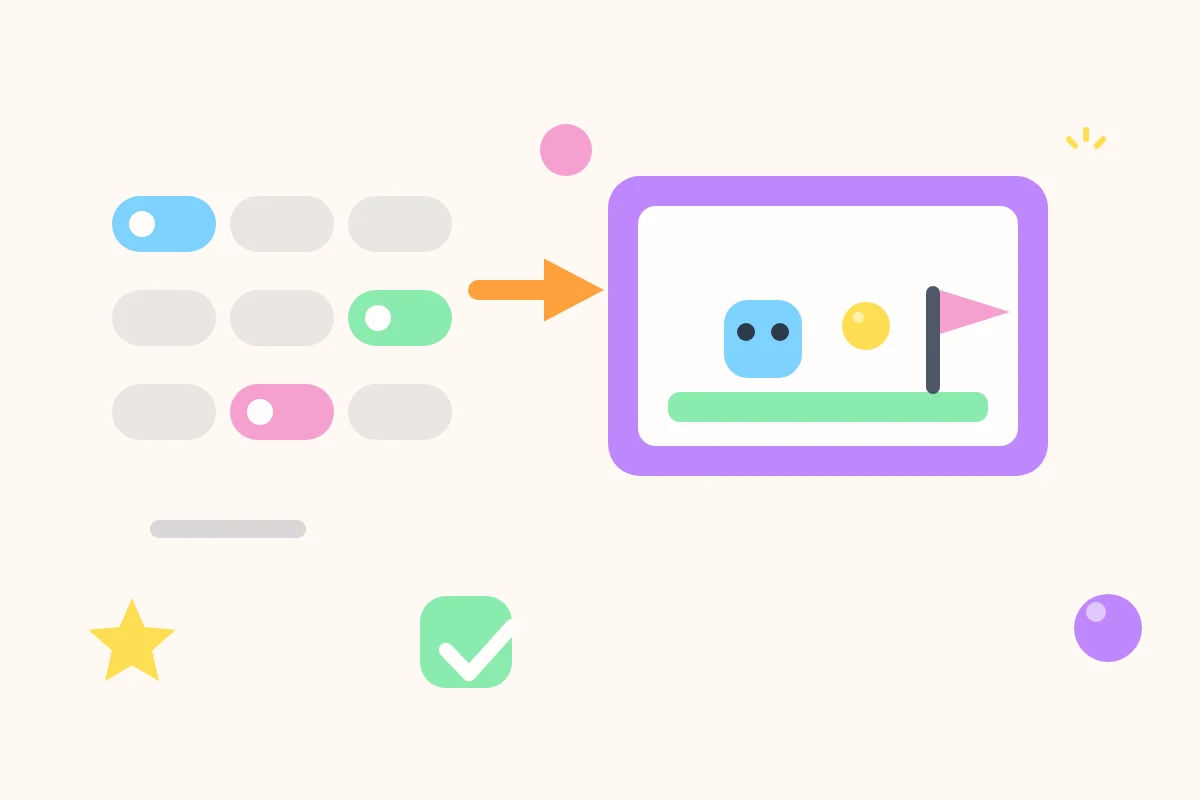
The three decisions above are easier to feel than to read about, so here they are as something to do. Pick what kind of thing to make, who it is for, and one rule that makes it fun — the three choices assemble the sentence and change the example on the screen.
Do this with your child rather than for them, and change one row at a time. The thing worth saying out loud is what happens when you leave the first two rows alone and only swap the rule: the result changes more than it did when you swapped who it was for. A child who notices that has learned the actual lesson of this page, which is that constraints carry more information than subjects do.
The exercise above is a set of taps, not a text box: pick one option from each of the three rows and the page assembles the prompt sentence for you, then plays the matching example. All of those examples were built in advance by the Luchi team and are stored on this page — nothing you tap generates anything new, and this page never calls an AI.
They are deliberately the size of a first project rather than a showcase: one screen, one goal, one way to lose. That is the scope a child can describe completely — and describing a thing completely is the skill this page is about.
Four rewrites worth more than any prompt list
- “Give me a hint, not the answer.” — The highest-value sentence on this page, and the only one with a measurement attached. It changes what the tool is for — from a thing that finishes your work to a thing that unsticks you — and a child can apply it to any question in any subject without being taught anything else.
- “Ask me a question first.” — This makes the child commit to their own thinking before the machine offers any, which is the mechanism in the research below. It also turns a one-way answer into something nearer a conversation, and children notice the difference in how much they remember afterwards.
- “Here is what I already tried.” — Worth teaching because it is honest and because it works. It forces the child to articulate their own attempt — which is the valuable cognitive act — and it also happens to get a more useful reply, so the incentive and the learning point line up for once.
- “Make it for my little sister.” — Naming a real audience is the fastest way to raise the quality of anything a child asks for, and it is the row in the exercise above that children find most fun. Pitching to a specific person is a skill the school will keep asking for in writing lessons for the next decade.
The one rewrite with a number behind it
Of everything on this page, the hint request is the one that is not a matter of taste. Bastani and colleagues gave nearly a thousand high-school students access to a GPT-4 assistant while they practised maths. The unguarded version raised their practice scores and then lowered their later unaided exam scores by about 17% — and a hint-giving version of the same tool essentially eliminated that harm.
Read the second half carefully, because it is routinely misquoted in both directions. The guardrailed arm did not raise exam scores; it removed the damage. The honest claim is narrow and still useful: the kind of help changes the outcome, and the lever is whether the tool answers or hints. This was high-school maths in Turkey, so what transfers is the direction and the mechanism, not the percentage.
Why it works is older than AI. Buçinca, Malaya and Gajos found that people "overrely on the AI: they accept an AI’s suggestion even when that suggestion is wrong", and that adding explanations "does not appear to reduce the overreliance". What did reduce it was cognitive forcing — making the person commit to their own answer before seeing the machine’s. Their inconvenient second finding is the one worth knowing in advance: "people assigned the least favorable subjective ratings to the designs that reduced the overreliance the most". The version that works is the version your child will complain about, and that is a reason to expect the complaint rather than to change course.
What to do with the answer once it arrives · Where this sits in the wider roadmap
Twenty minutes tonight
- 1. Make them say it three ways Ask what they want to make and accept the one-word answer first — "a game", "a story". Then ask the three questions: what kind of thing, who it is for, one rule that makes it fun. Write the final sentence down where they can see it. The point is not the sentence; it is them watching a vague want become buildable in three questions.
- 2. Change exactly one row and see what happens Keep the sentence and swap only the rule. Then put the rule back and swap only the audience. Ask which change mattered more. Almost every child says the rule, and almost every child is surprised by it — that is the lesson about instructions landing without being told, and it is far stickier than being told.
- 3. Teach the hint sentence and then shut up about it Give them one sentence to keep: give me a hint, not the answer. Use it yourself in front of them on something you are genuinely stuck on — worth more than any amount of instruction. Then let it be, and expect them to find it annoying: the research says the effective version is the unpopular one, and a habit you nag about is one they drop the moment you stop watching.
How you find out whether it stuck
The test of this is whether your child asks for a hint when nobody is watching, which is not something a score can tell you. You need to hear the questions they actually asked.
The research under this page
Three sources. The first is why this page teaches a skill instead of handing over a list; the other two are why one specific rewrite is worth more than the rest of the page put together.
- Rosenshine, Meister & Chapman, 1996 — Teaching students to generate questions: a review of the intervention studies. Review of Educational Research, 66(2), 181–221. (A review of intervention studies in which students were taught to generate their own questions about material they had read. "Overall, teaching students the cognitive strategy of generating questions about the material they had read resulted in gains in comprehension, as measured by tests given at the end of the intervention. All tests were based on new material. The overall median effect size was 0.36 (64th percentile) when standardized tests were used and 0.86 (81st percentile) when experimenter-developed comprehension tests were used.") The basis for the whole approach: children can be taught to generate their own questions, and the gains showed up on new material. Both effect sizes are quoted in the reference, because the smaller one is the honest guide. What it does not show: Question-generation about READING passages, in classrooms, long before chatbots existed — so it is evidence that the underlying skill is teachable and worth teaching, not a measurement of anybody prompting an AI. The two effect sizes are both quoted deliberately: the figure more than halves when the test is a standardised one somebody else wrote rather than one built for the study, and the smaller number is the more honest guide to what transfers.
- Bastani, Bastani, Sungu, Ge, Kabakcı & Mariman, 2024 — Generative AI without guardrails can harm learning: evidence from high school mathematics. (Nearly 1,000 students; an unguarded GPT-4 assistant raised practice scores but LOWERED later unaided exam scores by about 17%, an effect essentially eliminated by a hint-giving tutor version.) The measured difference between a tool that answers and a tool that hints. Cited with its ceiling attached — the guardrailed version removed the harm rather than producing a gain. What it does not show: High-school maths in Turkey, not elementary school, and the "guardrails" arm showed no POSITIVE exam effect either — it removed the harm. Anyone citing this as proof that AI tutoring raises attainment is citing the opposite of what it found.
- Buçinca, Malaya & Gajos, 2021 — To trust or to think: cognitive forcing interventions can reduce overreliance on AI in AI-assisted decision-making. Proceedings of the ACM on Human-Computer Interaction, 5(CSCW1), 1–21. (N = 199. "People supported by AI-powered decision support tools frequently overrely on the AI: they accept an AI’s suggestion even when that suggestion is wrong", and adding explanations "does not appear to reduce the overreliance". Cognitive forcing — making the person commit to their own answer before they see the AI’s — "significantly reduced overreliance compared to the simple explainable AI approaches". The trade-off: "people assigned the least favorable subjective ratings to the designs that reduced the overreliance the most".) The mechanism behind "ask me a question first", and the trade-off a parent should expect: the design that cut overreliance most was the one people rated worst. What it does not show: Adults in a controlled study on a decision task, not children on homework. Cited for the mechanism and for its uncomfortable trade-off — the intervention that worked best was the one people liked least — and never as a measured effect on a child.
Questions parents ask
- What is the best prompt for kids to use?
- The most useful one is "give me a hint, not the answer", and it is the only one here with a measurement behind it — an unguarded assistant lowered students’ later unaided exam scores by about 17%, while a hint-giving version removed that effect. Beyond that, a good prompt names three things rather than one: what kind of thing, who it is for, and one rule. There is no magic phrasing.
- Should I teach my child prompt engineering?
- Not as a subject, no. The specific tricks turn over every few months and most were never load-bearing. What is worth teaching is the durable part — being specific, naming an audience, adding one constraint, saying what you already tried — because that will outlast whatever the current tools are.
- My child just copies prompts off a list. Is that bad?
- It is not harmful, it is just not practice. The skill you want is producing the question, and a list does that part for them — which is why the research this page rests on is about teaching children to generate their own questions, and why those gains appeared on material the children had never been coached on. Use a list as a worked example if it helps, then make them write the next one.
- Is it cheating if the AI helps them write the prompt?
- No, and that one is usually worth saying out loud, because children ask it anxiously. Asking a tool to help you ask a better question is a reasonable thing to do and does not remove the thinking. The line that matters is not where the help came from but whether your child could explain what they asked for and why — and that is the thing to check rather than the thing to police.
A tool that asks before it answers
The hint-first habit is hard to practise with a general assistant, because answering instantly is what it is for. Luchi is built the other way round: it asks a kid what they think first, makes them explain what they made, and writes you a short note in their own words — so you can hear the questions they are asking rather than take our word for it.
Part of the series: Teaching kids about AI
Related guides in this series
- How to explain AI to a child — Simple analogies and sample scripts by age (5–12), plus the three things every kid should understand about AI.
- AI activities for kids — 10 free, screen-smart activities to explore how AI works together — no coding, no sign-up, mostly off the screen.
- Fall break activities for kids — A half-day-by-half-day plan for five unstructured days — ten low-prep blocks, screen and off-screen alternating, ending with your child explaining what they made.
- AI tools for kids — A parent’s shortlist of genuinely kid-appropriate AI tools — what to look for, what to avoid, and how to tell a real kid tool from a repackaged chatbot.
- AI tools that teach kids to think, not just get answers — The one testable property that separates a thinking tool from a vending machine, what happened when someone measured the difference, and the ten-minute test you can run tonight on whatever your child already uses.
- How do I know if what the AI told my kid is true? — The research says the move is to leave the answer, not to stare at it harder — and that the technique which works best is the one people like least. Four ways it goes wrong, and the check that catches each.
- Winter break projects a kid actually finishes — Six get started and none get finished, and that is a scoping problem rather than an attention one. Five projects with a finish line you can see, the three sessions that get one done, and why none of it is catch-up work.
- Is it cheating if my child makes art with AI? — Two questions in one coat: a rules question with a clear answer, and an effects question where the best study points both ways — individually better, collectively more similar. What to say, and the three situations that differ.
- The five-minute quiz that beats re-reading — Re-reading raised students’ confidence; being tested raised what they still knew a week later. The four instructions that make an AI run the tested version, and when to come back to it.