Is Siri the kind of AI parents worry about?
The worry that attaches to AI is a chatbot worry: it makes things up, it answers anything, a child can tell it secrets. Siri has been in the house for years and never felt like that. Both instincts are right — because Apple has quietly split Siri in two. How to tell which one your child is talking to, what each does with what they say, and the settings worth changing tonight.
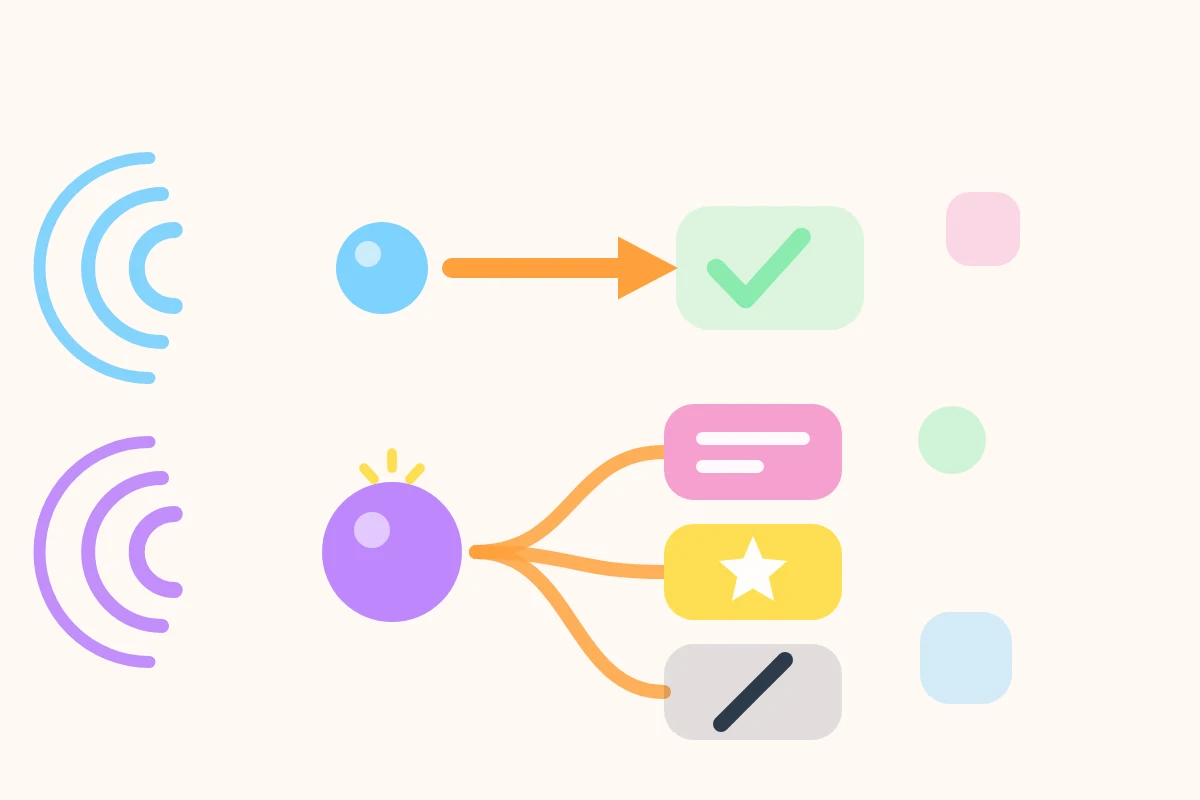
Apple has split Siri into two things, and only one of them is the thing you are worried about
The useful fact here is one almost nobody writing about this has picked up, and it comes from Apple rather than from a review site. Read on 31 October 2026, Apple’s own support page for the current release says plainly: "Apple Intelligence also powers an entirely new version of Siri: Siri AI." It is distributed as a beta, on a specific list of recent devices, and it is not the same software as the Siri that has been setting your kitchen timers since 2015.
That sentence resolves most of the confusion. Classic Siri is, in effect, a command parser: it matches a request to an action and does the action, and hands you a web search for anything outside that set. It does not compose, reason aloud, or sustain a conversation — which is exactly why it never felt like the AI in the headlines. Siri AI is a generative system of the kind those headlines are about, and the same page lists a "ChatGPT extension" among the features Apple Intelligence ships.
So "is Siri AI" has two honest answers, and which one applies depends on the device in your child’s hand. On an older iPhone or iPad, or a newer one not upgraded, they are talking to something closer to a voice-operated remote control. With Apple Intelligence on, some of what they say reaches a generative model and some can be handed to OpenAI. Different risk profiles, different rules — so the first step below is finding out which you have.
What the chatbot worry actually is, by age · The same split, on the Google side
What each one does with what your child says
Apple publishes this, and it is more specific than most coverage of it. All three rows are quoted from Apple’s own documentation, read 31 October 2026; the right-hand column is the part that changes what you would do about it.
| The question | What Apple says | What that means for a child |
|---|---|---|
| Is the audio of my child’s voice kept? | "Your audio data is not stored by Apple unless you opt in to Improve Siri and Dictation or Improve Siri & Apple Intelligence." Opting in is the switch that changes it: Apple then "will collect, store, and review additional data, including audio and text of what you say to Siri, Dictation, and Translate, as well as your conversation history with Siri if you use the Siri app". | Off by default, and the opt-in is genuinely broad — audio, text and conversation history, reviewed. That makes this the one setting worth opening rather than assuming, and it is a decision rather than a default you have to accept. |
| For how long, and attached to what? | Apple still stores data related to the request — its category, whether it succeeded, device specifications, and approximate location if Location Services is on for Siri. That history is "associated with a random, device-generated identifier that rotates multiple times per hour and is not tied to your Apple Account or email address", and Apple "may retain and use this data for up to two years". | Better than most of what a child uses: not joined to their name, and Apple states it "is not used to build a marketing profile, and is never sold to anyone". Two years is still two years, so this is a reason to decide about the toggle rather than to relax. |
| What about when Siri hands off to something else? | Apple is explicit: "When Siri interacts with a third-party app or service on your behalf, you are subject to that app or service’s terms and conditions and privacy policy." | This is the sentence that matters most now that a ChatGPT extension exists. Apple’s commitments stop at Apple’s border. Anything handed onward is governed by somebody else’s policy, and your child cannot hear the handover happen. |
What the research says children think they are talking to — including the part that surprises parents
The instinct behind the question is usually social: a parent pictures a child confiding in a device. The measured picture is more specific than that, and more useful. Girouard-Hallam and Danovitch tested children aged 4–5 and 7–8 against both a voice assistant and a human informant, and found that "with increasing age, children showed greater trust in the voice assistant for factual information and greater trust in the human for personal information". In a second study the same split showed up in what children chose to do: older children increasingly preferred to ask the device for facts and a person for personal things.
Read that carefully, because it cuts against the headline worry and replaces it with a sharper one. By seven or eight, children are not confusing the device for a friend — they are sorting it correctly as a thing you ask facts of. So the risk is not that your nine-year-old tells Siri their secrets. It is that they treat whatever it says as true, at precisely the age when the software behind the name has been swapped for one that generates fluent answers rather than looking them up. The same study found that endorsing an informant’s statements predicted what children recalled later, so a confidently wrong answer does not just pass by.
One null result in the same work kills a comfortable assumption: children’s preferences "were not related to… the presence of a voice assistant in children's homes". Not owning a smart speaker does not inoculate a child. Earlier work by Druga and colleagues, watching twenty-six children aged 3–10 play with these devices, found them actively forming theories about how clever the thing was relative to themselves — the beliefs form from the interaction, not from ownership.
The honest limits: both studies are small, the trust study used a novel assistant in a lab with children "from predominately White, upper middle-class families", and the Druga work is from 2017 on far less capable hardware. Neither measures Siri. They are good evidence about what children do with a talking box, and none about what any particular product says back.
Four things to do tonight, in order
- 1. Find out which Siri is on the device Open Settings and look for Apple Intelligence. Absent or switched off means your child is talking to the old command-parser Siri, and the chatbot worry mostly does not apply. On means they have the generative one, and the rest of this list matters more. Apple ships Siri AI as a beta on recent hardware, so the answer genuinely differs device to device in the same house.
- 2. Decide the Improve Siri toggle deliberately This is the single setting that changes what is kept. Left alone, Apple states your audio "is not stored by Apple"; opting in means Apple "will collect, store, and review additional data, including audio and text of what you say", plus conversation history. There is no wrong answer, but there is a wrong way to arrive at it, which is never having looked: Settings, then Privacy & Security, then Analytics & Improvements.
- 3. If Apple Intelligence is on, decide about the ChatGPT extension separately It is its own switch — Apple’s privacy page has a section beginning "when you choose to enable the ChatGPT extension in Siri" — and it is where Apple’s own commitments stop applying, because a hand-off to a third party puts you under that party’s terms. At this age the reasonable default is off: an open-ended assistant that answers anything is a different proposition from a timer, and the handover is not audible to the child.
- 4. Drill the one habit that outlasts every setting: how do you know? Pick one thing Siri says this week and check it together, out loud, without making it a test. It is the only defence against a confident wrong answer that still works on somebody else’s phone — and the research above says it is needed earlier than it feels: by seven or eight they already trust the device more than a person for facts.
The control you are looking for does not exist, and it is worth naming
Apple’s parental controls are real and worth setting up — Ask to Buy and Ask to Browse are on by default for children under 13, and you can allow or block apps and websites per child from your own device. Siri has its own switch inside them, at Settings, then Screen Time, then Content & Privacy Restrictions, then Other Features, then Siri. So the on-off control is better than most parents realise.
What none of them do is tell you what your child actually asked. The only control is all-or-nothing, and the information you probably wanted is on neither side of it. That is the same shape on every general-purpose assistant: a switch and a list of permissions, and nothing about the substance. If what you want is to know what your child is doing with AI — what they asked, what they made of the answer, whether they thought about it at all — that is a reason to choose something built with a parent side, not something you can extract from a voice assistant by configuring it harder.
AI apps that have a parent side at all · Four one-minute checks that tell you more than a setting
The sources under this page
Three Apple pages quoted directly and dated, and two studies of children with voice assistants. The vendor pages are the strongest source for what Apple commits to and the weakest for what the product does — which is why each carries its read date, and why this page is on a weekly re-read.
- Apple Support, next-generation Apple Intelligence, published 22 October 2026, read 31 October 2026 — Get started with the next generation of Apple Intelligence. (Apple’s own feature and availability page. It states that "Apple Intelligence also powers an entirely new version of Siri: Siri AI", distributed as a beta, and lists a "ChatGPT extension" among Apple Intelligence features, noting that "Integration with ChatGPT is available only in regions where the ChatGPT app and service is available.") The load-bearing fact of the first section: Apple’s statement that Apple Intelligence "powers an entirely new version of Siri: Siri AI", plus the ChatGPT extension in the feature list. Published 22 October 2026, read 31 October 2026. An availability page, so it establishes that the split exists and nothing about how either half behaves with a child. What it does not show: An availability matrix, not a safety assessment. It establishes that Apple now ships two different things under the Siri name and that a ChatGPT hand-off exists; it says nothing about how either behaves with a child, and the feature list changes with each release.
- Apple, Siri, Dictation & Privacy, read 31 October 2026 — Siri, Dictation & Privacy. (Apple’s own legal disclosure for Siri. It states that "Your audio data is not stored by Apple unless you opt in to Improve Siri and Dictation or Improve Siri & Apple Intelligence", and that opting in means Apple "will collect, store, and review additional data, including audio and text of what you say to Siri, Dictation, and Translate, as well as your conversation history with Siri if you use the Siri app"; that request history is "associated with a random, device-generated identifier that rotates multiple times per hour and is not tied to your Apple Account or email address", which Apple "may retain and use… for up to two years"; that this data "is not used to build a marketing profile, and is never sold to anyone"; that for Siri AI a request "may be processed on your device or sent to Private Cloud Compute", where "the data being processed… is not stored or made accessible to Apple"; and that "when Siri interacts with a third-party app or service on your behalf, you are subject to that app or service’s terms and conditions and privacy policy". It gives two switches: Settings > Siri > Turn Off Siri, and a Screen Time restriction at Settings > Screen Time > Content & Privacy Restrictions > Other Features > Siri.) Every quote in the table: audio not stored unless you opt in, what opting in then collects, a rotating identifier not tied to the Apple Account, up to two years, no marketing profile, and the third-party hand-off clause. Read 31 October 2026 — and Apple rewrote this page around Siri AI and Private Cloud Compute during the day it was first cited here, which is the clearest possible argument for the weekly re-read. What it does not show: A vendor’s own disclosure, so it is strong evidence about what Apple commits to and no evidence about what any third-party app does with the same request — Apple says so itself. It is also genuinely volatile: this page was rewritten around Siri AI and Private Cloud Compute DURING the session that first cited it on 2026-10-31, which is why the guide quoting it is on a weekly re-read.
- Apple Support, parental controls, read 31 October 2026 — Set up parental controls to manage your child’s iPhone or iPad. (Apple’s own Screen Time guidance for parents: Ask to Buy and Ask to Browse "are on by default for children under 13", Limit Adult Websites is on by default under 18, and apps and websites are allowed or blocked per child from the Family Sharing organiser’s own device. It also notes that depending "on your state, country, or region, and your child's age, some parental controls are on by default and can't be removed".) Used for the last section — what Screen Time covers (Ask to Buy and Ask to Browse on by default under 13, per-child app and website blocking) in order to be precise about what it does not: anything your child actually said. What it does not show: Describes the controls that exist, not their effect. Nothing on this page reports what a child actually asked a voice assistant, which is the gap the guide citing it is about.
- Girouard-Hallam & Danovitch, 2022 — Children’s trust in and learning from voice assistants. Developmental Psychology, 58(4), 646–661. (Two studies with children aged 4–5 and 7–8. "With increasing age, children showed greater trust in the voice assistant for factual information and greater trust in the human for personal information"; in a second study, "with increasing age, children showed an increasing preference to seek factual information from the voice assistant and an increasing preference to seek personal information from the human". Endorsement of an informant’s statements also predicted later recall.) The age split between factual and personal trust, and that endorsement predicted later recall. Cited for its null too: preferences were unrelated to whether the child had a voice assistant at home, so this page does not claim owning one causes anything. What it does not show: Eighty children per study, "from predominately White, upper middle-class families", using a novel voice assistant in a lab rather than Siri at home. CITED FOR ITS NULL AS WELL: children’s preferences "were not related to… the presence of a voice assistant in children's homes", so this is not evidence that owning a smart speaker changes what a child believes.
- Druga, Williams, Breazeal & Resnick, 2017 — "Hey Google is it OK if I eat you?": Initial explorations in child-agent interaction. Proceedings of the 2017 Conference on Interaction Design and Children (IDC ’17), 595–600. (Twenty-six children aged 3–10 played with Amazon Alexa, Google Home, Cozmo and a chatbot, then answered questions about trust, intelligence, personality and engagement. The authors identify four themes in child-agent interaction — perceived intelligence, identity attribution, playfulness and understanding — and report that "different modalities of interaction may change the way children perceive their intelligence in comparison to the agents'".) Used only for the softer claim that children actively form theories about how intelligent these devices are. Twenty-six children on 2017 hardware — enough for that, not enough for any number. What it does not show: Twenty-six children, exploratory and qualitative, on 2017 hardware that is far less capable than what a child speaks to today. It is evidence that children form beliefs about what these devices are — not a measurement of how many do, and not a finding about any current product.
Questions parents ask
- Is Siri actually AI?
- Both answers are now correct, on different devices. Apple’s own support page, read 31 October 2026, says Apple Intelligence "powers an entirely new version of Siri: Siri AI" — a generative assistant, shipped as a beta on recent hardware. The older Siri behaves more like a voice-operated remote control: it matches requests to actions and hands you a web search for the rest. Check Settings for Apple Intelligence to see which your child has.
- Does Apple record my child talking to Siri?
- Not by default. Apple states that "your audio data is not stored by Apple unless you opt in to Improve Siri and Dictation or Improve Siri & Apple Intelligence" — and opting in means Apple "will collect, store, and review additional data, including audio and text of what you say", plus conversation history. Either way Apple keeps data about the request itself for up to two years, attached to a rotating identifier rather than to your Apple Account, and states it is not used for marketing and is never sold.
- Can I see what my child asked Siri?
- No. Screen Time can switch Siri off entirely — Settings, Screen Time, Content & Privacy Restrictions, Other Features, Siri — but nothing in it surfaces what was said. The control is all-or-nothing, and the information most parents want is on neither side of it.
- Should I turn Siri off for a nine-year-old?
- Usually unnecessary for the classic version — a timer, a song and a spelling check are low-stakes, and Apple gives you both an off switch and a per-child Screen Time restriction if you want one. The decision deserving real thought is the generative one: if Apple Intelligence is on, treat the ChatGPT extension as a separate choice and default it off at this age. The research above says the live issue is believing rather than confiding, so whichever you choose, teach the habit of checking one answer.
An AI where you can see what they actually did
A voice assistant gives you a switch and tells you nothing. Luchi is built the other way round: kids make things, explain what they made in their own words, and you get a short weekly note built from those words — so "what did they ask it" is a question with an answer.
Part of the series: Is AI safe for kids?
Related guides in this series
- Is ChatGPT safe for kids? — A straight answer by age — the risks that actually come up, and the five habits that make AI safe when you do let kids use it.
- Screen time and AI — Not all screen time is equal. Why active, creative AI use is different from passive scrolling — and how to keep your child on the right side of the line.
- What is my kid doing on AI? — You can’t read every transcript. Four checks that take under a minute each, what each one tells you, and the one question a ten-year-old actually answers.
- AI apps a parent can actually monitor — Alert, transcript, or record — three different things sold under one word. What seven products say they show a parent, quoted from their own sites.
- Is Google Gemini safe for kids? — Google’s own page for parents is more candid than the reviews — imperfect filters, stated hallucination, "not a person to confide in". What it says, what it leaves out, and the four decisions that are yours.
- The school Chromebook already has AI on it — A school account is managed by the district, not by your Family Link. Who actually holds the switch, what Google’s own documentation says a student account gets, and five questions worth one email.
- Deepfakes: what to actually teach a 10-year-old — The “look closely, count the fingers” advice has been measured, and it does not work — neither warnings nor money improved anyone’s accuracy. What to teach instead, and why a detector app is not the backstop.
- What to ask at a parent-teacher conference about AI — The list you found ends with “ask how you can help with homework” — the one form of involvement a 50-study meta-analysis found was not associated with achievement. Six questions that are, and what each answer tells you.
- A family AI agreement you will actually keep — Twenty clauses, signed on Sunday, dead by Thursday. A four-clause version built on what a 94-test meta-analysis found actually makes a plan start — naming the when and the where — plus the one question to ask each week.
- An AI said something it should not have — Google’s own parent page says the filters "are not perfect". The order to do things in — keep the conversation, ask the one question, report from inside the chat, decide one thing — and the point at which this hands you to somebody qualified.
- My child believes everything the AI says — The gap is usually confidence rather than method, and a check is still a looking-up — which across nine experiments left people MORE sure of what they understood. The calibration habit that moves it, in four turns.