What to ask at a parent-teacher conference about AI
You have about fifteen minutes and the list you found ends with "ask how you can help at home with homework" — which is, according to the largest meta-analysis of the question, the one form of parental involvement that was not positively associated with achievement. Here are six questions that are, what each answer tells you, and the one thing worth asking that most schools have not been asked yet.
Why not to ask how you can help with homework
Hill and Tyson meta-analysed 50 studies of parental involvement and found that "parental involvement was positively associated with achievement, with the exception of parental help with homework." The form that came out strongest was what they call academic socialization — communicating expectations, linking schoolwork to where the child is going, talking about learning strategies and plans rather than supervising tasks.
That is a correlational finding across middle-school studies, so it does not promise that changing your questions moves a grade, and the children are slightly older than the ones this site is written about. But the direction is clear enough to change what you bring to fifteen minutes: questions about what is expected and how learning is judged, rather than questions about how to supervise the work. It is also, conveniently, the kind of question a teacher can answer well in two minutes.
Applied to AI, that distinction does most of the work. "How do I stop them using ChatGPT on homework?" is a supervision question, and the answer is almost always disappointing. "How will you be able to tell whether my child understood this?" is an academic-socialization question, and the answer tells you something you can act on for the rest of the year.
Six questions, and what each answer tells you
- “What is your policy on kids using AI for homework?” — Open with it because you need the baseline, and listen for whether the answer is a document or an opinion. Either is fine; they are just different situations. A written policy means you are dealing with the school, and a personal view means your child may be getting different rules in different classrooms — which is the single most common reason a child gets caught out.
- “Does that differ by subject or by teacher?” — Usually yes, and almost never written down. This is the question that prevents the accusation conversation later, because most trouble comes from a child applying the maths teacher’s rules in an English class. If the answer is "it varies", the useful follow-up is who your child should ask when they are unsure.
- “How will you tell whether my child understood it?” — The most informative question on the list. You are asking what the assessment actually measures, and the answers vary enormously — in-class writing, being asked to explain their reasoning aloud, or simply the finished artifact. The last one is worth knowing about, because an assignment judged only on the artifact is one where a tool can produce a clean page over an empty understanding.
- “Is AI something you teach, or something you manage?” — Asked without judgement, because managing it is a legitimate answer from a stretched school. What you are finding out is whether anybody is teaching your child how to check what a machine tells them, or whether that is now your job. Both answers are actionable; only one of them is a surprise in April.
- “What happens if you think a child used AI when they shouldn’t have?” — Ask while nothing is wrong, which is the only time you will get a calm answer. You want to know whether there is a process, whether detector software is involved, and whether a child gets to explain. This is a fifteen-second answer that is worth an enormous amount on the day you need it.
- “What would you like them to practise without a machine?” — Close on this rather than on how to help. It gives the teacher the thing they actually want to tell you, it gets you something specific and small enough to do, and it is an academic-socialization question in the sense the research means — it is about what matters and why, not about supervising tasks.
The one most schools have not been asked
The fourth question above is the one worth pressing gently, because the assumption behind it is usually wrong. Schools are mostly managing AI — deciding what is allowed, blocking some things, handling incidents — and far less often teaching the evaluation skill. It is reasonable to assume a child picks that up through exposure, and it does not appear to happen.
Breakstone and colleagues gave 3,446 US high-school students six tasks with a live internet connection and reported plainly that "the students struggled on all of them." Ninety-six per cent never discovered that a site presenting itself as publishing factual climate reports had ties to the fossil fuel industry. The mechanism is the useful part: the students "were often duped by weak signs of credibility: a website’s ‘look’, its top-level domain, the content on its About page, and the sheer quantity of information it provided."
Those are surface properties — and surface properties are precisely what a generative model produces perfectly. These were high-school students on websites rather than primary-school children on chatbots, so no figure here transfers. What transfers is that this capability does not arrive on its own with age or screen time. If the answer to question four is "we manage it", then the checking habit is a household job, and it is better to know that in the autumn than to discover it later.
The device and the account: who actually holds the switch · The checking habit, if it turns out to be your job
How to spend the fifteen minutes
- 1. Pick three, not six You will not get through the list and the conference is not only about this. Take the policy question, the how-will-you-know question, and the what-should-they-practise question — those three give you the rules, the measurement and something to do. Send the rest by email afterwards if you want them; a teacher answering in writing at their own pace usually answers better anyway.
- 2. Ask the process question while nothing is wrong Work in what happens if a child is suspected of using AI, even though nothing has happened. It is a short answer, it is far harder to ask calmly once there is an incident, and knowing whether detector software is part of the process tells you how to advise your child — detectors are unreliable in both directions, which matters most to a child who did nothing.
- 3. Write down one sentence and tell your child Before you leave, get one specific thing: the rule in that classroom, or the thing to practise unaided. Then tell your child what the teacher said, in the teacher’s words rather than as a new rule from you. That is the academic-socialization move in its most ordinary form — the expectation came from school, you are the one who relayed it, and it lands completely differently than a parental instruction.
Bringing something specific rather than a worry
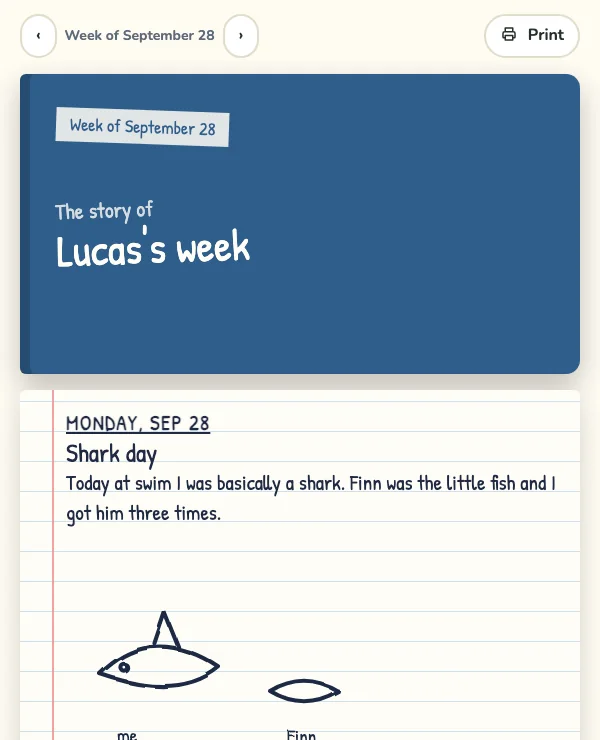
The conversation goes better when you can describe what your child is actually doing instead of asking in the abstract — and better still when the description is in their words.
The research under this page
Two sources. The first is cited against the ending every other conference list has, and the second is why one of the six questions is about teaching rather than blocking.
- Hill & Tyson, 2009 — Parental involvement in middle school: a meta-analytic assessment of the strategies that promote achievement. Developmental Psychology, 45(3), 740–763. ("The authors conducted a meta-analysis on the existing research on parental involvement in middle school to determine whether and which types of parental involvement are related to achievement. Across 50 studies, parental involvement was positively associated with achievement, with the exception of parental help with homework. Involvement that reflected academic socialization had the strongest positive association with achievement.") The spine of the page: across 50 studies, involvement was positively associated with achievement except for help with homework, and academic socialization was strongest. Middle school and correlational — a reason to change the question, not a promise about a grade. What it does not show: Middle school, so slightly older than the children this site is written about, and correlational across 50 studies rather than an experiment — none of it says that changing what a parent asks causes a grade to move. CITED AGAINST THE OBVIOUS READING: it is the reason this page does not end in "ask how to help with homework", because that was the one form of involvement the analysis found was not positively associated with achievement.
- Breakstone, Smith, Wineburg, Rapaport, Carle, Garland & Saavedra, 2021 — Students’ civic online reasoning: a national portrait. Educational Researcher, 50(8), 505–515. (3,446 US high-school students with a live internet connection, on six constructed-response tasks. "The students struggled on all of them." 96% never learned that a site claiming to disseminate factual climate reports had ties to the fossil fuel industry; two thirds could not distinguish news stories from ads; more than half believed an anonymously posted video shot in Russia was "strong evidence" of US voter fraud. Students "were often duped by weak signs of credibility: a website’s ‘look’, its top-level domain, the content on its About page, and the sheer quantity of information it provided.") Why "is AI something you teach?" is on the list. High-school students on websites, so the numbers do not transfer; the mechanism does — they were duped by surface signals of credibility, which is what a generative model produces best. What it does not show: High-school students, and about websites rather than chatbots. It is evidence that this skill does not arrive on its own with age or screen time — not a measurement of what a seven-to-twelve-year-old can do, and we quote no figure as if it were.
Questions parents ask
- What should I ask the teacher about AI?
- Three things, if you only get three. What the policy is on using AI for homework, how the teacher will be able to tell whether your child understood the work, and what they would like your child to practise without a machine. Those cover the rules, the measurement and your next action. Notice what is not on the list: how you can help with homework, because the largest meta-analysis of parental involvement found that was the one form not positively associated with achievement.
- Is it rude to ask whether the school teaches AI literacy?
- Not if you ask it as a genuine question rather than a test, and most teachers are glad someone did. Schools are mostly managing AI rather than teaching the evaluation skill, which is understandable. The reason to ask is that the skill does not seem to arrive on its own — in one large study of high-school students on live websites, almost all of them were fooled by surface signs of credibility. If the answer is "we manage it", that tells you the checking habit is a household job.
- What if the teacher’s answer contradicts another teacher’s?
- Very common, and worth surfacing rather than resolving. Ask who your child should check with when they are unsure, and make sure your child knows that the rules differ by classroom — most AI trouble comes from a child applying one teacher’s rules in another teacher’s subject. You are not trying to get the school to agree with itself in fifteen minutes.
- Should I bring up detector software?
- Ask what the process is if a child is suspected, and let detectors come up in that answer rather than leading with them. It is a calmer conversation before anything has happened, and what you want to learn is whether a child gets to explain themselves. Detection tools are unreliable in both directions, so a process that rests on one is worth knowing about in advance — particularly for a child who did nothing.
Walk in with their words, not a worry
The hardest part of this conversation is having something specific to describe. Luchi asks a kid to explain what they made and writes you a short note built from their own words each week — which is the difference between asking a teacher about AI in general and showing them how your child actually thinks.
Part of the series: Is AI safe for kids?
Related guides in this series
- Is ChatGPT safe for kids? — A straight answer by age — the risks that actually come up, and the five habits that make AI safe when you do let kids use it.
- Screen time and AI — Not all screen time is equal. Why active, creative AI use is different from passive scrolling — and how to keep your child on the right side of the line.
- What is my kid doing on AI? — You can’t read every transcript. Four checks that take under a minute each, what each one tells you, and the one question a ten-year-old actually answers.
- AI apps a parent can actually monitor — Alert, transcript, or record — three different things sold under one word. What seven products say they show a parent, quoted from their own sites.
- Is Google Gemini safe for kids? — Google’s own page for parents is more candid than the reviews — imperfect filters, stated hallucination, "not a person to confide in". What it says, what it leaves out, and the four decisions that are yours.
- The school Chromebook already has AI on it — A school account is managed by the district, not by your Family Link. Who actually holds the switch, what Google’s own documentation says a student account gets, and five questions worth one email.
- Deepfakes: what to actually teach a 10-year-old — The “look closely, count the fingers” advice has been measured, and it does not work — neither warnings nor money improved anyone’s accuracy. What to teach instead, and why a detector app is not the backstop.
- Is Siri the kind of AI parents worry about? — Apple has quietly split Siri in two — its own page now says Apple Intelligence “powers an entirely new version of Siri: Siri AI”. How to tell which one your child is talking to, what Apple keeps, and the settings worth changing tonight.
- A family AI agreement you will actually keep — Twenty clauses, signed on Sunday, dead by Thursday. A four-clause version built on what a 94-test meta-analysis found actually makes a plan start — naming the when and the where — plus the one question to ask each week.
- An AI said something it should not have — Google’s own parent page says the filters "are not perfect". The order to do things in — keep the conversation, ask the one question, report from inside the chat, decide one thing — and the point at which this hands you to somebody qualified.
- My child believes everything the AI says — The gap is usually confidence rather than method, and a check is still a looking-up — which across nine experiments left people MORE sure of what they understood. The calibration habit that moves it, in four turns.