When you can’t help with the math homework
The method on the page is not the one you were taught, the worked example may as well be in another language, and your child is waiting. You do not need to learn it. You need a different job on homework night — and it is a better one than the job you were trying to do.
It is not just you, and it is not you
In a national survey of K–8 teachers published by the Fordham Institute in 2016, 85 percent agreed that reinforcement of maths learning at home is declining because parents do not understand the way maths is being taught. That measures what teachers believe, not what parents do — but as a description of how common this evening is, it is about as official as it gets.
What changed is the order, not the maths. You were taught the algorithm first and the reason afterwards, if at all. Your child is being walked the route before being handed the shortcut: number lines, arrays, breaking numbers apart. The algorithm you know is still the destination — it arrives later, and it is meant to arrive as an obvious shortcut rather than a rule to memorise.
So your method is not wrong and does not need defending. It is further along the road than tonight’s worksheet, and that is the whole reason it does not help.
The two ways helping anyway goes wrong
The first is teaching your own method. It works for one evening and costs you the next three: your child now holds two procedures, cannot say why either works, and gets marked down for using the one you taught — which reads as you being wrong, and then as maths being arbitrary. Do it after the homework is handed in, as a second way, not as a rescue.
The second is staying in it while getting frustrated, and that one has research on it. Wu, Barger, Oh and Pomerantz found in 2022 that the more affectively negative a parent’s involvement in maths homework, the poorer their child’s maths motivation and achievement a year later; Maloney and colleagues found in 2015 that children of maths-anxious parents learned less maths across a year, specifically where those parents frequently helped. Both are observational, and both point the same way: tension is more transmissible than technique.
So the move is not to try harder at the maths. It is to take a job you can do well, which turns out to be the more valuable one anyway.
Four moves that need no maths from you
- 1. Ask them to teach you, and mean it Not as a trick — you genuinely do not know. "Teach me how your class does it" is the highest-value thing that happens on most homework nights, because explaining is where understanding either shows up or audibly does not. You will find the gap within two sentences, without knowing the method.
- 2. Read the worked example out loud together The first question of a set, or the boxed example at the top, is almost always a demonstration rather than a question. It takes sixty seconds and is written for someone who does not know the topic — which tonight is both of you. Read it as two people working it out, not as the adult catching up in private.
- 3. Hunt the stuck point instead of the answer "Read me question three. Now show me the last bit you were sure about." You are looking for the sentence where it stopped making sense, and finding it is useful whether or not either of you can fix it — because a located gap is something a teacher can act on in thirty seconds.
- 4. Write the question down and send it, in front of them When you are both stuck, stop. Write the actual question down, email the teacher, and let your child watch you do it. Most parents treat this as a failure; it is the move most worth modelling — adults who do not know something find out from a person who does, and say so plainly. It also tends to work.
What the unfamiliar method is actually for
One line each, so you can recognise it rather than teach it. These are the common purposes of each representation, not findings from a study. The last column is the only part you need to say.
| What is on the page | What it is doing | What to say |
|---|---|---|
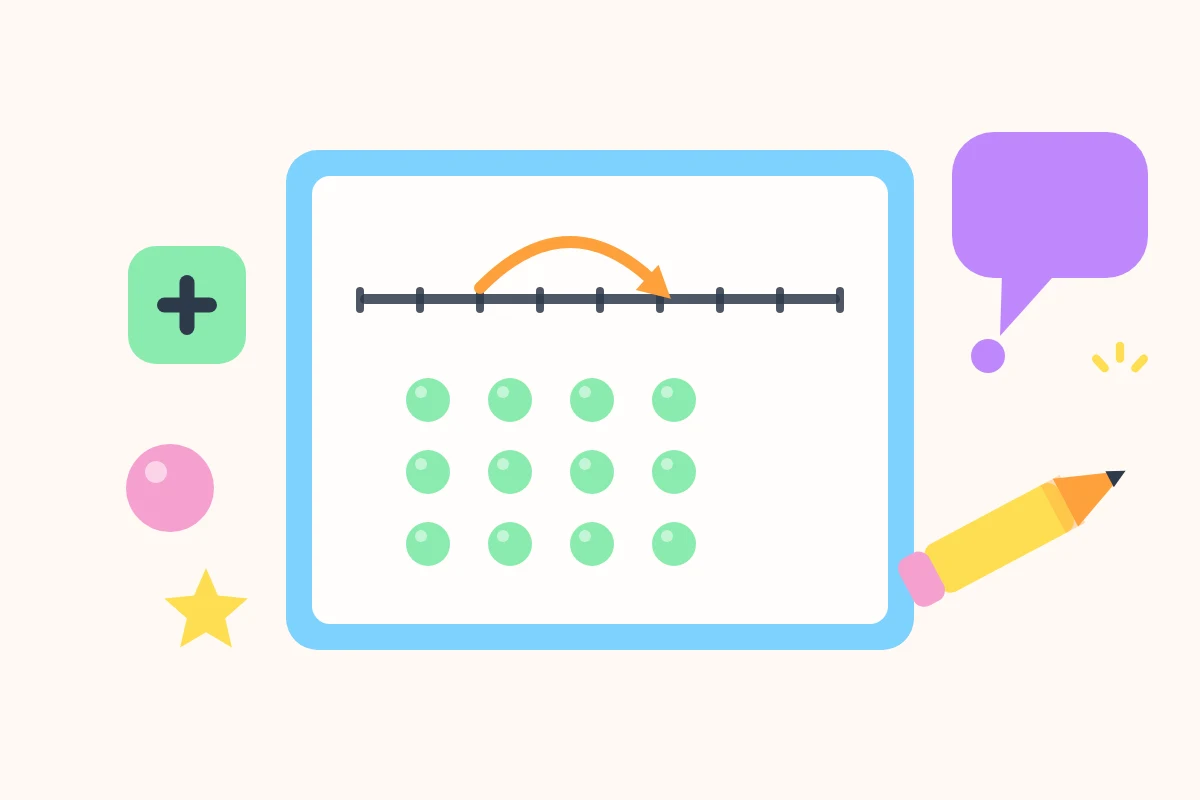
| A number line with hops drawn on it | Turning adding and subtracting into movement, so "how far apart" and "how much more" are the same picture. | "Show me where you started and where you need to get to." |
| A grid or array of dots | Making multiplication a shape rather than a fact, so rows times columns is something you can see and count. | "How many rows, how many in each row?" |
| Numbers broken apart (partial sums, partial products) | Doing the place values separately before combining, which is exactly what the column method does silently. | "Which bit did you do first?" |
| "Show your thinking" with no obvious answer box | The thinking IS the question. Marks are for the route, so a correct answer with nothing shown is an incomplete answer. | "Say it out loud and write down what you just said." |
Why AI is the most tempting wrong answer here, specifically
This is exactly the gap an AI answer fills most seductively: nobody in the room can check it. The evening you are most likely to accept a finished answer is the evening you are least able to notice it is wrong — or right by a route the teacher will not accept.
Bastani and colleagues gave nearly a thousand high-school maths students an AI assistant: the unguarded version raised practice scores and then LOWERED later unaided exam scores by about 17 percent, while a hint-giving version essentially removed the harm. High-school maths in Turkey, not an elementary worksheet, and the guardrailed arm showed no positive effect either — it removed damage rather than adding benefit. The useful part survives anyway: the distinction that mattered was hints versus answers, not AI versus no AI.
The practical version for tonight: it is fine to ask an AI to explain a method you do not recognise, to you, after your child has gone to bed. It is not fine to point it at the worksheet while your child watches.
The research under this page
Four sources, each doing one job, and each weaker than the sentence it is tempting to write from it.
- Bay-Williams, Duffett & Griffith, 2016 — Common Core math in the K–8 classroom: results from a national teacher survey. Thomas B. Fordham Institute, 23 June 2016. (85 percent of surveyed teachers agreed that reinforcement of math learning at home is declining because parents do not understand the way math is being taught.) Used for one number only — that 85 percent of surveyed K–8 teachers said home reinforcement is declining because parents do not understand how maths is taught. A teacher-perception survey, not a measurement of parents. What it does not show: A survey of what TEACHERS believe, not a measurement of what parents understand or do, and it was fielded in the Common Core transition — so it is good evidence that the problem is widely perceived and no evidence at all about its size.
- Wu, Barger, Oh & Pomerantz, 2022 — Parents’ daily involvement in children’s math homework and activities during early elementary school. Child Development, 93(5), 1347–1364. Used for the claim that the AFFECT of homework help, rather than its amount, is what tracked later maths motivation and achievement. What it does not show: A daily-diary study, so it is about covariation over time rather than cause. What it supports is that the AFFECT of homework involvement tracked later maths motivation and achievement; the amount of involvement did not do the same work.
- Maloney, Ramirez, Gunderson, Levine & Beilock, 2015 — Intergenerational effects of parents’ math anxiety on children’s math achievement and anxiety. Psychological Science, 26(9), 1480–1488. Used for the maths-anxious-parent finding, with its condition: it appeared where those parents frequently helped with maths homework. What it does not show: Observational and in first and second graders. The finding carries its own condition and must never be quoted without it: the effect appeared where maths-anxious parents FREQUENTLY HELPED with maths homework, and not where they did not. It is not evidence that anxious parents should stop helping.
- Bastani, Bastani, Sungu, Ge, Kabakcı & Mariman, 2024 — Generative AI without guardrails can harm learning: evidence from high school mathematics. (Nearly 1,000 students; an unguarded GPT-4 assistant raised practice scores but LOWERED later unaided exam scores by about 17%, an effect essentially eliminated by a hint-giving tutor version.) Used for the hints-versus-answers distinction, with its caveat: high-school students, and the guardrailed version removed harm rather than producing a gain. What it does not show: High-school maths in Turkey, not elementary school, and the "guardrails" arm showed no POSITIVE exam effect either — it removed the harm. Anyone citing this as proof that AI tutoring raises attainment is citing the opposite of what it found.
What the explain-back looks like when it is written down
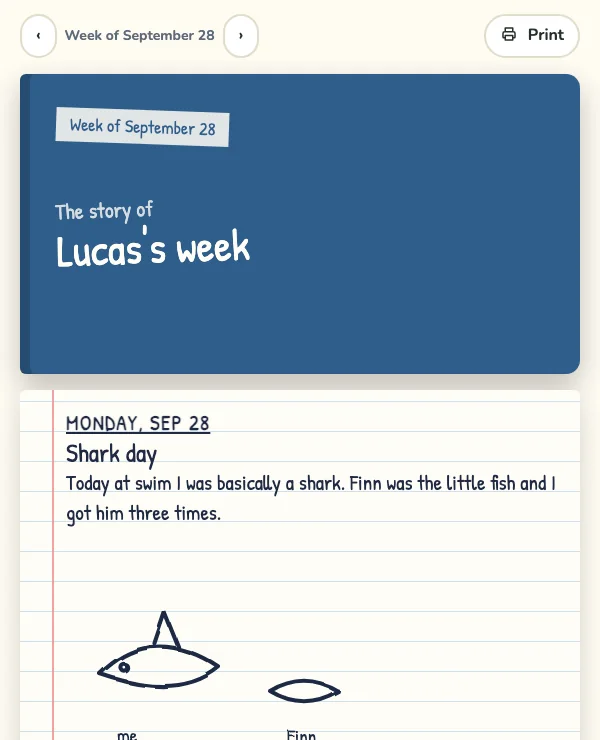
The one job here you can always do is ask your child to explain it. This is the parent-facing screen where that lands.
Questions parents ask
- I do not understand my child’s math homework. What do I do?
- Stop trying to understand it and change jobs. Ask your child to teach you the method, read the worked example at the top of the page together, and hunt for the sentence where it stopped making sense. If you are both stuck, write the question down and email the teacher in front of your child. Every one of those is useful and none of them requires you to know the maths.
- Can I just teach my child the way I learned it?
- Afterwards, not instead. Taught as a rescue, your method leaves your child holding two procedures with no idea why either works, and being marked down for the one you gave them. Taught after the homework is handed in, as "here is the fast way, now that you know why it works", it is a gift. The order is the whole difference.
- Should I use ChatGPT to help with math homework I do not understand?
- For yourself, after bedtime, to understand a method — reasonable. Pointed at the worksheet with your child watching — this is the worst case, because neither of you can check it. The Bastani study found an unguarded AI assistant raised practice scores and then lowered later unaided exam scores by about 17 percent, while a hint-only version removed the harm. The distinction that mattered was hints versus answers.
- How do I know whether to email the teacher?
- Email when you can name the stuck point, or when the two of you have spent twenty minutes and are no further. Both are good emails and teachers generally want them — a located gap takes a teacher thirty seconds to close. The email that does not work is "my child does not understand maths"; the one that does is "she is fine until the second step of question three, where the method asks her to split the number."
Someone to do the explaining, when you cannot
Luchi works a maths question with your child by asking rather than answering — the hint-shaped help the research distinguishes from the answer-shaped kind. Afterwards you get a short note in your child’s own words, so you can tell whether it landed without being able to check the method yourself.
Part of the series: Math games for kids
Related guides in this series
- When your child says they’re bad at math — "I’m bad at math" is a loop, not a level — and one of the clearest findings in it is about the parent doing the helping, not the child. Five things to change this week.
- Times tables that actually stick — Retrieve, space it, mix it up — the three findings that do nearly all the work, in five minutes a day. Plus four practice formats scored honestly against the evidence.