When your child says they’re bad at math
It is rarely a report about ability. It is a prediction, and predictions about maths have a way of coming true, because the worry eats the working memory the maths needed. There is one finding here that is genuinely about you rather than about your child, and it changes what to do tonight.
What the sentence usually means
Maths anxiety is not a figure of speech. Ramirez, Gunderson, Levine and Beilock measured it in first and second graders and found it tracked lower achievement — with a twist that explains a lot of kitchen tables. The link was strongest in children with the HIGHEST working memory: the ones who would otherwise be using the clever strategies. Worry occupies the workspace the maths needed, so it costs the most from the children who had the most to spend.
That is why the sentence is a loop rather than a level. Foley and colleagues reviewed the maths-anxiety literature in 2017 and concluded the link runs both ways: struggling makes you anxious, and anxiety makes you struggle. A child who says "I am bad at maths" is usually reporting the inside of that loop, not the result of an assessment.
So you do not have to argue with the sentence, and arguing rarely works anyway. You have to take one turn out of the loop — usually the one happening during homework.
The finding about you, which is the uncomfortable one
In 2015 Maloney, Ramirez, Gunderson, Levine and Beilock followed first and second graders across a school year. Children of maths-anxious parents learned less maths over the year and were more likely to become maths-anxious themselves — but, critically, only when those parents frequently helped with maths homework. Where the anxious parent was not doing the helping, the effect was not there.
Read that carefully, because the obvious conclusion is the wrong one. It is not evidence that you should stop helping. It is evidence that the thing being transmitted is the affect, not the arithmetic — and the transmission happens on homework night, at the moment it gets tense. Wu, Barger, Oh and Pomerantz found the same shape in 2022: the more affectively negative a parent’s involvement in maths homework, the poorer the child’s maths motivation and achievement a year later.
Both are observational, so neither proves that changing your face changes your child’s marks. What they jointly support is narrower and still useful: if help is going to turn tense, the tension is the part worth removing — and removing it is cheaper than becoming good at maths.
Five things to change this week
- 1. Retire "I was bad at maths too" It is meant kindly and lands as a licence: being bad at maths is a permanent kind of person, you are one, and the matter is settled. Replace it with a sentence about this week rather than about them — "this bit is hard right now, let us find where it stopped making sense."
- 2. Ask for the stuck point, not the answer "Show me the first place it stopped making sense" turns a verdict into a location. A location can be worked on; a verdict cannot. It also gives you something to do that requires no maths from you, which matters more than it should.
- 3. Take the clock out of it Timed drills are where maths anxiety concentrates, because speed is the thing anxiety takes first. Practise untimed until the facts are there, then add the timer back as a game if your child wants it. If they do not want it, it was never the point.
- 4. Stop helping out loud when you get tense Not storm off — narrate it. "I am getting frustrated and that is about me, not about you. I am going to make tea and come back." This is the one move the research points at most directly, and it costs nothing. Staying in the room while not explaining is still company.
- 5. Give them one unassessed maths thing a week Something with maths in it and no mark on it: a card game, a recipe doubled, a game they make. The point is not practice — it is one weekly data point, in their own experience, that contradicts "maths is a thing I fail at."
What they say, and what is usually underneath
The middle column is what it most often is — not always, which is why the right column is a question rather than a reassurance. Reassurance that misses makes the next sentence less likely to be said out loud.
| What you hear | What it is usually about | What to say |
|---|---|---|
| "I am bad at maths." | A prediction they have started acting on, often after one public moment of being slow. | "Bad at which bit? Show me the question that made you think so." |
| "This is stupid / pointless." | Almost always "I cannot do it and I would rather be contemptuous than exposed." | "Fair enough. Read me the first line and tell me what it is even asking." |
| "Everyone else finished already." | Speed, not understanding — the classroom signal that turns into maths anxiety fastest. | "Finishing first is not the thing being measured. Did you get it right, and do you know why?" |
| "I had it yesterday and now I have forgotten." | Usually true, and usually normal: the practice was blocked and massed, so it never stuck. | "That is a practice problem, not a you problem. Five minutes a day beats an hour on Sunday." |
| Nothing — just a closed book and a bad mood. | Often the work is genuinely beyond them, which looks identical to refusal from across the kitchen. | "Show me question one. If it is too hard, that is information about the worksheet." |
The research under this page
What each source supports and where it stops. All four are observational, so none licenses a sentence of the form "do this and your child will improve" — which is the sentence this subject attracts.
- Ramirez, Gunderson, Levine & Beilock, 2013 — Math anxiety, working memory, and math achievement in early elementary school. Journal of Cognition and Development, 14(2), 187–202. Used for the central mechanism: maths anxiety relates to lower achievement in early elementary, most strongly in the children with the highest working memory. Not a claim that anxiety causes the gap. What it does not show: Correlational, in first and second graders. It establishes that maths anxiety relates to lower achievement — most strongly in children with HIGH working memory — not that the anxiety caused the gap.
- Foley, Herts, Borgonovi, Guerriero, Levine & Beilock, 2017 — The math anxiety-performance link: a global phenomenon. Current Directions in Psychological Science, 26(1), 52–58. Used for the loop: the anxiety-performance relationship runs in both directions. A review, so it is a summary of the field rather than a new measurement. What it does not show: A review article summarising a field, not a new measurement. Its useful claim is the direction of travel — the relationship runs both ways — which is weaker than "anxiety is the cause".
- Maloney, Ramirez, Gunderson, Levine & Beilock, 2015 — Intergenerational effects of parents’ math anxiety on children’s math achievement and anxiety. Psychological Science, 26(9), 1480–1488. Used for the finding about parents, with its one real condition — the effect appeared where maths-anxious parents frequently helped with maths homework, and not otherwise. What it does not show: Observational and in first and second graders. The finding carries its own condition and must never be quoted without it: the effect appeared where maths-anxious parents FREQUENTLY HELPED with maths homework, and not where they did not. It is not evidence that anxious parents should stop helping.
- Wu, Barger, Oh & Pomerantz, 2022 — Parents’ daily involvement in children’s math homework and activities during early elementary school. Child Development, 93(5), 1347–1364. Used for the affect claim specifically: negative affect during maths homework, not the amount of help, is what predicted poorer maths motivation and achievement a year later. What it does not show: A daily-diary study, so it is about covariation over time rather than cause. What it supports is that the AFFECT of homework involvement tracked later maths motivation and achievement; the amount of involvement did not do the same work.
The instrument you actually want is not a grade
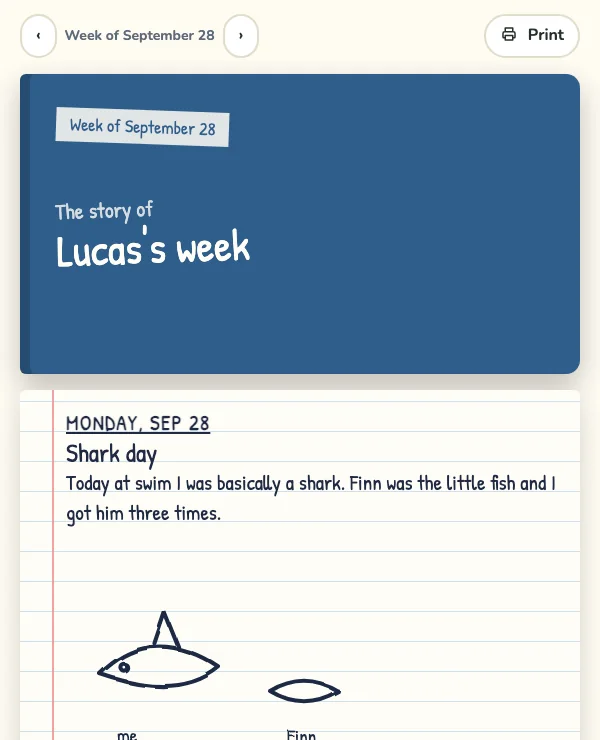
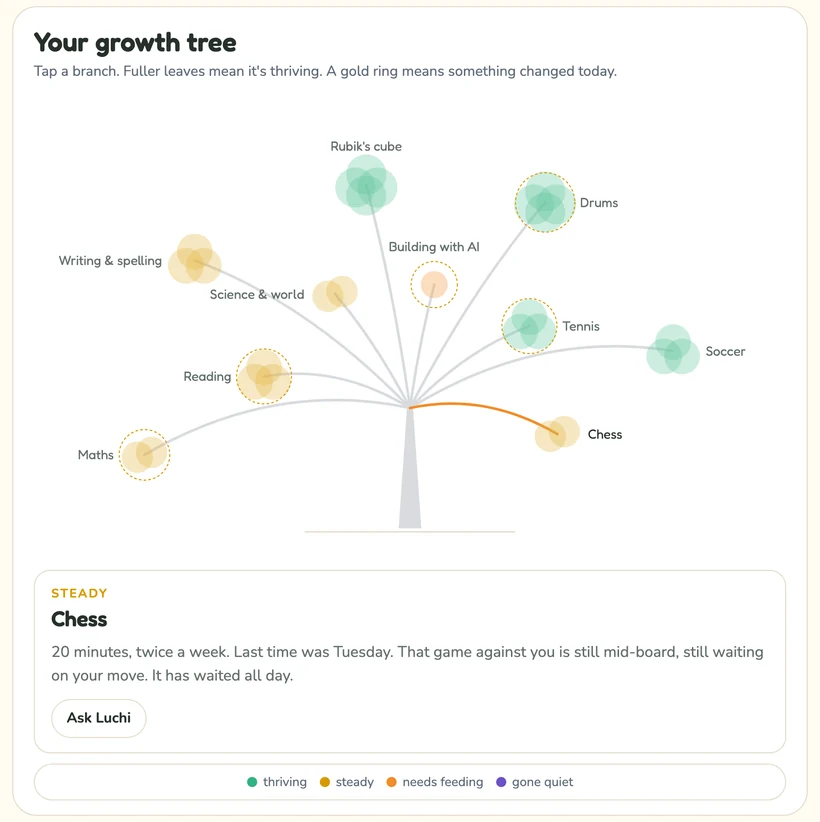
A mark tells you where your child landed against a class. It cannot tell you whether the sentence is still there. Two parent-facing screens Luchi already publishes, and what each is honestly good for.
Questions parents ask
- My child says they are bad at math. What should I say?
- Not "no you are not", and not "I was bad at maths too." Ask which part: "bad at which bit — show me the question that made you think so." It moves the conversation from a verdict about them to a location on a page, and a location can be worked on. Then do one question together and stop while it is still going well.
- Is math anxiety a real thing or just an excuse?
- Real and measurable, including in first and second graders. Ramirez and colleagues found it related to lower maths achievement most strongly in children with high working memory — the worry occupies the same mental workspace the maths needs, so it costs the most from the children who had the most to spend. It is not an excuse, and treating it as one tends to deepen it.
- Should I stop helping with math homework if I am bad at math myself?
- Not stop — change what help means. The 2015 Maloney study found children of maths-anxious parents learned less maths across the year only where those parents frequently helped with maths homework. The transmissible thing is the tension, not the arithmetic. So keep the company, hand off the explaining, and leave the room out loud when you feel yourself tightening.
- How do I know if my child is actually behind or just anxious?
- You usually cannot tell from the kitchen, and the two look identical. The separating question is what happens with the pressure off: sit with one question, untimed, no audience, and see whether it comes. If it does, the problem was the conditions. If it does not, that is worth one email to the teacher — and it is information about a worksheet, not a verdict on a child.
Let the explaining come from somewhere else
The company is yours to give. The explaining does not have to be. Luchi works through a maths question with your child by asking rather than answering, and writes you a short note afterwards in your child’s own words — which is where you will see the sentence change, before any mark does.
Part of the series: Math games for kids
Related guides in this series
- When you can’t help with the math homework — You do not need to learn the new method. Four moves that need no math from you, one line each on what the number lines and arrays are for, and when to email the teacher.
- Times tables that actually stick — Retrieve, space it, mix it up — the three findings that do nearly all the work, in five minutes a day. Plus four practice formats scored honestly against the evidence.