“Careless mistakes” are usually not careless
They know how to do it. They did ten of them right last week. The page comes back with four crosses on it and everyone agrees it was carelessness, so the advice is to slow down and check — which has never once worked, in your house or anyone else’s. There is a better explanation, it has been known since 1978, and finding it needs ten wrong answers and about fifteen minutes.

The finding that changes what a marked page is for
In 1978 Brown and Burton built something odd: a program that took a child’s wrong answers in subtraction and worked backwards to the procedure that would produce exactly those answers. Not "this one is wrong" — a model that could then predict which other questions that child would get wrong, and how. Their stated aim was a system that "provides a mechanism for explaining why a student is making a mistake as opposed to simply identifying the mistake", and they reported using it on "1300 school students from a data base of 20.000 test items".
The word they used for what it found was bugs, borrowed from programming, and the metaphor is the useful part. A bug is not a failure of attention. It is a small, consistent, incorrect step sitting inside an otherwise working procedure — and because it is consistent, it fires every single time that step comes round. A child with a bug is not being careless. They are being extremely reliable, at the wrong thing.
That is an existence claim rather than a prevalence claim, and the page will not pretend otherwise: nothing here says most errors are bugs. What it means practically is enough. If some of your child’s wrong answers are generated by a rule, then they repeat — and a repeat is visible from the page, for free, without a tutor, a test, or any maths you have to remember.
It also explains why "check your work" fails. Checking means running the same procedure again. A procedure with a bug in it produces the same answer the second time, and your child, having checked, now tells you it is right.
If it is only the word problems that go wrong · If the tears arrive before the worksheet does
The ten wrong answers
- 1. Collect ten, from more than one day Old homework, a returned test, the back of the exercise book. Ten from across two or three weeks, not from tonight’s unfinished page — nothing diagnostic happens while a deadline is in the room, and one bad evening is not a pattern. You are not fixing any of these; say so out loud, because a child who thinks this is a correction session will go quiet.
- 2. Write down the wrong answer, not the right one This is the move everyone skips and it is the whole method. A red cross records that something failed; the wrong answer records what happened instead. Two children who both got 42 wrong, one answering 44 and one answering 6, have nothing in common. Copy out what they actually wrote, next to the question.
- 3. Look for the repeat, in the step and not in the topic Not "three of these are subtraction". Look at the position inside the working: is it always the carrying, always the borrowing across a zero, always the second of two operations, always the units column when the digit on top is smaller? A bug lives at a position. If three of your ten break at the same step, you have found something, and you have found it without doing any maths.
- 4. Ask them to do one out loud, slowly, while you say nothing Pick a fresh question of the same kind. "Talk me through it as you go — I want to hear the order you do things in." Then be quiet. The bug is usually audible within thirty seconds, and the single hardest part of this step is not interrupting the moment you hear it. Let them finish, wrong answer and all.
- 5. Say the step back to them as a thing, not as a mistake "So when the top number is smaller you’re taking the small one from the big one — that’s the bit. Everything else is working." Naming it as one specific step is what makes it fixable, and it is also the sentence that stops this being a verdict on them. One step is a thing to practise; "careless" is a kind of person.
The repeat you found, and what it is
Three kinds, and they need different things — a structure borrowed from Geary’s review of arithmetic difficulties, which separates procedural problems from fact-retrieval problems from the spatial business of keeping a sum lined up. Used here to choose what to practise. It is not a diagnosis and nothing on this page can make one.
| What the ten pages show | What it probably is | What actually helps |
|---|---|---|
| The same step fails, nearly every time it appears. | A procedural bug. One incorrect sub-step inside a procedure that is otherwise sound. | Practise that step alone, divorced from whole questions, for about a week — ten of just-the-borrowing beats three full questions. Then put it back and check the repeat has gone. If it has not, the step you named was not the step. |
| The method is right throughout and the number facts are wrong, scattered. | Fact retrieval, not procedure. The working is sound and the raw facts underneath it are slow or unreliable, so they get rebuilt under load and sometimes rebuilt wrong. | A fluency problem, with its own well-evidenced routine: short, daily, mixed up, retrieved rather than reviewed. Leave the procedures alone while you do it — they are not the problem. |
| Right digits, wrong places. Columns drift, decimal points wander, carried digits land in the wrong column. | The spatial half of written arithmetic rather than the arithmetic. The child knows what to do and loses the layout while doing it. | Squared paper, one digit per square, and more space than looks necessary. Unglamorous, and often the entire fix. If a page is cramped, widen it before concluding anything else. |
| No repeat at all. Different step, different kind, every time. | This is the residual category, and it is the one case where "careless" might be accurate — or where the real variable is not the maths. Tiredness, speed, the hour, or a worksheet that is simply too long. | Look at the conditions rather than the maths: when it is being done, how long the session runs, whether the last third of every page is worse than the first. That last pattern is a stamina finding, fixed by shortening the session rather than by practising anything. |
Why the explaining has to come from them
Once you have found the step there is a strong temptation to explain it. Fifteen seconds, clearly, done — and it is usually the least effective thing you can do with what you just learned.
Chi and colleagues had students talk aloud while studying worked examples and found that the ones who learned well "generate many explanations which refine and expand the conditions for the action parts of the example solutions", and that these self-explanations "are guided by accurate monitoring of their own understanding and misunderstanding". The contrast is the part that bites: poorer learners "do not generate sufficient self-explanations, monitor their learning inaccurately, and subsequently rely heavily on examples." A clear explanation from you is another example to rely on.
So the sequence that works is inverted from the obvious one. They do one out loud, you name the step, and then they explain the step back to you before anything is practised. If the explanation is a shrug or a recitation of what you just said, the step has not landed and more practice will make the bug more reliable rather than less.
Be fair to the source: that is a small protocol study of university students on physics problems, and it is correlational — good and poor students differed in how much they explained, which is not the same as showing that making someone explain causes the gain. It is cited for the direction, never as a promised effect, and never as a measurement about children.
What to say to the teacher, and what to say to your child
If you find a repeat, one email is worth more than a fortnight of practice, and the thing that makes it worth answering is specificity. "She is careless in maths" gives a teacher nothing to act on. "Across ten wrong answers from the last three weeks, seven break at the same place — subtracting across a zero — and she does it the same way every time" is a sentence a teacher can do something with on Monday, and it is a sentence you can write without being able to do the maths yourself.
One limit on the whole page. Brown and Burton built a diagnostic program in 1978; they did not measure how common bugs are among children in general, and this page quotes no percentage because none is available from it. The fourth row of the table above exists precisely because the answer is sometimes "no pattern" — and finding no pattern in ten wrong answers is a real result that saves you a fortnight of practising the wrong thing.
If it turned out to be the number facts · If the last third of every page is the worst third
The reasoning, when it is written down rather than guessed at
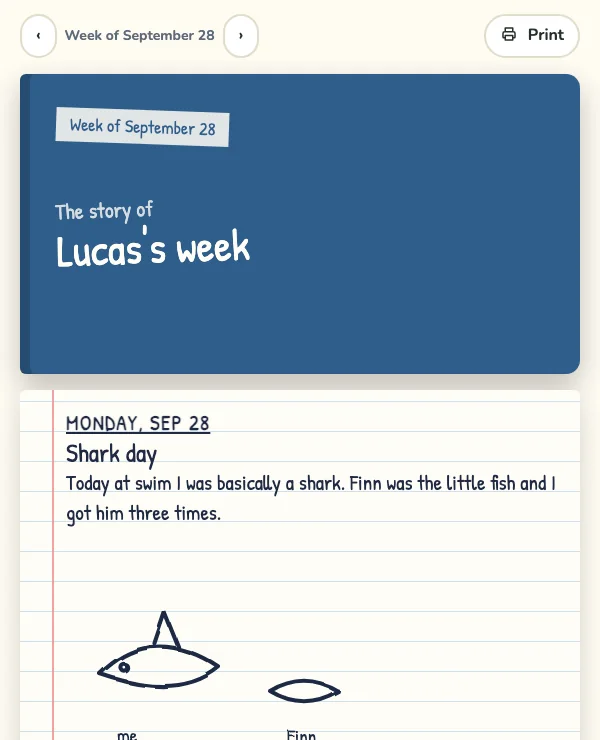
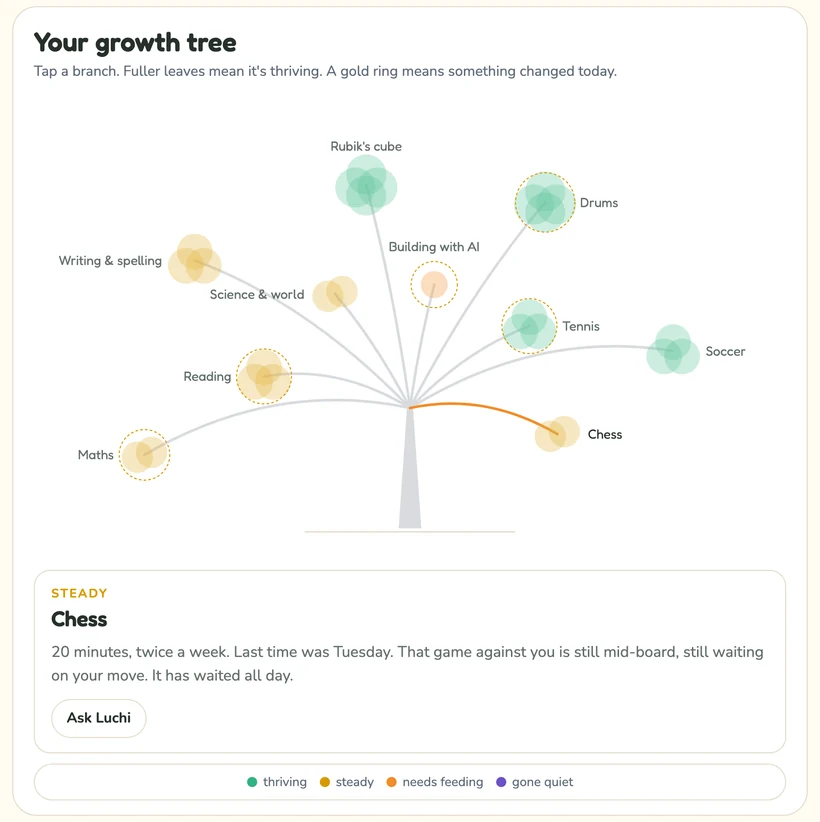
Everything on this page depends on getting at the procedure rather than the answer, and a marked page hides the procedure by design. Two parent-facing screens Luchi already publishes, and what each is honestly good for here.
The research under this page
Three sources, each cited for one job. The first is an existence claim and not a prevalence claim; the second is a structure borrowed from a clinical literature and used non-clinically, which the page says out loud; the third is correlational and about adults.
- Brown & Burton, 1978 — Diagnostic models for procedural bugs in basic mathematical skills. Cognitive Science, 2(2), 155–192. (A system for "automatically synthesizing a deep-structure model of a student’s misconceptions or bugs in his basic mathematical skills", which "provides a mechanism for explaining why a student is making a mistake as opposed to simply identifying the mistake". The report includes "a discussion of the success of this system in diagnosing 1300 school students from a data base of 20.000 test items".) The spine of the page: a model that explains why a student is making a mistake rather than identifying that one was made, built around consistent procedural bugs. It licenses the claim that wrong answers can repeat because a rule produces them — and therefore that a repeat is findable from the page — and it licenses no number about how often that is the case. What it does not show: A 1978 artificial-intelligence paper about subtraction, written to build a diagnostic program rather than to measure how common bugs are among children in general — so it licenses no percentage, and the page quotes none. What it establishes, and what nothing newer has overturned, is the existence claim the page rests on: a child’s wrong answers can be generated by a consistent incorrect procedure, which makes them predictable and therefore findable from the work itself. Note the DOI — a commonly recalled variant (…cog0202_6) is a different article and 404s.
- Geary, 2004 — Mathematics and learning disabilities. Journal of Learning Disabilities, 37(1), 4–15. ("Between 5% and 8% of school-age children have some form of memory or cognitive deficit that interferes with their ability to learn concepts or procedures in one or more mathematical domains… The deficits are discussed in terms of three subtypes of mathematics learning disability and in terms of a more general framework for linking research in mathematical cognition to research in learning disabilities.") Used only for the shape of the table: arithmetic difficulties separate into procedural, fact-retrieval and spatial kinds that need different responses. It is a review of mathematics learning DISABILITY, a clinical category, so the page uses the three kinds to choose what to practise and explicitly not to diagnose anything. What it does not show: A review about mathematics learning DISABILITY, which is a clinical category and not what most children with a messy worksheet have. Cited for one structural idea only — that difficulties in arithmetic separate into procedural, fact-retrieval and visuospatial kinds needing different responses — and the page is explicit that sorting your child’s errors that way is how you choose what to practise, never a diagnosis. The 5–8% prevalence figure is quoted here and deliberately NOT on the page: a prevalence number for a clinical condition, inside a guide about homework, invites precisely the self-diagnosis this source cannot support.
- Chi, Bassok, Lewis, Reimann & Glaser, 1989 — Self-explanations: how students study and use examples in learning to solve problems. Cognitive Science, 13(2), 145–182. (Talk-aloud protocols from students studying worked examples of mechanics problems. "We find that 'Good' students learn with understanding: They generate many explanations which refine and expand the conditions for the action parts of the example solutions, and relate these actions to principles in the text. These self-explanations are guided by accurate monitoring of their own understanding and misunderstanding." The contrast is the finding that matters here: "'Poor' students do not generate sufficient self-explanations, monitor their learning inaccurately, and subsequently rely heavily on examples.") Used for why the child explains the step rather than the parent: good learners generated explanations and monitored their own understanding accurately, while poorer ones under-explained and leaned on worked examples. University students on physics problems, correlational, cited for the direction and never as an effect. What it does not show: A small protocol study of university students on physics problems, and correlational in its design — good and poor students differed in how much they explained to themselves, which is not the same as showing that making someone explain causes the gain. Cited for the mechanism and for the direction of the dependence (poor explainers leaned on the worked example), never as an effect size, and never as a measurement about children.
Questions parents ask
- Why does my child keep making careless mistakes in math?
- Often because they are not careless. Since Brown and Burton’s 1978 work it has been known that wrong answers in arithmetic can be generated by a consistent incorrect step — a bug — sitting inside a procedure that is otherwise fine. It fires every time that step comes round, which is why it looks random from a distance and is perfectly regular up close. Collect ten wrong answers from across a few weeks and look for a repeat in the step rather than the topic.
- Why doesn’t telling them to check their work help?
- Because checking means running the same procedure again, and a procedure with an incorrect step in it produces the same answer the second time. Your child then reports, accurately, that they checked and it is right. Checking only catches slips — the genuinely random kind — and those are the minority worth worrying about least. What catches a bug is hearing the working out loud, or spotting the same step failing across several pages.
- How do I find the pattern if I am not good at maths myself?
- You do not need to be. The method is clerical: write down what they actually answered rather than what was correct, line ten of them up, and look at where in the working the trouble sits — the carrying, the borrowing, the second operation, the units column. You are looking for a position that repeats, not for a mathematical insight. The one step that needs any judgement is listening to them work one out loud, and there the job is to stay quiet.
- What if there is no pattern at all?
- That is a real and useful result rather than a failed exercise, and it saves you a fortnight spent practising the wrong thing. When ten wrong answers break in ten different places, look at the conditions rather than the maths: the hour it is being done, how long the session runs, and whether the last third of each page is reliably worse than the first. That last one is a stamina finding, and it is fixed by making the session shorter, not by practising anything at all.
The working, not just the answer
Everything on this page needs the procedure, and a marked page hides it. Luchi asks a kid to say why their answer is what it is, in the moment, and writes you a short weekly note from their own words — so the step that keeps going wrong has somewhere to show itself other than a red cross.
Part of the series: Math games for kids
Related guides in this series
- When your child says they’re bad at math — "I’m bad at math" is a loop, not a level — and one of the clearest findings in it is about the parent doing the helping, not the child. Five things to change this week.
- When you can’t help with the math homework — You do not need to learn the new method. Four moves that need no math from you, one line each on what the number lines and arrays are for, and when to email the teacher.
- Times tables that actually stick — Retrieve, space it, mix it up — the three findings that do nearly all the work, in five minutes a day. Plus four practice formats scored honestly against the evidence.
- When your child can read, but can’t do the word problems — Word problems need a third thing that neither reading nor arithmetic supplies. A ten-minute diagnosis that finds which of three places it breaks, and what to do about each.
- When fractions stop making sense — Not effort, and not ability — a rule that worked for four years and stops working here. Three questions in ten minutes tell you which version you have, and each one has a different fortnight behind it.