Studying for a test: what goes on tonight’s list, and when it comes off
The test is Friday, the revision sheet has eleven things on it, and you have three evenings. Most advice answers a question you did not ask — how to study — and skips the one you did: which of the eleven, and when are you allowed to stop. Both of those are decisions, both have research behind them, and the input most families use to make them is the one that has been measured and found to carry no information.
The decision this page is about, and the one it is not
There is a well-evidenced way to run a study session, and this is not it. Being tested beats re-reading, producing an answer beats recognising one, and coming back later beats going over it twice tonight — that is settled, it is five minutes long, and there is already a page on this site that runs it end to end. Assume it from here.
What that page does not do, and what no revision timetable does either, is tell you what to point the five minutes at. It says "pick the one topic that matters", which is the right instruction and a completely unspecified one. Eleven topics and three evenings is a triage problem, triage has a wrong answer as well as a right one, and the wrong answer is the one almost every household reaches for because it is free and feels respectful: ask your child what they need to work on.
The five minutes themselves: how to run the session · If what has to stick is facts rather than topics
Why you cannot ask them what to study
Karpicke and Roediger gave students vocabulary to learn and then, once an item had been produced correctly, varied what happened to it: kept in study, kept in testing, kept in both, or dropped from both. The headline result is about dropping, and we will come back to it. The line that matters here is the quieter one at the end: "students’ predictions of their performance were uncorrelated with actual performance."
Uncorrelated is a strong word and it is the authors’ own. Not "weakly related", not "optimistic by a margin you can adjust for" — these were university students, asked about material they had just worked on, and what they expected to remember told you nothing about what they did remember. There is no reason to think a ten-year-old at 7pm does better than that.
So "what do you feel shaky about?" is not a question with a bad answer. It is a question whose answer is noise, and acting on noise is how three evenings get spent on the two topics that were already secure. The replacement is not an argument with your child. It is a measurement, and it takes about eight minutes.
Building the list, in four moves
- 1. Get the actual list of topics, not the remembered one From the school: the revision sheet, the teacher’s email, the unit page. Not your child’s memory of what the test covers, which has the same problem as every other self-report here. If there is genuinely no list, the last three weeks of the exercise book is a serviceable one.
- 2. One cold question per topic, in one sitting, tonight Books closed. One question each, straight through, no teaching, no corrections, no going back. Eleven topics is about eight minutes. This sitting is not studying and it is important that neither of you treat it as studying — it is the sort. Say that out loud before you start, because a child who thinks this is the test will steer you.
- 3. Three piles, scored on production and nothing else Produced it cleanly / got most of it / nothing came. Score what came out of their mouth, not how confident they sounded and not whether they said "oh I know this one". The middle pile is usually the biggest and is the whole point of doing this.
- 4. Tonight’s list is the middle pile, and it is shorter than you want The "nothing came" pile is usually not a revision problem — it is material that was never learned, and three evenings will not fix it, though one honest email to the teacher might. The "produced it cleanly" pile comes back later, cheaply, and the next section is about why it comes back at all. What you work on is the middle: the things that are half-there, which is where the effort converts.
When an item comes off the list, and why the number is three
Here is the result we deferred. In the same experiment, items that had been correctly produced once were either kept in the testing rotation or dropped from it. "Repeated studying after learning had no effect on delayed recall, but repeated testing produced a large positive effect." Getting it right once and striking it off the list was, measurably, the expensive move — and it is the move every revision timetable is built around, because a list that only shrinks feels like progress.
Rawson and Dunlosky went looking for the replacement number. Across three experiments with 533 students and, in their words, "more than 100,000 short-answer recall responses… collected and hand-scored", they varied how many correct recalls an item had to reach before it was parked, and how many times it came back afterwards. Their prescriptive conclusion, verbatim: "practice recalling concepts to an initial criterion of 3 correct recalls and then to relearn them 3 times at widely spaced intervals."
Three, not one. And the second half of that sentence is the cheap half — relearning "had pronounced effects on long-term retention with a relatively minimal cost in terms of additional practice trials". An item that is already nearly there costs ten seconds to re-ask and is the reason it is still there in June.
Be honest about where the number comes from: university students on conceptual material, measured one to four months later. It is a floor worth copying, not a property of your child. The rule you can hold in your head on a Tuesday is this — nothing leaves the list on the day it first goes right; it leaves after it has gone right on three separate days.
The same week, decided two ways
Same test, same three evenings, same child. The left column is what the revision timetable produces; the right is what the sort and the drop criterion produce. The difference is not effort — it is identical effort pointed somewhere else.
| The usual way | What this page does instead | Why it changes the outcome |
|---|---|---|
| Ask what they feel shaky about and start there. | Eight minutes of one cold question per topic, scored on what was produced. | Predictions of performance were uncorrelated with actual performance in the experiment that measured it. Feeling shaky and being shaky are different variables, and only one is on the test. |
| Work down the revision sheet in order, as far as you get. | Work only the middle pile — half-known — and leave both ends alone. | The secure end does not need three evenings and the blank end cannot be fixed by them. In order is the one ordering guaranteed to be unrelated to where effort converts. |
| Tick a topic off once they get it right. | Nothing comes off until it has gone right on three separate days. | Dropping an item after one correct recall had a measured cost to delayed recall; extra studying after that point had none. The tick is the satisfying move and the expensive one. |
| Re-teach the missed bits first when you come back. | Ask cold again, including the ones they got right last time. | Re-teaching first turns the second session back into re-reading. The items they can already answer cost ten seconds and are the ones being made permanent. |
| A long session the night before. | Three short ones, the last not on Thursday. | Cramming does not fail Friday — it fails everything after it. If the material is in next term’s paper too, the gaps between sessions matter more than their length. |
Where an AI helps here, and the one instruction that matters
The sort is the part a chatbot is genuinely good at, and it is a narrow job: turning a list of topics into one question each. "Here are eleven topics from my child’s revision sheet. Give me ONE short question on each, one at a time, wait for the answer, and do not say whether it was right until we have done all eleven." The withholding is what keeps it a sort rather than a lesson — feedback after each one turns the eleven minutes into eleven small teaching moments and you end up with no measurement.
What it cannot do is the scoring, and you should not ask it to. Whether what your child said counts as "produced it" is a judgement about a nine-year-old at the end of a long day, and it is the one part of this that needs a person who knows them. It is also the part that decides everything downstream.
One honest limit on the whole page, stated rather than buried: the research here is laboratory work with older learners, and nobody has measured a parent running a sort at a kitchen table. What transfers is the structure — measure before you choose, and do not let one correct answer end an item — not a promised result.
Where the line sits between help and doing it for them · If the asking has already become the first move
The same rule, when nobody has to remember it
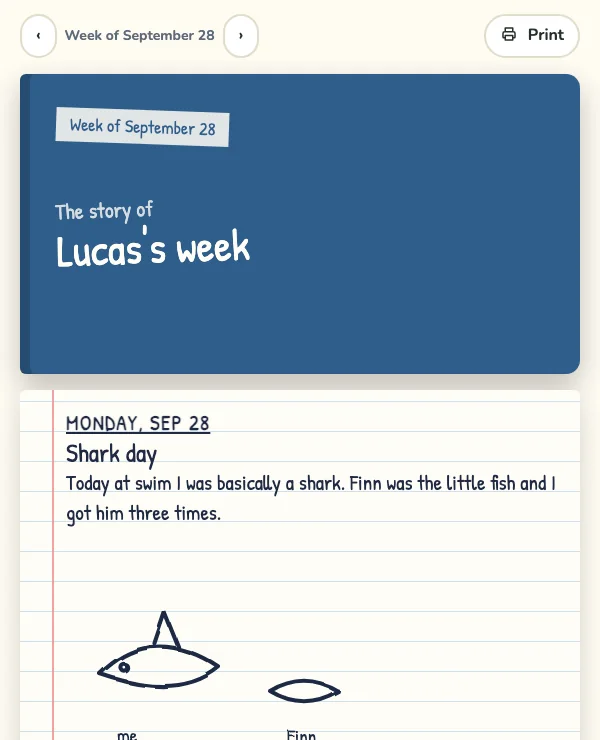
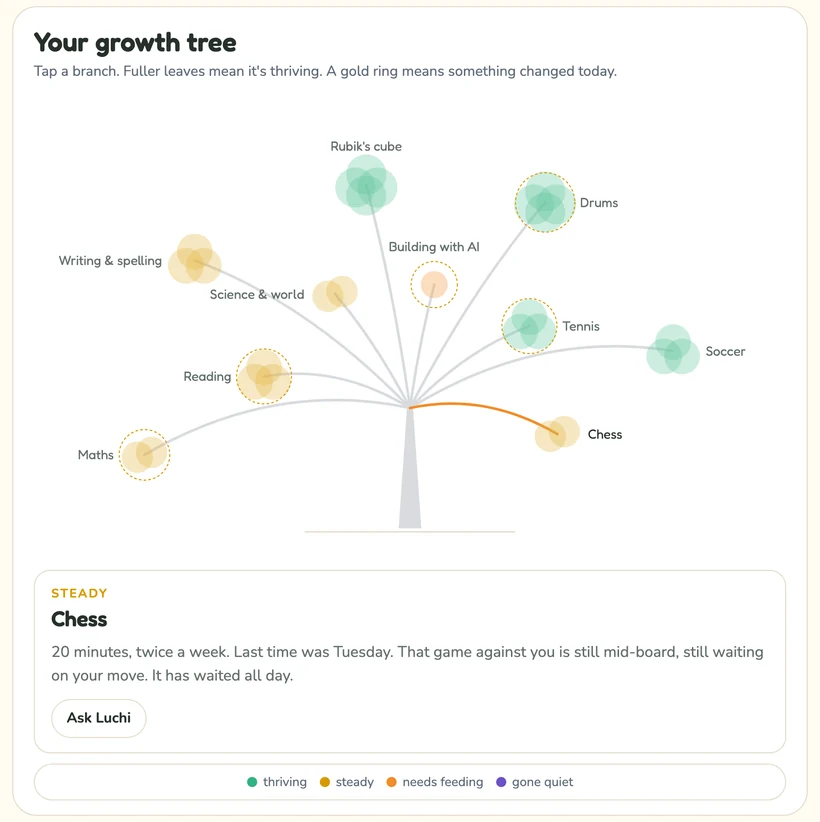
The part of this that defeats most households is not the sort — it is the coming back. Two parent-facing screens Luchi already publishes, and what each is honestly good for here.
The research under this page
Three sources. The first is where the drop criterion comes from and where the number three comes from, the second is why your child’s own estimate cannot be the input, and the third is the ranking that decides what three evenings are worth spending on at all.
- Karpicke & Roediger, 2008 — The critical importance of retrieval for learning. Science, 319(5865), 966–968. ("Learning is often considered complete when a student can produce the correct answer to a question." Once an item had been correctly produced it was, by condition, repeatedly studied but dropped from testing, repeatedly tested but dropped from study, or dropped from both. "Repeated studying after learning had no effect on delayed recall, but repeated testing produced a large positive effect. In addition, students’ predictions of their performance were uncorrelated with actual performance.") Used for two separate claims, both quoted rather than paraphrased: dropping an item once it has been produced correctly cost delayed recall while extra studying after that point did not, and students’ predictions of their own performance were uncorrelated with their actual performance. University students on vocabulary pairs — the transfer to a child is the structure of the decision, not the size of the effect. What it does not show: University students on Swahili–English vocabulary pairs in a laboratory, over one week — a long way from a child revising fractions. Cited for two things that do transfer and that a parent can act on: dropping an item once it has been right once is a decision with a measured cost, and the learner’s own prediction of what they would remember carried no information. It is NOT evidence about how many repetitions any particular child needs.
- Rawson & Dunlosky, 2011 — Optimizing schedules of retrieval practice for durable and efficient learning: how much is enough? Journal of Experimental Psychology: General, 140(3), 283–302. (Three experiments, 533 students, "more than 100,000 short-answer recall responses were collected and hand-scored". "Relearning had pronounced effects on long-term retention with a relatively minimal cost in terms of additional practice trials. On the basis of the overall patterns of durability and efficiency, our prescriptive conclusion for students is to practice recalling concepts to an initial criterion of 3 correct recalls and then to relearn them 3 times at widely spaced intervals.") Used for the replacement number and for nothing else. The authors’ own prescriptive conclusion is three correct recalls followed by three widely spaced relearnings, and their finding that relearning is cheap is what makes the rule survivable on a weeknight. A floor worth copying, not a measurement of your child. What it does not show: University students learning conceptual material, with durability measured one to four months later — not a child on a Friday test. What transfers is the SHAPE of the prescription: one correct recall is not a finish line, and coming back cheaply several times buys more than drilling harder once. The number three is the authors’ own prescriptive conclusion from their materials, so it is worth copying as a floor and is not a measured property of your child. Crossref carries no abstract for this DOI; the quoted finding is read from the Europe PMC record (hit 1, full abstract) against a positive control that returned in the same call.
- Dunlosky, Rawson, Marsh, Nathan & Willingham, 2013 — Improving students’ learning with effective learning techniques: promising directions from cognitive and educational psychology. Psychological Science in the Public Interest, 14(1), 4–58. Used for the prior question: of everything three evenings could be spent on, practice testing and distributed practice were the only two of ten techniques rated high utility. It is what justifies spending the evenings this way instead of on summarising or highlighting, and it is a review of the general literature rather than a study of children. What it does not show: Rates ten techniques across subjects and ages; practice testing and distributed practice were the only two rated high utility. It is a review of the general literature, not a study of times tables or of elementary-age children specifically.
Questions parents ask
- How should my child study for a test?
- By being asked questions rather than going over notes — that part is well established and there is a separate page on how to run it. The decision this page is about comes first: which topics. Do one cold question per topic in a single sitting before any studying happens, sort into produced-it / half-there / nothing, and spend the evenings on the middle pile only. The ends of that range are the two places effort converts worst.
- My child says they already know it. Should I believe them?
- Not as evidence, and not because they are being lazy. In the experiment that measured it, learners’ predictions of what they would remember were uncorrelated with what they actually remembered — the word is the researchers’ own. One cold question settles it in fifteen seconds and removes the argument entirely, which is usually worth more than the information.
- When can we stop practising something?
- Later than feels right. Getting it right once and crossing it off is the move with a measured cost: in the study that compared them, items dropped after one correct recall did worse on the delayed test, while extra studying after that point added nothing. The best-evidenced replacement is three correct recalls, then a few cheap returns at growing gaps — and the returns are genuinely cheap, which is what makes this survivable.
- The test is tomorrow and nothing has been done.
- Then do the sort anyway — it takes eight minutes and it is the difference between revising three topics and revising the wrong three. Spend what is left on the half-known pile, and be straight with yourself that one evening buys Friday and not next term. If this is a recurring Thursday night, the thing to change is not the evening, it is that the first session now happens on Monday.
The coming back, without anyone remembering
The sort is twenty minutes of your life. The returning is what fails, every week, in every household. Luchi brings an idea back as a short check on its own schedule, counts it mastered only after it has come back right on three separate days, and writes you a weekly note in your child’s own words about what they actually said.
Part of the series: How to end the daily homework battle
Related guides in this series
- Teaching kids to start homework without reminders — Independence is a prompt you remove on purpose, not a trait you wait for. A five-rung ladder from "you say it daily" to "you only ask afterwards", with how long each rung takes.
- Seven practical homework focus strategies — Seven things that help once they have started, in the order worth trying them — plus an honest table of which rest on solid evidence and which do not.
- What parents should know about AI homework helpers — Unguarded AI help measurably lowered later unaided test scores; guardrails removed the harm. What is known, what is not, and five questions to ask any product.
- AI homework help for kids — Where the line sits between help and doing it for them, subject by subject — plus a five-step routine for one hard question and five questions to ask any homework product.
- Is my kid cheating with AI? — Why AI detectors are not reliable enough to accuse a child on, the ninety-second check that is, and what to do about each of the four things you are likely to find.
- The after-school hour, without the nagging — The fight is about the forty minutes before homework. A five-block plan, the four traps that turn a routine back into nagging, and the research that makes it work.
- Is your child actually learning from AI? — Fluent output is not learning. The three signs of real learning, the three signs the tool did the thinking, and a five-point checklist a parent can run on any AI app tonight.
- Your child has been accused of using AI — The detectors are published as unreliable by the people who test them. What to do in the first hour, what to ask the school, and what it calls for in each of the four things it might actually be.
- When reading is hard: what AI helps with, and what it hides — One sentence from a child can mean three different problems, and they want opposite responses. A ten-minute check that tells you which, what read-aloud support actually measures, and the dull thing with the best evidence.
- My child just asks the AI for the answer — Not laziness — a help-seeking failure documented in tutoring software twenty years before chatbots. The one change with a measured effect, and the commit-first rule you can start tonight.
- Let the AI mark the draft, not write it — The feedback research says it has to be nonevaluative, supportive, timely and specific — and a chatbot’s default reply fails three of the four. The sentences that fix that, and why the child does the typing.
- A science fair project with AI, without the AI doing it — Teacher-led science beat student-led by about .40 in effect size across 37 studies — so hands-off and hand-it-over fail the same way. Which two of six parts a chatbot helps with, and the four questions that prove the project is theirs.