When your child can read, but can’t do the word problems
They can do the sum on its own. They can read the page out loud without a stumble. Put the two together and it stops. That is not a contradiction and it is not carelessness — word problems need a third thing that neither reading nor arithmetic supplies, and it is the part nobody teaches on purpose. Here is how to find out which of three places it actually breaks, and what to do about each.

Why a good reader can be stuck here
Fuchs and colleagues followed 206 children from the beginning of second grade to test a specific idea: that solving a word problem is a form of text comprehension. It mostly is — working memory and reasoning did the same work for word problems as for ordinary reading. But one piece did not line up. The effect of general language comprehension on word problems ran partly through something they called word-problem-specific language, while on ordinary text it ran directly.
In plain terms: there is a dialect. "How many are left", "three times as many", "altogether", "how many more does Ben have than Ana" — not hard English, and a fluent reader can decode every word and still not know that the last one is a subtraction wearing a comparison costume. The vocabulary of maths is learned separately from the vocabulary of reading, and mostly picked up by accident.
That changes what to do next, because the obvious interventions aim at the wrong thing. More arithmetic will not help a child who can already do the arithmetic; more reading will not help a child who already reads. The gap is the translation step between them, and it is teachable in its own right.
The ten-minute diagnosis: which of three places is it?
- 1. Pick a problem they got wrong, and do not mention it was wrong Choose one from last week, not from tonight’s unfinished homework. Nothing diagnostic happens while a deadline is in the room, and you are not trying to get this one finished.
- 2. Ask them to tell you the story with no numbers in it "Forget the maths. What is happening in this one?" If they cannot retell it — who is doing what to what — the break is comprehension, and you have found it in about ninety seconds. This is less common than parents expect and more common than teachers see, because a child who can read aloud looks fine from the front of a classroom.
- 3. Ask what the question is asking for Not the answer — the thing being asked for. "Is it asking how many in total, or how many more, or how many each?" This is where most children in the seven-to-twelve range actually stop, and it is the dialect problem. They have the story and they do not know what the last sentence wants.
- 4. Ask which operation, and then let them say why If they say "add" to a comparison problem, ask what made them think so. The honest answer is often "because the last three were adding", or "because it says altogether". That is a child running a keyword strategy, which works until it does not, and is worth knowing about.
- 5. Only now, let them compute If the answer comes out right once you have talked through the first four steps, the arithmetic was never the problem — the most common result of this exercise. Say so, in those words. A child who thinks they are bad at maths because of word problems has usually mislocated their own difficulty, and relocating it is worth more than tonight’s answer.
What the stuck point means, and what to do for a fortnight
One row per break point. Pick the row the diagnosis landed on and do only that; running all three at once is how a ten-minute routine becomes a thing your child dreads.
| Where it broke | What that means | What to do for the next two weeks |
|---|---|---|
| Cannot retell the story without numbers. | A comprehension problem that happens to be in a maths lesson. The maths is downstream and currently irrelevant. | Retelling only, one problem a night, out loud, numbers banned. Add the maths back once the retelling is easy. Mention it to the teacher — it may be showing up in other subjects where it is easier to miss. |
| Retells it fine, cannot say what is being asked. | The maths dialect. Most common in this age range by a distance, and the most fixable. | Build a short list of the phrases that keep appearing in their own homework, with what each one is asking for in their words. Theirs, not yours — a phrase they wrote down is one they will recognise next week. |
| Knows what is asked, picks the wrong operation. | They are matching keywords rather than modelling the situation. It works on simple problems and collapses on two-step ones. | Draw it before computing — two bars for the parts and one for the total, or counters on the table. The point is to make the relationship visible so the operation follows from it instead of from a word. |
| All of the above is fine, the arithmetic is wrong. | An ordinary fact-fluency gap, and the word problem is just where it became visible. | Leave word problems alone for now and practise the facts themselves — short, daily, mixed up. That is a different page and a well-evidenced routine. |
Honest limits on the bit everyone sells you
Drawing the problem — bar models, schemas, "the picture" — is the headline advice everywhere. It is reasonable, and the evidence is weaker than the confidence of the advice suggests. Griffin and Jitendra ran an eighteen-week comparison in third-grade classrooms between schema-based instruction and ordinary general strategy instruction. Both improved, and schema-based instruction did not beat the general approach on the standardised post-test.
So the modest claim is the one worth making: having an explicit routine beats having none, and which routine matters less than whether it is used every time. Fuchs and colleagues got third-grade gains by teaching an explicit routine with self-checking built in — delivered by teachers, in school, over weeks.
That last clause is the limit on this whole page. Every study here ran in classrooms, taught by teachers. None measured a parent doing this at a kitchen table for ten minutes, and nobody should tell you it did. What transfers is the shape — diagnose before you teach, use one routine, make the relationship visible before choosing an operation — not a promised result.
What it looks like when the dialect is the thing being learned
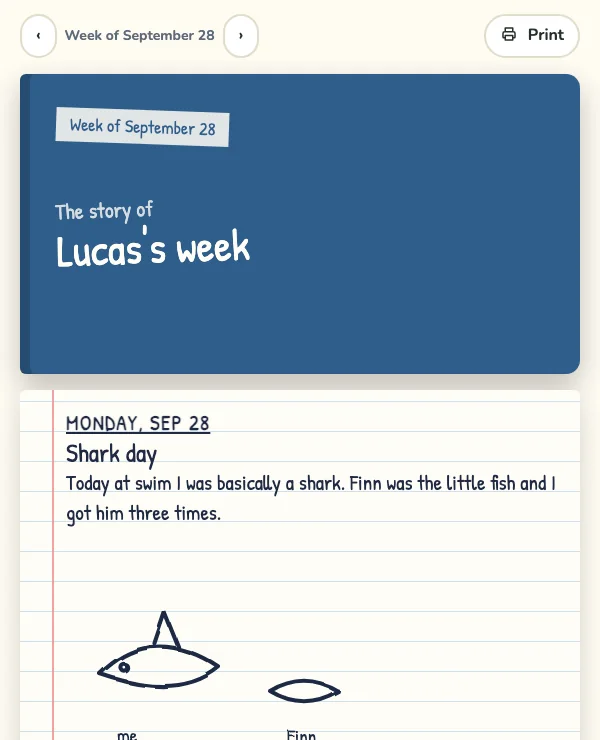
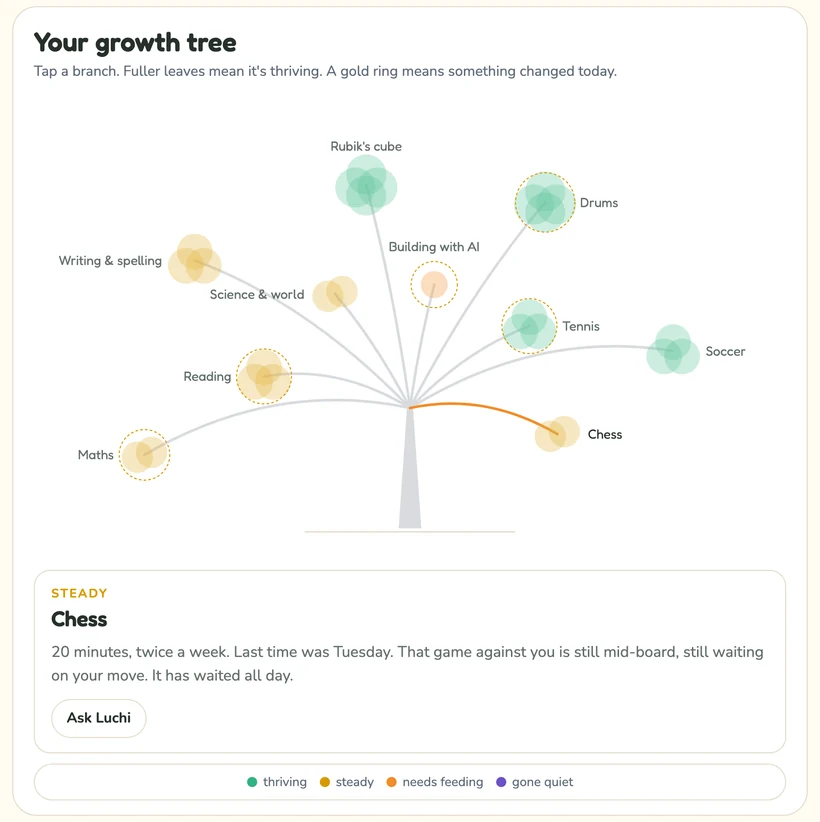
The reason this gap persists is that it is invisible in a mark. A wrong answer looks the same whether the child misread the story, misread the question, or just miscounted. Two parent-facing screens Luchi already publishes, and what each is honestly good for here.
The research under this page
Three sources, one of which is cited for its null result. All three are classroom or school studies of children in roughly this age range, and none of them tested a parent running the routine at home.
- Fuchs, Fuchs, Compton, Hamlett & Wang, 2015 — Is word-problem solving a form of text comprehension? Scientific Studies of Reading, 19(3), 204–223. (206 children followed from the beginning of second grade; word problems required WP-SPECIFIC language comprehension on top of general language comprehension, while working memory and reasoning behaved the same way for word problems and for ordinary text.) Used for the central mechanism: word problems need word-problem-specific language comprehension on top of general language comprehension. It is a mediation analysis, so it shows which skills travel together rather than proving that teaching the dialect raises scores. What it does not show: A path-analytic mediation study, so it is about which skills travel together, not proof that teaching maths vocabulary raises word-problem scores. It also does not say reading is the bottleneck — the point is the opposite, that a child can read the words and still not have the maths-specific language.
- Fuchs, Fuchs, Prentice, Burch, Hamlett & Owen, 2003 — Enhancing third-grade students’ mathematical problem solving with self-regulated learning strategies. Journal of Educational Psychology, 95(2), 306–315. Used for the claim that an explicit, self-checked routine helped third graders — the basis for "one routine, used every time". Delivered by teachers in classrooms over weeks, which is the limit on reading it as advice for a kitchen table. What it does not show: A classroom intervention with third graders, in school, delivered by teachers. It supports teaching an explicit routine rather than hoping for transfer; it is not evidence about a parent running the same routine at a kitchen table, and no study in this cluster is.
- Griffin & Jitendra, 2009 — Word problem-solving instruction in inclusive third-grade mathematics classrooms. The Journal of Educational Research, 102(3), 187–202. (An 18-week comparison of schema-based instruction — teaching the shape of a problem — against general strategy instruction.) Cited for what it did NOT find. Over eighteen weeks, schema-based instruction did not outperform general strategy instruction on the standardised post-test, which is why this page does not sell bar models as the answer. What it does not show: CITED WITH ITS NULL RESULT, NOT AS SUPPORT FOR BAR MODELS. Both conditions improved, and schema-based instruction did NOT beat general strategy instruction on the standardised post-test. Anyone citing this as proof that drawing the problem wins is citing more than it found; what it supports is that having SOME explicit routine beats having none.
Questions parents ask
- Why does my child struggle with word problems but not with math?
- Because they are not the same task. Fuchs and colleagues found word problems draw on a word-problem-specific kind of language comprehension that ordinary reading does not need — the dialect of "altogether", "how many more", "three times as many". A child can have the arithmetic and the reading and still be missing the translation between them. That is a separate skill, not carelessness.
- Should I teach my child keywords like "altogether means add"?
- Sparingly, and knowing where it breaks. Keyword matching works on one-step problems and fails on two-step ones and on anything worded to defeat it — most of what they meet from about fourth grade. Treat it as a temporary scaffold, not the method. If your child is already running one silently, the diagnosis above surfaces it.
- Do bar models and drawing the problem actually work?
- They help, with less evidence behind them than the confidence of the advice suggests. In an eighteen-week third-grade comparison, Griffin and Jitendra found schema-based instruction did not outperform general strategy instruction on the standardised post-test, though both improved. Use one routine consistently rather than shopping for the best one.
- How long should this take before I worry?
- Two weeks of a short nightly routine aimed at the one break point you found is enough to see movement. If nothing shifts, that is worth one email to the teacher — and what you can report is specific: "she can retell the problem but cannot say what it is asking for" is far more actionable than "she struggles with word problems".
Let the asking come from somewhere else
The diagnosis is yours to run once. Doing it nightly is a lot to ask of a kitchen table. Luchi works through a problem with your child by asking what the question is looking for rather than handing over the answer, and writes you a short note afterwards in their own words.
Part of the series: Math games for kids
Related guides in this series
- When your child says they’re bad at math — "I’m bad at math" is a loop, not a level — and one of the clearest findings in it is about the parent doing the helping, not the child. Five things to change this week.
- When you can’t help with the math homework — You do not need to learn the new method. Four moves that need no math from you, one line each on what the number lines and arrays are for, and when to email the teacher.
- Times tables that actually stick — Retrieve, space it, mix it up — the three findings that do nearly all the work, in five minutes a day. Plus four practice formats scored honestly against the evidence.
- When fractions stop making sense — Not effort, and not ability — a rule that worked for four years and stops working here. Three questions in ten minutes tell you which version you have, and each one has a different fortnight behind it.
- “Careless mistakes” are usually not careless — A wrong answer is produced by something, and since 1978 we have known it is often a consistent bad step rather than inattention. Ten wrong answers, fifteen minutes, and why "check your work" cannot catch it.