When fractions stop making sense
Your child was fine at maths and then fractions arrived and they were not. That is the most ordinary story in this subject, and it is usually not about effort or ability: it is a rule that worked perfectly for four years and quietly stops working here. Three questions, ten minutes, tell you which version of it you have — and the version decides what is worth practising for the next fortnight.

Why this topic and not another one
Fractions get a disproportionate amount of parental worry, and for once the worry is pointing at something. Siegler and colleagues analysed nationally representative longitudinal data from both the United States and the United Kingdom and found that "elementary school students’ knowledge of fractions and of division uniquely predicts those students’ knowledge of algebra and overall mathematics achievement in high school, 5 or 6 years later, even after statistically controlling for other types of mathematical knowledge, general intellectual ability, working memory, and family income and education."
That is an unusually heavy set of controls, and a different research group found the same direction with a different design: Bailey, Hoard, Nugent and Geary followed 212 children and found sixth-grade fraction concepts predicted a year of gains in maths achievement, over and above whole-number arithmetic fluency, number-line performance, working-memory span and intelligence.
Now the honest caveat, in the same breath rather than in a footnote, because the unlicensed version of this is what a tutoring advert prints: both are correlational. Neither shows that teaching your child fractions raises their algebra marks at sixteen. What they jointly support is narrower and still worth your fortnight — of everything a nine-year-old is doing in maths, this is the topic most worth not leaving broken.
The rule that worked for four years
Everything your child has met until now behaved one way. Bigger digits meant bigger numbers. Multiplying made things bigger and dividing made them smaller. Numbers had a next one. Every one of those is false for fractions, and none of them was ever stated out loud as a rule, which is exactly why it does not get unlearned — you cannot retire a belief nobody knows they hold.
So one eighth looks bigger than one fifth, because eight is bigger than five. One half plus one third comes out as two fifths, because that is what adding looks like. Multiplying by three quarters is expected to make the number grow, and when it does not, the arithmetic feels broken rather than the rule.
Siegler, Thompson and Schneider put the useful half of this in one idea: what whole numbers and fractions have in common is "the centrality of knowledge of numerical magnitudes in overall understanding", and in their eleven- and thirteen-year-olds the accuracy of a child’s sense of how big a fraction IS accounted for achievement beyond their ability to compute with fractions at all. Being able to carry out the procedure and knowing what the number is worth are separable, and the second one is the one that is missing.
There is one more finding here that is uncomfortable and that changes what you do. Siegler and Pyke compared lower- and higher-achieving sixth and eighth graders and found the gap "much greater in 8th grade" — the lower-achieving children knew about the same amount two years later — "despite both groups having been in the same classrooms, using the same textbooks, and having the same teachers and classmates." More of the same lesson is the intervention those data already ran. Something has to be different, not just longer.
Three questions, ten minutes, tonight
- 1. Set it up as curiosity, not a test "I read something about fractions and I want to try three questions on you." No marking, no scores, no reaction to a wrong answer beyond "interesting, why?". The why is where the information is — a right answer for a wrong reason and a wrong answer are the same state, and only the reason tells you which you have.
- 2. Which is bigger: one fifth or one eighth? If they say one eighth, you have the whole-number rule, cleanly. Ask why and you will usually hear "because eight is more". That is not a slip and it is not guessing; it is a consistent belief being applied correctly to the wrong kind of number.
- 3. Draw a line, mark the ends nought and one, and ask them to put three quarters on it Nothing else on the line. Watch where their hand goes before it lands. Confident and roughly right is a working sense of magnitude. Hovering, or landing past the one, or treating the line as a row of boxes to count, means the number does not yet have a size — which is the thing the research says most predicts the rest.
- 4. What is one half plus one third — and is the answer bigger or smaller than one half? Ask the second part even if the first one defeats them, because it is the diagnostic one. A child who cannot do the procedure but knows the answer has to be more than a half has magnitude and is missing a method, which is a good position. A child who produces two fifths and is content with it has an answer smaller than what they started with and did not notice, which is the position worth working on.
What each answer means, and what to do for a fortnight
Find the row that matches and do that one thing. Running all four at once is how a ten-minute conversation becomes a nightly ordeal, and the rows are not a sequence — most children are only in one.
| What happened | What it means | The next two weeks |
|---|---|---|
| One eighth is bigger, because eight is bigger. | The whole-number rule, applied consistently. Not carelessness — a correct inference from four years of evidence. | Unit fractions on a number line, nothing else. One half, one third, one quarter, one eighth, placed by hand on a drawn line, every night for a week. Say the rule out loud once — "the more pieces, the smaller each one" — and then stop talking and let the line do it. |
| The three quarters mark lands anywhere, or past the one. | No magnitude yet. The symbol is a pair of digits rather than a quantity, which is the thing most associated with later achievement in the cited work. | Measurement, not pictures. A tape measure, a kitchen scale, a jug with markings. Ask for three quarters of a cup and let them be wrong and check. The goal is that a fraction becomes an amount of something before it is an operation. |
| One half plus one third is two fifths, and that seems fine. | Procedure running without a sanity check. The estimate and the computation are not talking to each other. | Estimate before computing, every time, and only then do the sum. "Is it going to be more or less than a half?" One sentence, before any pencil moves. You are not teaching common denominators this fortnight — you are installing the check that would have caught it. |
| Cannot do the sum, but knows the answer must be over a half. | Magnitude is there and the method is missing. This is the best of the four and the easiest to mistake for the worst. | Teach the procedure, and know that it will land, because there is something for it to land on. Mention to the teacher that the understanding is ahead of the method — it is the one version of this that a teacher can act on in a week. |
The thing to stop doing, and the honest limits
The default picture for fractions is a circle cut into slices, and it is not wrong so much as it is finished too early. A pizza can show you three quarters of one thing. It cannot show you where three quarters sits relative to two thirds, it cannot show you seven quarters at all, and it cannot survive the moment fractions stop being parts of a cake and start being numbers you do arithmetic with. The work cited on this page is about magnitude, and the representation that carries magnitude is a line with positions on it.
So the swap is small and specific: when you reach for a picture, draw a line with nought and one on it instead of a circle. Keep the pizza for explaining what a denominator is on the first day, and then put it away.
Three limits, because this subject attracts more confidence than the evidence supports. The predictive findings are correlational, and a strong set of controls is not a randomised trial. The magnitude work was done with eleven- and thirteen-year-olds, at the top of the range this page is written for and above it. And none of these studies measured a parent doing anything at a kitchen table — what transfers is which thing is worth looking at, not a promised result from looking at it.
Unassessed maths, for the fortnight where everything is tense · If the method on the page is the part you cannot follow
What the misconception looks like when it is written down
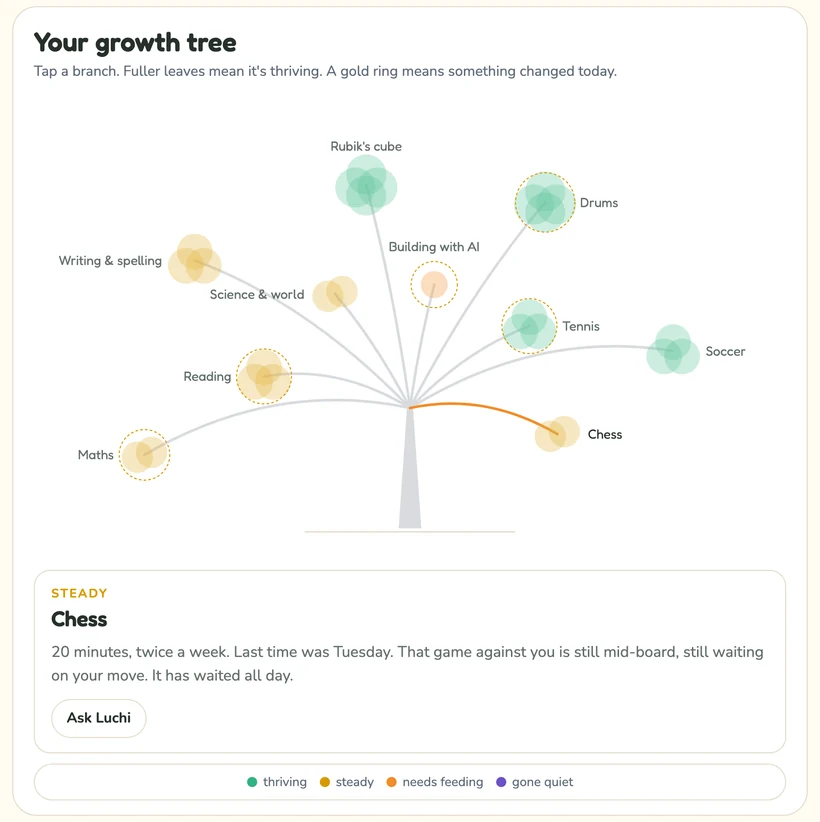
The reason this one runs for months is that it is invisible in a mark. "One eighth is bigger" and a slip of the pen produce the same red cross. Two parent-facing screens Luchi already publishes, and what each is honestly good for here.
The research under this page
Four sources. Two establish why this topic is worth the fortnight and are cited with their correlational limit attached; two are about what is actually going wrong inside the child.
- Siegler, Duncan, Davis-Kean, Duckworth, Claessens, Engel, Susperreguy & Chen, 2012 — Early predictors of high school mathematics achievement. Psychological Science, 23(7), 691–697. ("Analyses of large, nationally representative, longitudinal data sets from the United States and the United Kingdom revealed that elementary school students’ knowledge of fractions and of division uniquely predicts those students’ knowledge of algebra and overall mathematics achievement in high school, 5 or 6 years later, even after statistically controlling for other types of mathematical knowledge, general intellectual ability, working memory, and family income and education.") Used for why fractions and not some other topic: fractions and division knowledge in elementary school uniquely predicted high-school algebra and overall maths achievement in two national data sets, with heavy controls. Correlational, which the page states next to the claim rather than in a footnote. What it does not show: Longitudinal and CORRELATIONAL. Controlling for other mathematical knowledge, intellectual ability, working memory and family background is a strong set of controls and it is still not a randomised trial — so this supports "fractions knowledge at ten is unusually predictive of maths at sixteen" and does not support "teach your child fractions and their algebra marks will rise". The page citing it says so in the same breath, because the unlicensed version of that sentence is exactly what a tutoring advert prints.
- Bailey, Hoard, Nugent & Geary, 2012 — Competence with fractions predicts gains in mathematics achievement. Journal of Experimental Child Psychology, 113(3), 447–455. (A cross-lagged study of 212 children across sixth and seventh grade. "The cross-lagged effects indicated that performance on the sixth grade fractions concepts measure predicted 1-year gains in mathematics achievement", and "measures of fluency with computational fractions significantly predicted seventh grade mathematics achievement above and beyond the influence of fluency in computational whole number arithmetic, performance on number fluency and number line tasks, central executive span, and intelligence".) Used as the independent check on the sentence above — a different group, a different design, 212 children, same direction. One result is a result; two from separate labs is a finding. Also correlational. What it does not show: Also correlational, and 212 children is a far smaller sample than the national data sets above. It is cited for exactly one job that the larger study cannot do for itself: an INDEPENDENT research group finding the same direction with a different design, which is the difference between a result and a finding. Crossref carries no abstract for this DOI; the quoted text is read from the Europe PMC record (hit 1) against a positive control that returned in the same call.
- Siegler, Thompson & Schneider, 2011 — An integrated theory of whole number and fractions development. Cognitive Psychology, 62(4), 273–296. ("Although whole numbers and fractions differ in many ways that influence their development, an important commonality is the centrality of knowledge of numerical magnitudes in overall understanding. The present findings with 11- and 13-year-olds indicate that, as with whole numbers, accuracy of fraction magnitude representations is closely related to both fractions arithmetic proficiency and overall mathematics achievement test scores, that fraction magnitude representations account for substantial variance in mathematics achievement test scores beyond that explained by fraction arithmetic proficiency.") Used for the central mechanism: a child’s sense of how big a fraction is accounts for achievement beyond their ability to compute with fractions, so magnitude and procedure come apart. Eleven- and thirteen-year-olds, and a theory paper rather than a teaching trial. What it does not show: The sample is 11- and 13-year-olds, which sits at the top of the range this page is written for and above it. It establishes that magnitude knowledge is associated with fraction arithmetic and with achievement over and above arithmetic proficiency — an association, in a theory paper, not a trial of teaching magnitude first. Crossref carries no abstract for this DOI; the quoted finding is read from the Europe PMC record (hit 1) against a positive control that returned in the same call.
- Siegler & Pyke, 2013 — Developmental and individual differences in understanding of fractions. Developmental Psychology, 49(10), 1994–2004. ("Results indicated that the difference between low achieving and higher achieving children’s fraction arithmetic knowledge, already substantial in 6th grade, was much greater in 8th grade. The fraction arithmetic knowledge of low achieving children was similar in the 2 grades, whereas higher achieving children showed much greater knowledge in 8th than 6th grade, despite both groups having been in the same classrooms, using the same textbooks, and having the same teachers and classmates.") Used for the uncomfortable one: the gap between lower- and higher-achieving children was much wider two years later despite identical classrooms, textbooks, teachers and classmates. Cross-sectional, so it shows a wider gap at the later grade rather than a gap opening inside one child — and it is why this page asks for something different rather than something longer. What it does not show: Cross-sectional, so the two-grade comparison is between different children rather than the same children followed forward — it shows a gap that is wider at the later grade, not a gap opening inside one child. Cited for the thing a parent most needs to hear and that no amount of effort talk substitutes for: the children who were not learning fractions sat in the same rooms with the same teachers and the same books as the children who were, so "more of the same lesson" is the one intervention these data already ran. Crossref carries no abstract for this DOI; the quoted finding is read from the Europe PMC record (hit 1) against a positive control that returned in the same call.
Questions parents ask
- Why does my child suddenly struggle with fractions when they were fine at maths?
- Because fractions break rules that were reliable until now and were never said out loud: bigger digits mean bigger numbers, multiplying makes things bigger, every number has a next one. All false here. A child applying those consistently is not being careless — they are generalising correctly from four years of evidence, which is why "concentrate harder" does nothing. The fix is to find which rule is still running and replace it, and the three questions above identify it in about ten minutes.
- Is one eighth bigger than one fifth? My child thinks so.
- No — one fifth is bigger, and the belief behind the wrong answer is the most common single misconception in this topic. The more pieces you cut something into, the smaller each piece is, which is a sentence children can repeat long before it changes their answers. What changes answers is placing unit fractions on a drawn number line by hand, repeatedly, until the ordering is something they can see rather than something they recite.
- How important are fractions really?
- More than most topics, with a caveat. Elementary fractions knowledge uniquely predicted maths achievement in high school five or six years later in two national data sets, even after controlling for other maths knowledge, intellectual ability, working memory and family background — and an independent group found the same direction in a separate sample. Both studies are correlational, so this is a reason to prioritise fractions over another topic, not a promise that fixing them buys an algebra grade.
- Should we use pizza slices or a number line?
- Both, in that order, and the circle has a shorter life than people expect. Slices are a reasonable way to introduce what a denominator means on day one. They cannot show where three quarters sits relative to two thirds, cannot represent seven quarters, and do not survive the point where fractions become numbers you do arithmetic with. The research on this page is about magnitude, and magnitude lives on a line.
The explaining, where the rule shows itself
A wrong answer tells you almost nothing; the reason behind it tells you everything, and the reason only arrives if somebody asks. Luchi asks your child why, in the moment, and writes you a short weekly note from what they actually said — which is where a belief like "more pieces means bigger" becomes visible instead of staying inside a red cross.
Part of the series: Math games for kids
Related guides in this series
- When your child says they’re bad at math — "I’m bad at math" is a loop, not a level — and one of the clearest findings in it is about the parent doing the helping, not the child. Five things to change this week.
- When you can’t help with the math homework — You do not need to learn the new method. Four moves that need no math from you, one line each on what the number lines and arrays are for, and when to email the teacher.
- Times tables that actually stick — Retrieve, space it, mix it up — the three findings that do nearly all the work, in five minutes a day. Plus four practice formats scored honestly against the evidence.
- When your child can read, but can’t do the word problems — Word problems need a third thing that neither reading nor arithmetic supplies. A ten-minute diagnosis that finds which of three places it breaks, and what to do about each.
- “Careless mistakes” are usually not careless — A wrong answer is produced by something, and since 1978 we have known it is often a consistent bad step rather than inattention. Ten wrong answers, fifteen minutes, and why "check your work" cannot catch it.