When reading is hard: what AI helps with, and what it hides
"Reading is hard" is at least three different problems, and they want opposite responses. Getting a machine to read the page aloud is a genuine help for one of them, does nothing for another, and quietly conceals the third — which is why the honest first move is ten minutes of working out which one you are looking at, before any tool is involved at all.
Three problems wearing the same sentence
Gough and Tunmer proposed a model simple enough to be useful at a kitchen table: reading is the product of decoding and comprehension. Because it is a product rather than a sum, "it follows that there must be three types of reading disability, resulting from an inability to decode, an inability to comprehend, or both." Either factor near zero takes the whole thing down, which is why two children who both say reading is hard can need completely different help.
In plain terms. One child can say the words but has no idea what the paragraph meant. Another knows exactly what it means when you read it to them but cannot get the words off the page. A third has both. Those are not degrees of the same problem — they are different problems, and the support that rescues one can mask another.
Two caveats worth stating before anyone acts on this. It is a model from the 1980s, not a measurement, and reading researchers have argued about it ever since, mostly over whether "comprehension" is one thing. And it is not a diagnostic instrument. Nothing on this page identifies a learning difficulty or rules one out; if what you find below worries you, the next step is your school’s assessment process, not a tool and not an article.
The ten-minute check that tells you which one
- 1. Have them read a short passage aloud to you Pick something they have not seen, around a page, roughly at their school level. Listen only to the getting-the-words-out part and keep your face neutral. Hesitation on individual words, guessing from the first letter, losing the line, reading in a flat monotone because every word costs effort — those point towards decoding. If that is where it breaks, nothing further down this page matters as much as telling the school what you just heard.
- 2. Now ask them to tell you what happened No looking back at the page. Not a quiz — just "what was that about?" and then one question about something not stated outright. A child who read it fluently and cannot retell it is showing you the comprehension side. A child who struggled through every word and then retells it well has told you something important: the understanding is intact and the bottleneck is access.
- 3. Read the same kind of passage to them and ask again This is the step that separates the three cases, and it is the one people skip. If their retelling is dramatically better when you did the reading, the comprehension machinery works and the words on the page are the obstacle. If it is just as thin when they only had to listen, then audio support of any kind — human or machine — is not the thing that will help, and that is genuinely useful to know before you buy anything.
What read-aloud actually does, measured
If step three said the bottleneck is access, there is real evidence behind having text read aloud — and it is more modest than the products built on it imply. Wood, Moxley, Tighe and Wagner meta-analysed text-to-speech and related read-aloud tools for students with reading difficulties and reported an average weighted effect size of 0.35, with a confidence interval running from 0.14 to 0.56. Their own summary is appropriately careful: this "suggests that text-to-speech technologies may assist students with reading comprehension. However, more studies are needed."
That is worth having and it is not a cure. A real but modest average, imprecisely known — and critically, it is evidence about understanding while listening. It says nothing about whether the child gets better at reading the words. Text-to-speech is a ramp, and a ramp is enormously valuable when the problem is a step; it is not instruction, and treating it as instruction is how a decoding problem goes unaddressed for a year while the child keeps up in every subject.
The practical rule that falls out of this is simple enough to hold in your head. Use audio support freely for the things reading is in the way of — the science text, the instructions, the history chapter, anything where the reading is a toll rather than the lesson. Do not use it for reading practice itself, because the practice is the part being skipped.
The same shape, when the subject is maths · Where AI help fits in homework generally
The thing with the fluency evidence is unglamorous
If decoding is the problem, the intervention with the strongest track record is not a product. Therrien meta-analysed repeated reading — rereading the same short passage aloud a few times — and found it "can be used effectively with nondisabled students and students with learning disabilities to increase reading fluency and comprehension on a particular passage and as an intervention to increase overall fluency and comprehension ability." Both halves matter: it improves the passage in front of them, and it improves reading generally.
The part that resists being replaced by an app is that the studied versions involve an adult listening and correcting, and Therrien is explicit that which components matter depends on the version of the technique. So an app that plays audio is not doing this, and neither is an app that listens and scores. Four or five minutes, same short passage, three times through, a few evenings a week, with you in the room — that is the whole protocol, and its ordinariness is the reason it gets skipped in favour of something with a subscription.
Where a machine genuinely earns a place is the part that is hard to do at home: generating material at the right level and on something the child actually cares about, or being the audience for a child who will not read aloud to a parent but will read to something that does not sigh. That is a supply-and-patience problem, which is a reasonable thing to delegate, and it is a different claim from treating anything.
Four ways this goes wrong with a chatbot in the house
- It summarises the book — The most common failure and the least visible. A summary arrives, the homework gets done, and the child has practised nothing — the retrieval that reading a chapter demands is exactly what got skipped. Worth naming explicitly as a thing you do not want, because to a child it looks like efficient studying rather than avoidance.
- It answers the comprehension questions — Comprehension questions are not busywork; they are the retrieval. A tool that answers them removes the only part of the exercise that was doing anything, and it does so while producing a page that looks like completed work — which is why this one survives so long undetected.
- Audio becomes the default for everything — The ramp quietly replaces the stairs. Reading practice stops happening because listening is always easier, and because the grades hold up nobody notices for a long time. The fix is a line, not a ban: audio for the subject, eyes for the reading practice.
- It rewrites their writing — Children who find reading hard often find writing hard too, and a tool that smooths their sentences hides exactly the information a teacher needs to help them. Ask for feedback on what they wrote rather than a better version of it — the distinction is easy for a child to apply once it has been pointed out.
Seeing the comprehension rather than the completion
For a child who finds reading hard, "finished the homework" is the least informative thing you can know. What you want is whether they understood it, in their words.
The research under this page
Three sources. The first is why this page triages before it recommends, and the second is cited with its own hedge attached because the products built on it drop the hedge.
- Gough & Tunmer, 1986 — Decoding, reading, and reading disability. Remedial and Special Education, 7(1), 6–10. ("To clarify the role of decoding in reading and reading disability, a simple model of reading is proposed, which holds that reading equals the product of decoding and comprehension. It follows that there must be three types of reading disability, resulting from an inability to decode, an inability to comprehend, or both." The authors name the three: dyslexia, hyperlexia, and "common, or garden variety, reading disability.") The decomposition the whole page rests on: reading as decoding times comprehension, so one sentence from a child can mean three different problems. A model, not a measurement, and explicitly not a diagnostic tool. What it does not show: A theoretical model from the 1980s, not a measurement, and reading science has argued about it ever since — chiefly that "comprehension" is not one thing. It is cited here for exactly one job: that reading trouble decomposes, so the same support can help one child and hide another child’s problem. It is not a diagnostic instrument and this page does not use it as one.
- Wood, Moxley, Tighe & Wagner, 2018 — Does use of text-to-speech and related read-aloud tools improve reading comprehension for students with reading disabilities? A meta-analysis. Journal of Learning Disabilities, 51(1), 73–84 (print issue January 2018; published online 23 January 2017). ("It is not clear how effective text-to-speech is at improving reading comprehension… Random effects models yielded an average weighted effect size of (d̄ = .35, with a 95% confidence interval of .14 to .56, p < .01). Moderator effects of study design were found to explain some of the variance. Taken together, this suggests that text-to-speech technologies may assist students with reading comprehension. However, more studies are needed to further explore the moderating variables of text-to-speech and read-aloud tools’ effectiveness.") The measured case for read-aloud support, quoted with its interval and its authors’ own "more studies are needed". Evidence about comprehension while listening — not about learning to decode. What it does not show: CITED WITH ITS OWN HEDGE ATTACHED. Students with reading difficulties, and the authors’ own verbs are "may assist" and "more studies are needed" — the confidence interval runs from .14 to .56, so the honest reading is "a real but modest average, imprecisely known", never "text-to-speech fixes reading". It is also evidence about comprehension while listening, which is the case for read-aloud as an access ramp and says nothing about whether decoding improves.
- Therrien, 2004 — Fluency and comprehension gains as a result of repeated reading: a meta-analysis. Remedial and Special Education, 25(4), 252–261. ("Repeated reading is an evidenced-based strategy designed to increase reading fluency and comprehension… This analysis indicates that repeated reading can be used effectively with nondisabled students and students with learning disabilities to increase reading fluency and comprehension on a particular passage and as an intervention to increase overall fluency and comprehension ability. Essential instructional components of repeated reading varied as a function of the type of repeated reading.") Why the recommendation here is four minutes of rereading with an adult rather than a product. The adult listening is a component of the studied technique, not an optional extra. What it does not show: A meta-analysis of a classroom and clinic intervention, with an adult listening and correcting — which is the component this page tells a parent not to delegate. It supports rereading the same short passage aloud a few times; it is not evidence that any app which plays audio produces the same gain, and the authors are explicit that which components matter depends on the version of the technique.
Questions parents ask
- Can AI help a child who struggles with reading?
- For one of the three problems, yes, and usefully. If your child understands things perfectly well when someone reads to them but cannot get the words off the page, read-aloud support removes a toll that was blocking every other subject — the meta-analytic average for text-to-speech with struggling readers is about 0.35, which is real and modest. If the understanding is thin even when you do the reading, audio will not help, and the ten-minute check on this page is how you tell which you have.
- Will text-to-speech stop my child learning to read?
- Not if you draw one line: audio for the subject, eyes for the reading practice. The evidence for text-to-speech is about comprehension while listening, so it says nothing about decoding improving — which means using it everywhere can let a decoding problem coast along invisibly while the grades stay fine. Used for the science chapter and not for reading practice, it is a ramp rather than a substitute.
- Should I get my child assessed?
- If the first step of the check above is where it breaks, tell the school exactly what you heard and ask what their assessment process is. Nothing on this page identifies or rules out a learning difficulty, and no app does either — a tool that offers to screen for dyslexia is making a claim it cannot support. The useful thing you can bring is a specific observation about which part is hard, because that is what gets a conversation past "they just need to read more".
- What actually works if it is the words themselves?
- The best-evidenced thing is also the dullest: rereading the same short passage aloud three times, a few evenings a week, with you listening and correcting. The meta-analysis found that improves fluency and comprehension both on that passage and more generally — and the adult in the room is part of the technique rather than an optional extra, which is the bit an app cannot quietly take over.
Evidence in their words, not a completion tick
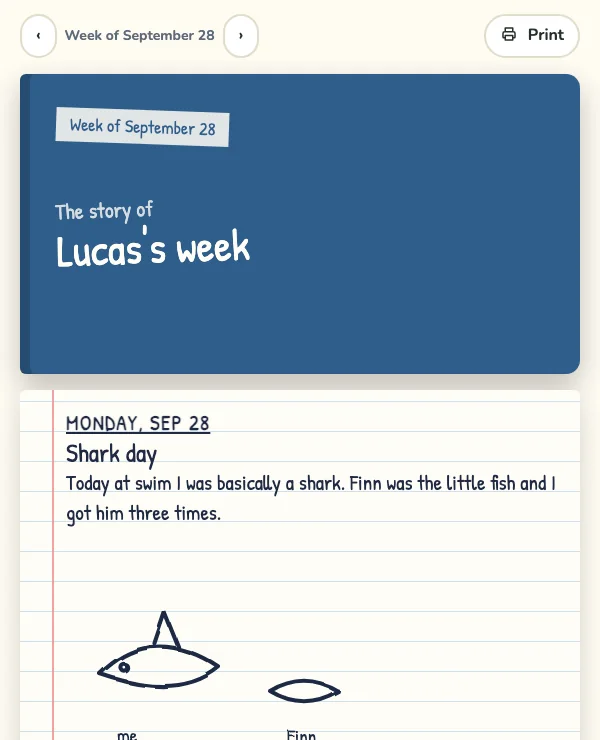
For a child who finds reading hard, the question is never whether the work got finished — it is whether they understood it. Luchi asks a kid to explain what they made and then writes you a short note built from their own words, which is the one thing a finished worksheet cannot tell you.
Part of the series: How to end the daily homework battle
Related guides in this series
- Teaching kids to start homework without reminders — Independence is a prompt you remove on purpose, not a trait you wait for. A five-rung ladder from "you say it daily" to "you only ask afterwards", with how long each rung takes.
- Seven practical homework focus strategies — Seven things that help once they have started, in the order worth trying them — plus an honest table of which rest on solid evidence and which do not.
- What parents should know about AI homework helpers — Unguarded AI help measurably lowered later unaided test scores; guardrails removed the harm. What is known, what is not, and five questions to ask any product.
- AI homework help for kids — Where the line sits between help and doing it for them, subject by subject — plus a five-step routine for one hard question and five questions to ask any homework product.
- Is my kid cheating with AI? — Why AI detectors are not reliable enough to accuse a child on, the ninety-second check that is, and what to do about each of the four things you are likely to find.
- The after-school hour, without the nagging — The fight is about the forty minutes before homework. A five-block plan, the four traps that turn a routine back into nagging, and the research that makes it work.
- Is your child actually learning from AI? — Fluent output is not learning. The three signs of real learning, the three signs the tool did the thinking, and a five-point checklist a parent can run on any AI app tonight.
- Your child has been accused of using AI — The detectors are published as unreliable by the people who test them. What to do in the first hour, what to ask the school, and what it calls for in each of the four things it might actually be.
- My child just asks the AI for the answer — Not laziness — a help-seeking failure documented in tutoring software twenty years before chatbots. The one change with a measured effect, and the commit-first rule you can start tonight.
- Let the AI mark the draft, not write it — The feedback research says it has to be nonevaluative, supportive, timely and specific — and a chatbot’s default reply fails three of the four. The sentences that fix that, and why the child does the typing.
- A science fair project with AI, without the AI doing it — Teacher-led science beat student-led by about .40 in effect size across 37 studies — so hands-off and hand-it-over fail the same way. Which two of six parts a chatbot helps with, and the four questions that prove the project is theirs.
- Studying for a test: what goes on tonight’s list — Eleven topics, three evenings. Asking what they feel shaky about is the one input that has been measured and found uncorrelated with what they actually know — so sort it in eight minutes instead, and do not cross anything off after one right answer.