The five-minute quiz that beats re-reading
Going over the notes again feels like studying. In the experiment that compared them, re-reading raised students’ confidence and testing raised what they actually remembered a week later — and the gap went the wrong way for the group who felt most prepared. This is how to run the testing version in five minutes, with an AI doing the part that used to need you to have read the chapter.
The finding, and why it feels wrong
Roediger and Karpicke had students read prose passages, then either re-read them or take recall tests with no feedback, and measured what stuck after five minutes, two days and a week. After five minutes, re-reading won. On the delayed tests, "prior testing produced substantially greater retention than studying" — and the detail that matters for a parent is the next clause: that was true "even though repeated studying increased students’ confidence in their ability to remember the material."
So the two things came apart. The method that felt like it was working was the one that worked less. A child who has read the chapter three times feels ready and is not, and no amount of asking "do you feel like you know it?" will detect that, because their confidence is tracking the wrong thing.
This is not one study. Adesope and colleagues meta-analysed the literature and found that "practice tests are more beneficial for learning than restudying and all other comparison conditions", with the size of the benefit moderated by the features of the test, the participants and the study design. Which is the honest way to hold it: the direction is about as settled as education research gets, and the magnitude depends on things like whether the child has to produce the answer or pick it.
What has changed is only who can run it. Making a child retrieve requires somebody to ask questions about material they half-know, which is the bit that defeated most households by Tuesday. That part is now cheap.
The other half: how to tell whether it is working · Tools that ask rather than tell
The five minutes
- 1. Books closed first Before anything is typed, ask your child to tell you three things they remember from the topic. Closed book, no notes, no help. It will be uncomfortable and incomplete and that is the active ingredient — the effort of retrieving is what the research is measuring, not the accuracy of what comes out. Do not correct anything yet.
- 2. Have the AI ask, one at a time Then: "Quiz me on the water cycle. One question at a time. Wait for my answer before the next one, and don’t tell me if I’m right until the end." The one-at-a-time instruction is the part people skip, and it is what stops this becoming a worksheet the child reads rather than a test they take. The feedback-at-the-end instruction keeps them producing instead of checking.
- 3. Make them produce the answer, not pick it Ask for short written or spoken answers rather than multiple choice. If the tool offers options, say so: "no multiple choice". The meta-analysis found the benefit varies with the features of the practice test, and recognising a right answer among four is a much weaker version of the act than producing it from nothing. This is the single most common way the five minutes gets wasted.
- 4. Score it together, and stop Go through what they got and what they did not, say the missing bits out loud once, and finish. Five minutes, no revision session on the back of it. The point is that the quiz happened at all — adding twenty minutes of going-over afterwards is precisely the re-reading that lost.
What to type, and the version that quietly fails
Every row on the right is a thing these tools do by default, and each one turns a retrieval exercise back into reading.
| Ask for this | Not this | What goes wrong |
|---|---|---|
| "Quiz me on fractions, one question at a time, wait for my answer." | "Give me ten practice questions on fractions." | Ten questions on screen at once is a worksheet, and a child reads a worksheet before answering it. The whole effect depends on attempting from memory before the next prompt arrives. |
| "Short answers. No multiple choice." | Whatever format it offers. | Multiple choice is recognition, not retrieval. It is the weakest version of the thing the evidence is about, and it is what every quiz generator produces by default because it is easy to mark. |
| "Don’t tell me if I’m right until the end." | "Tell me after each one." | Immediate feedback turns each question into a lookup — the child stops reaching and starts waiting. In the original experiment the tests carried no feedback at all and still beat re-reading. |
| "Ask about what we covered this week, not the whole topic." | "Quiz me on everything in the chapter." | Too wide and nothing is retrievable, so the child fails every question, concludes they know nothing and stops. Narrow enough to half-know is the zone this works in. |
| "Explain photosynthesis — then quiz me on it tomorrow." | "Explain photosynthesis." (and stop there) | An explanation is the comfortable half. It is also the half whose benefit was smaller on every delayed test. Explanations are fine; they are not the exercise. |
When to come back to it
The second lever is timing, and it is the one that makes this nearly free. Cepeda and colleagues synthesised 839 assessments of distributed practice across 317 experiments and reported that the gap between study sessions and the time until the test "operate jointly to affect final-test retention" — specifically, that the interval producing the best retention grew as the retention interval grew.
Translated into a household: how long to leave it depends on how long it needs to last. For a test on Friday, a quiz tonight and another on Wednesday. For something that should survive to next term, come back after a week or two rather than tomorrow. The instinct to cram it into the night before is the one the evidence is most clearly against — not because cramming fails the Friday test, but because it fails everything after it.
Two honest limits. Most of this work is on verbal material with older students, and a seven-year-old on multiplication facts is not the studied case. And a synthesis of 317 experiments gives you a reliable direction, not a schedule for your child — the useful takeaway is "later than feels right, and more than once", rather than a number of days.
The version that survives a real week is smaller than any revision timetable. Pick the one topic that matters, quiz it for five minutes tonight, and put a single reminder in your phone for the gap you chose — that reminder is doing most of the work, because the step everybody skips is the second one. When it fires, do not re-teach the bits they missed last time first; ask again cold, including the bits they got right. Re-teaching first turns the second session back into re-reading, and the questions they can already answer cost ten seconds and are the ones being made permanent.
One thing worth telling your child directly, because it changes how the five minutes feels: getting a question wrong now is not a failure of the session, it is the session. Children who have only ever been quizzed as assessment assume a quiz is a judgement, and they will steer you towards the material they already know. If you say out loud that you are specifically looking for the parts that have not stuck yet, you get a far more useful five minutes — and so do they.
Retrieval, when it is not about a test at all
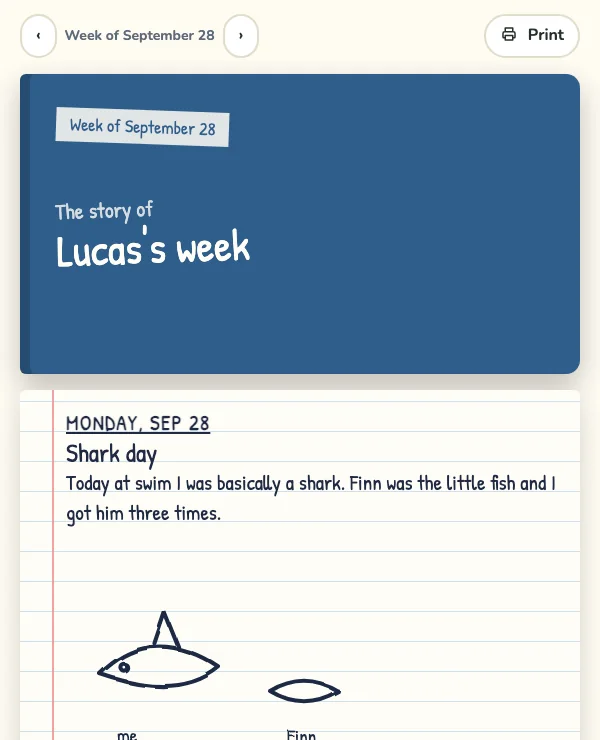
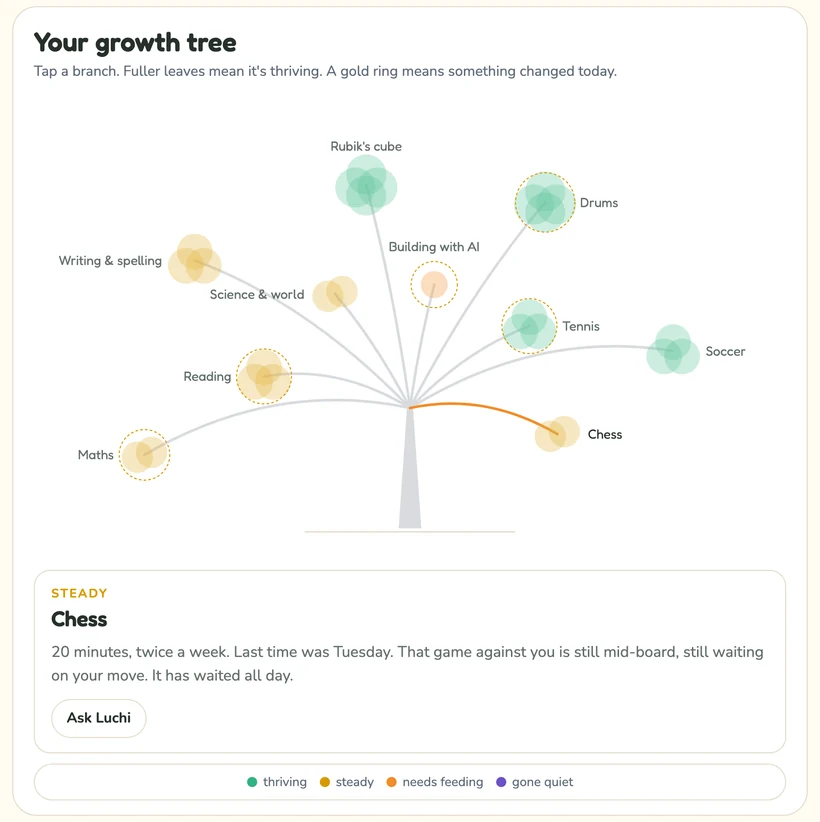
The same act — reaching for what you know and saying it in your own words — is what makes the weekly note in Luchi work, and it is the reason the note is built from the kid talking rather than from what they clicked.
The research under this page
Three sources. The first is the experiment that separated feeling-prepared from being-prepared, the second is the meta-analysis that makes it more than one study, and the third is why you come back later than feels right.
- Roediger & Karpicke, 2006 — Test-enhanced learning: taking memory tests improves long-term retention. Psychological Science, 17(3), 249–255. ("In two experiments, students studied prose passages and took one or three immediate free-recall tests, without feedback, or restudied the material the same number of times… When the final test was given after 5 min, repeated studying improved recall relative to repeated testing. However, on the delayed tests, prior testing produced substantially greater retention than studying, even though repeated studying increased students’ confidence in their ability to remember the material. Testing is a powerful means of improving learning, not just assessing it.") The spine of the page, including the clause that makes it actionable: repeated studying raised confidence while repeated testing raised retention. University students on prose passages — so the mechanism transfers, the magnitudes do not. What it does not show: University students recalling prose passages in a laboratory, not children on school subjects, and the retention intervals run to one week rather than a term. The transferable part is the dissociation — confidence tracked restudying while retention tracked testing — and the reversal at five minutes, which is why the page does not claim testing wins at every horizon.
- Adesope, Trevisan & Sundararajan, 2017 — Rethinking the use of tests: a meta-analysis of practice testing. Review of Educational Research, 87(3), 659–701. ("This meta-analysis fills this gap by examining the effects of practice tests versus nontesting learning conditions. Results reveal that practice tests are more beneficial for learning than restudying and all other comparison conditions. Mean effect sizes were moderated by the features of practice tests, participant and study characteristics, outcome constructs, and methodological features of the studies.") Why this is a direction rather than a single result: practice tests beat restudying and every other comparison condition. Cited with its own moderator caveat, which is also why the page insists on produced answers over multiple choice. What it does not show: A meta-analysis across heterogeneous studies, and the authors are explicit that the mean effect sizes were moderated by the features of the practice test and by who was in the study — so it supports the direction strongly and a single number weakly. It is cited here as the reason this is more than one experiment, and its moderator finding is why the page insists on produced answers rather than multiple choice.
- Cepeda, Pashler, Vul, Wixted & Rohrer, 2006 — Distributed practice in verbal recall tasks: a review and quantitative synthesis. Psychological Bulletin, 132(3), 354–380. ("The authors performed a meta-analysis of the distributed practice effect to illuminate the effects of temporal variables that have been neglected in previous reviews. This review found 839 assessments of distributed practice in 317 experiments located in 184 articles… Analyses suggest that ISI and retention interval operate jointly to affect final-test retention; specifically, the ISI producing maximal retention increased as retention interval increased.") The timing half — 839 assessments across 317 experiments, finding that the best gap between sessions grows with how long the material has to last. A direction for when to come back, not a schedule. What it does not show: A synthesis of VERBAL recall studies, overwhelmingly with adults. The direction — spacing beats massing, and the right gap grows with how long the material must last — is what carries to maths facts and to a weeknight quiz; the specific optimal intervals do not, and anyone quoting a number of days from this source is over-reading it.
Questions parents ask
- Is it better to re-read notes or be tested?
- Tested, if you care about next week rather than the next ten minutes. In the experiment that ran both, re-reading won when the final test came five minutes later and lost badly when it came after two days or a week — and repeated studying raised students’ confidence while delivering less retention. A later meta-analysis found practice tests beat restudying and every other comparison it looked at. The practical version is five minutes of being asked, not twenty more minutes of going over it.
- How do I use AI to quiz my child?
- Four instructions carry nearly all of it: one question at a time, short answers rather than multiple choice, wait for my answer before the next question, and don’t tell me if I’m right until the end. Then keep the scope to what was covered this week rather than the whole chapter. What you are avoiding is the default output — a block of ten multiple-choice questions, which a child reads instead of attempts.
- My child gets most of them wrong and finds it demoralising.
- Usually a scope problem rather than a signal to stop. Narrow it to what was covered this week, not the topic — the exercise only works in the zone where things are half-known, and a child who fails every question learns that they know nothing rather than which bits to revisit. It also helps to say the uncomfortable part out loud first: getting them wrong now is what makes them stick, which is the opposite of how school usually feels. Start with the three-things-from-memory step, where there is no score at all.
- How often should we do it?
- Twice is worth far more than once, and the gap matters more than the length of either session. The best-evidenced rule of thumb is that the gap should grow with how long the material needs to last: for a test on Friday, tonight and Wednesday; for something that should survive to next term, come back in a week or two rather than tomorrow. The synthesis behind that covers hundreds of experiments and gives a direction rather than a schedule — later than feels right, and more than once.
The explaining, built in
The hard part of all this is remembering to ask. Luchi asks for you: a kid builds something, explains what they made in their own words, and you get a short note each week showing how they thought about it — a retrieval habit that does not depend on anybody having read the chapter.
Part of the series: Teaching kids about AI
Related guides in this series
- How to explain AI to a child — Simple analogies and sample scripts by age (5–12), plus the three things every kid should understand about AI.
- AI activities for kids — 10 free, screen-smart activities to explore how AI works together — no coding, no sign-up, mostly off the screen.
- Fall break activities for kids — A half-day-by-half-day plan for five unstructured days — ten low-prep blocks, screen and off-screen alternating, ending with your child explaining what they made.
- AI tools for kids — A parent’s shortlist of genuinely kid-appropriate AI tools — what to look for, what to avoid, and how to tell a real kid tool from a repackaged chatbot.
- AI tools that teach kids to think, not just get answers — The one testable property that separates a thinking tool from a vending machine, what happened when someone measured the difference, and the ten-minute test you can run tonight on whatever your child already uses.
- How do I know if what the AI told my kid is true? — The research says the move is to leave the answer, not to stare at it harder — and that the technique which works best is the one people like least. Four ways it goes wrong, and the check that catches each.
- Winter break projects a kid actually finishes — Six get started and none get finished, and that is a scoping problem rather than an attention one. Five projects with a finish line you can see, the three sessions that get one done, and why none of it is catch-up work.
- How to teach a kid to write a good AI prompt — A list of fifty prompts teaches nothing, because the skill is producing the question. The three decisions that make a prompt good, a try-it bench on the page, and the one rewrite with a measurement behind it.
- Is it cheating if my child makes art with AI? — Two questions in one coat: a rules question with a clear answer, and an effects question where the best study points both ways — individually better, collectively more similar. What to say, and the three situations that differ.